

384
22. The GSW Gauge Theory of Electroweak Interactions
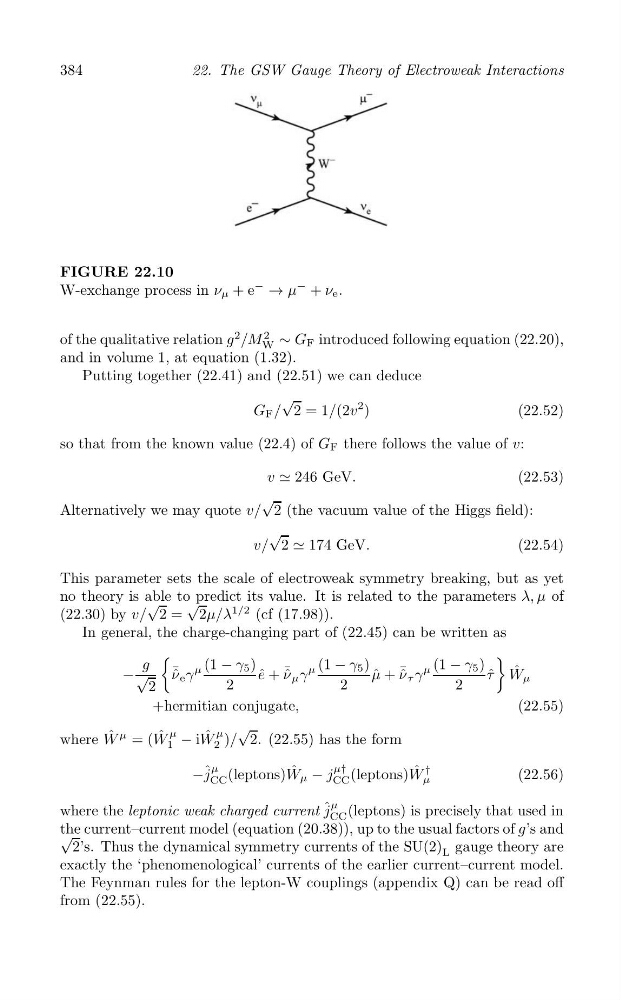
FIGURE 22.10
W-exchange process in ν μ + e
−
→ μ
− + ν e .
of the qualitative relation g
2 /M
2
∼ G F introduced following equation (22.20),
W
and in volume 1, at equation (1.32).
Putting together (22.41) and (22.51) we can deduce
√
G F / 2 = 1/(2v
2 )
(22.52)
so that from the known value (22.4) of G F there follows the value of v:
v ⋍ 246 GeV.
(22.53)
√
Alternatively we may quote v/ 2 (the vacuum value of the Higgs field):
√
v/ 2 ⋍ 174 GeV.
(22.54)
This parameter sets the scale of electroweak symmetry breaking, but as yet
no theory is able to predict its value. It is related to the parameters λ, μ of
√
√
(22.30) by v/ 2 = 2μ/λ
1/2 (cf (17.98)).
In general, the charge-changing part of (22.45) can be written as
(
)
g
γ
μ (1 − γ 5 )
ν μ γ
μ (1 − γ 5 )
ν τ γ
μ (1 − γ 5 )
¯
¯
¯
ˆ
− √
ν ˆ e
e ˆ + ˆ
μ ˆ + ˆ
τ ˆ W μ
2
2
2
2
+hermitian conjugate,
(22.55)
√
μ
μ
where W ˆ μ = (W ˆ − iW ˆ )/ 2. (22.55) has the form
1
2
μ
μ†
− ˆ j (leptons) W ˆ μ − j (leptons) W ˆ †
(22.56)
CC
CC
μ
μ
where the leptonic weak charged current ˆ j (leptons) is precisely that used in
CC
the current–current model (equation (20.38)), up to the usual factors of g’s and
√
2’s. Thus the dynamical symmetry currents of the SU(2) gauge theory are
L
exactly the ‘phenomenological’ currents of the earlier current–current model.
The Feynman rules for the lepton-W couplings (appendix Q) can be read off
from (22.55).