

381
22.2. The SU(2) × U(1) electroweak gauge theory
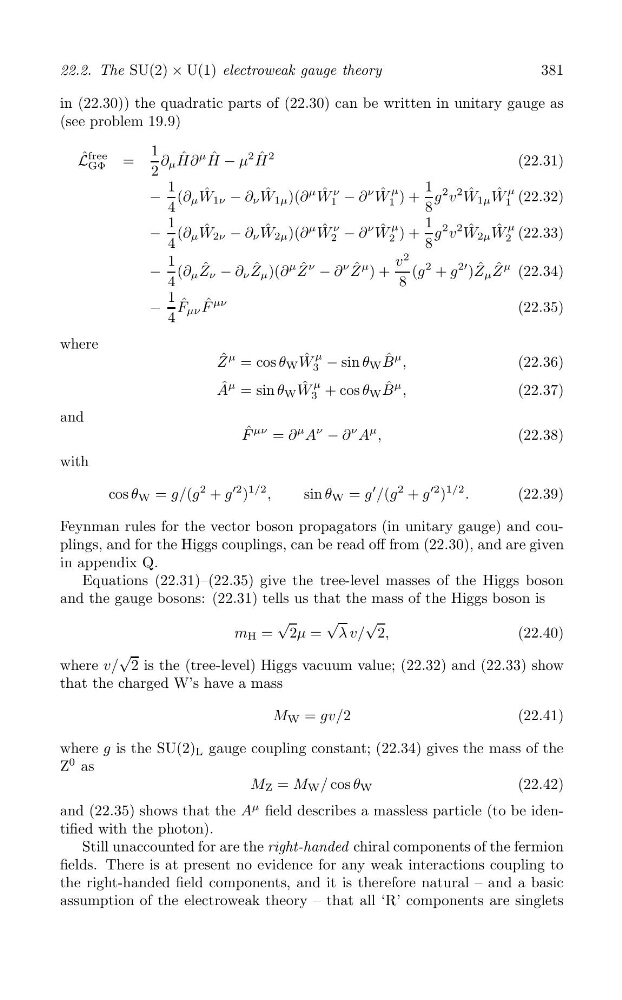
in (22.30)) the quadratic parts of (22.30) can be written in unitary gauge as
(see problem 19.9)
L ˆ free
ˆ
H
2
=
1 ∂ μ H∂
μ H ˆ − μ
2 ˆ
(22.31)
GΦ
2
μ
2 2 ˆ
μ
−
1 (∂ μ W ˆ 1ν − ∂ ν W ˆ 1μ )(∂
μ W ˆ
1
ν
− ∂
ν W ˆ
1 ) +
1 g v W 1μ W ˆ
1 (22.32)
4
8
μ
2
μ
2 ˆ ˆ
−
1 (∂ μ ˆ
W ˆ 2μ )(∂
μ W ˆ ν − ∂
ν W ˆ ) +
1
4
W 2ν − ∂ ν
2
2
8
g v W 2μ W 2 (22.33)
2
2
1 (∂ μ Z ˆ ν − ∂ ν Z ˆ μ )(∂
μ Z ˆ ν − ∂
ν Z ˆ μ ) +
v (g + g
2′ )Z ˆ μ Z ˆ μ (22.34)
− 4
8
1 ˆ F ˆ μν
− F μν
(22.35)
4
where
μ
Z ˆ μ
ˆ
B ˆ μ
= cos θ W W − sin θ W ,
(22.36)
3
μ
A ˆ μ = sin θ W W ˆ + cos θ W B ˆ μ ,
(22.37)
3
and
F
μν
ˆ = ∂
μ A
ν
− ∂
ν A
μ ,
(22.38)
with
2
′2 )
1/2
2
′2 )
1/2
cos θ W = g/(g + g
,
sin θ W = g
′ /(g + g
.
(22.39)
Feynman rules for the vector boson propagators (in unitary gauge) and couplings, and for the Higgs couplings, can be read off from (22.30), and are given
in appendix Q.
Equations (22.31)–(22.35) give the tree-level masses of the Higgs boson
and the gauge bosons: (22.31) tells us that the mass of the Higgs boson is
√
√
√
m H = 2μ = λ v/ 2,
(22.40)
√
where v/ 2 is the (tree-level) Higgs vacuum value; (22.32) and (22.33) show
that the charged W’s have a mass
M W = gv/2
(22.41)
where g is the SU(2) L gauge coupling constant; (22.34) gives the mass of the
Z
0 as
M Z = M W / cos θ W
(22.42)
and (22.35) shows that the A
μ field describes a massless particle (to be identified with the photon).
Still unaccounted for are the right-handed chiral components of the fermion
fields. There is at present no evidence for any weak interactions coupling to
the right-handed field components, and it is therefore natural – and a basic
assumption of the electroweak theory – that all ‘R’ components are singlets