

362
21. CP Violation and Oscillation Phenomena
different for ν e and ν μ . The difference in refractive indices is determined by
the difference in the real parts of the forward ν e e
− and ν μ e
− elastic scattering amplitudes (Wolfenstein 1978). The essential point is that the scattering
can be coherent, with the spins and momenta of the particles remaining unchanged. This means that the effect is going to be proportional to the density
of electrons in the matter traversed, N e . The scattering amplitude, in turn, is
proportional to G F , so that a figure of merit for the effect is given by the product G F N e . This has the dimensions of an energy, and can be interpreted as an
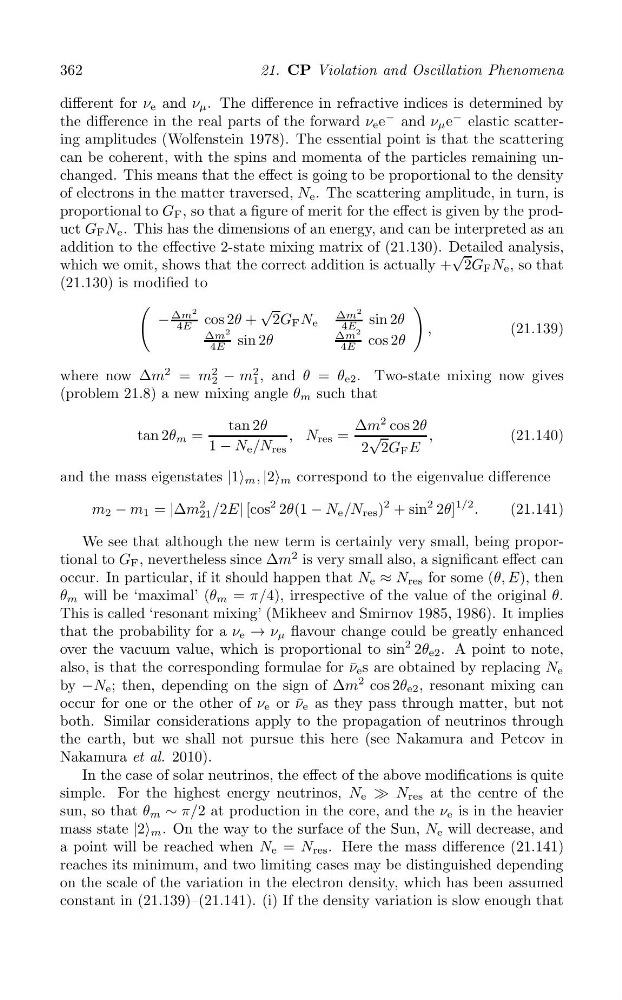
addition to the effective 2-state mixing matrix of (21.130). Detailed analysis,
which we omit, shows that the correct addition is actually +
√
2G F N e , so that
(21.130) is modified to
(
−
Δm
2
2
)
cos 2θ +
4E
√
2G
Δm
F N e
sin 2θ
4E
Δm
2
,
Δ
2
(21.139)
sin 2θ
m cos 2θ
4E
4E
where now Δm
2 = m
2
2 − m
2
1 , and θ = θ e2 . Two-state mixing now gives
(problem 21.8) a new mixing angle θ m such that
tan 2θ
Δm
2 cos 2θ
tan 2θ m =
, N res =
140)
1 − N e /N re
2
√
,
(21.
s
2G F E
and the mass eigenstates |1› m , |2› m correspond to the eigenvalue difference
m 2 − m 1 = |Δm
2
21 /2E| [cos
2 2θ(1 − N e /N res )
2 + sin
2 2θ]
1/2 .
(21.141)
We see that although the new term is certainly very small, being proportional to G F , nevertheless since Δm
2 is very small also, a significant effect can
occur. In particular, if it should happen that N e ≈ N res for some (θ, E), then
θ m will be ‘maximal’ (θ m = π/4), irrespective of the value of the original θ.
This is called ‘resonant mixing’ (Mikheev and Smirnov 1985, 1986). It implies
that the probability for a ν e → ν μ flavour change could be greatly enhanced
over the vacuum value, which is proportional to sin
2 2θ e2 . A point to note,
also, is that the corresponding formulae for ν ¯ e s are obtained by replacing N e
by −N e ; then, depending on the sign of Δm
2 cos 2θ e2 , resonant mixing can
occur for one or the other of ν e or ν ¯ e as they pass through matter, but not
both. Similar considerations apply to the propagation of neutrinos through
the earth, but we shall not pursue this here (see Nakamura and Petcov in
Nakamura et al. 2010).
In the case of solar neutrinos, the effect of the above modifications is quite
simple. For the highest energy neutrinos, N e ≫ N res at the centre of the
sun, so that θ m ∼ π/2 at production in the core, and the ν e is in the heavier
mass state |2› m . On the way to the surface of the Sun, N e will decrease, and
a point will be reached when N e = N res . Here the mass difference (21.141)
reaches its minimum, and two limiting cases may be distinguished depending
on the scale of the variation in the electron density, which has been assumed
constant in (21.139)–(21.141). (i) If the density variation is slow enough that