

356
21. CP Violation and Oscillation Phenomena
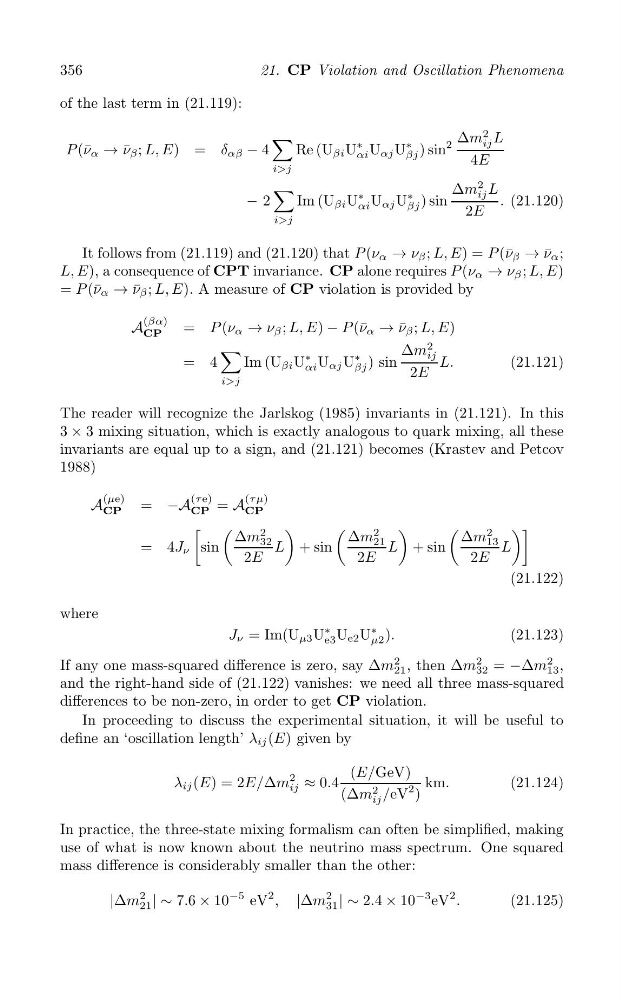
of the last term in (21.119):
∑
Δm
2
ij L
P (¯ ν α → ν ¯ β ; L, E) = δ αβ − 4
Re (U βi U
∗
αi U αj U
∗
βj ) sin
2
4E
i>j
∑
Δm
2
− 2
Im (U βi U
∗
αi U αj U
∗
ij L
βj ) sin
. (21.120)
2E
i>j
It follows from (21.119) and (21.120) that P (ν α → ν β ; L, E) = P (¯ ν β → ν ¯ α ;
L, E), a consequence of CPT invariance. CP alone requires P (ν α → ν β ; L, E)
= P (¯ ν α → ν ¯ β ; L, E). A measure of CP violation is provided by
A
(βα)
CP
= P (ν α → ν β ; L, E) − P (¯ ν α → ν ¯ β ; L, E)
∑
Δm
2
= 4
Im (U βi U αi
∗ U αj U
∗
ij
βj ) sin
L.
(21.121)
2E
i>j
The reader will recognize the Jarlskog (1985) invariants in (21.121). In this
3 × 3 mixing situation, which is exactly analogous to quark mixing, all these
invariants are equal up to a sign, and (21.121) becomes (Krastev and Petcov
1988)
A
(μe)
−A
(τ e)
(
CP
=
CP = A
τ μ)
CP
[ (
m
2
)
(
Δ
2
)
(
2
)]
= 4J sin
32
Δm
Δm
ν
L + sin
21 L + sin
13 L
2E
2E
2E
(21.122)
where
J ν = Im(U μ3 U
∗
e3 U e2 U
∗
μ2 ).
(21.123)
If any one mass-squared difference is zero, say Δm
2
21 , then Δm
2
32 = −Δm
2
13 ,
and the right-hand side of (21.122) vanishes: we need all three mass-squared
differences to be non-zero, in order to get CP violation.
In proceeding to discuss the experimental situation, it will be useful to
define an ‘oscillation length’ λ ij (E) given by
2
(E/GeV)
λ ij (E) = 2E/Δm ij ≈ 0.4
km.
(21.124)
(Δm 2
ij /eV
2 )
In practice, the three-state mixing formalism can often be simplified, making
use of what is now known about the neutrino mass spectrum. One squared
mass difference is considerably smaller than the other:
|Δm
2
21 | ∼ 7.6 × 10
−5 eV
2 , |Δm
2
31 | ∼ 2.4 × 10
−3 eV
2 .
(21.125)