

21.4. Neutrino mixing and oscillations
355
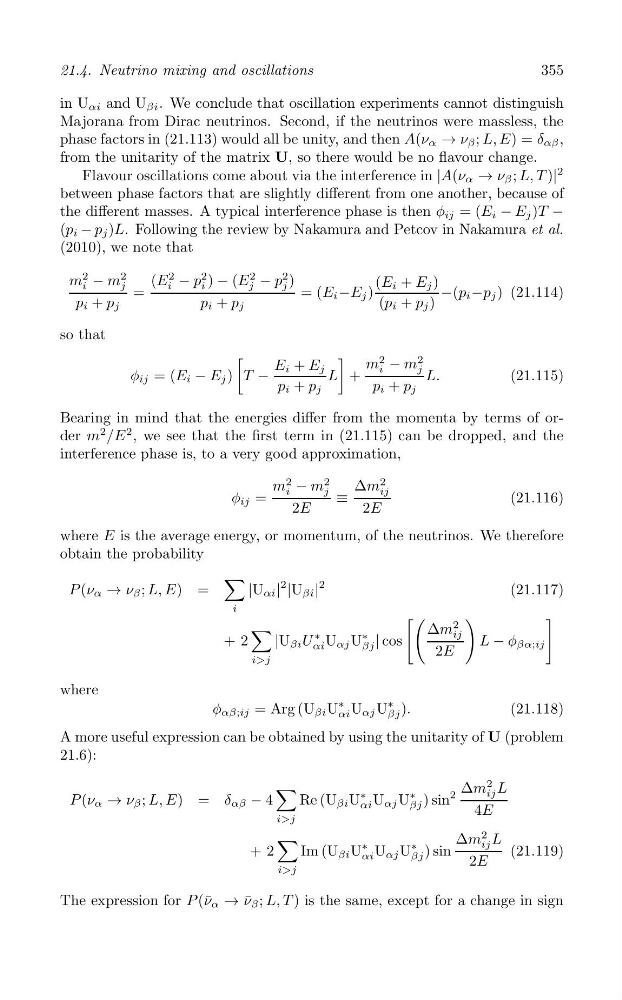
in U αi and U βi . We conclude that oscillation experiments cannot distinguish
Majorana from Dirac neutrinos. Second, if the neutrinos were massless, the
phase factors in (21.113) would all be unity, and then A(ν α → ν β ; L, E) = δ αβ ,
from the unitarity of the matrix U, so there would be no flavour change.
Flavour oscillations come about via the interference in |A(ν α → ν β ; L, T )|
2
between phase factors that are slightly different from one another, because of
the different masses. A typical interference phase is then φ ij = (E i − E j )T −
(p i − p j )L. Following the review by Nakamura and Petcov in Nakamura et al.
(2010), we note that
m
2
− m
2
(E
2
− p
2 )
2
−
2
i
j
i
i − (E j p j )
(E i + E j )
=
= (E i E j )
(p i p j ) (21.114)
p i + p j
p i + p j
−
(p i + p j )
− −
so that
[
]
E
−
i + E
2
2
−
j
m i
φ ij = (E i E ) T
L +
− m j
j
L.
(21.115)
p i + p j
p i + p j
Bearing in mind that the energies differ from the momenta by terms of order m
2 /E
2 , we see that the first term in (21.115) can be dropped, and the
interference phase is, to a very good approximation,
m
2
2
i
φ ij =
− m j
Δm
2
2E
≡
ij
(21.116)
2E
where E is the average energy, or momentum, of the neutrinos. We therefore
obtain the probability
∑
P (ν α → ν β ; L, E) =
i
|U αi |
2
|U βi |
2
(21.117)
[(
)
]
∑
Δm
2
+ 2
|
ij
U βi U αi
∗ U αj U
∗
βj
i>
| cos
L
2E
− φ βα;ij
j
where
φ αβ;ij = Arg (U βi U
∗
αi U αj U
∗
βj ).
(21.118)
A more useful expression can be obtained by using the unitarity of U (problem
21.6):
∑
Δm
2 L
P (ν α → ν β ; L, E) = δ αβ − 4
Re (U
2
ij
βi U αi
∗ U αj U βj
∗ ) sin
4E
i>j
∑
Δm
2 L
+ 2
Im (U βi
∗
ij
U αi U αj U
∗
βj ) sin
(21.119)
2E
i>j
The expression for P (¯ ν α → ν ¯ β ; L, T ) is the same, except for a change in sign