

344
21. CP Violation and Oscillation Phenomena
¯
and there is a similar formula, with appropriate changes, for the case of a B
0
tag at t = 0. We now write
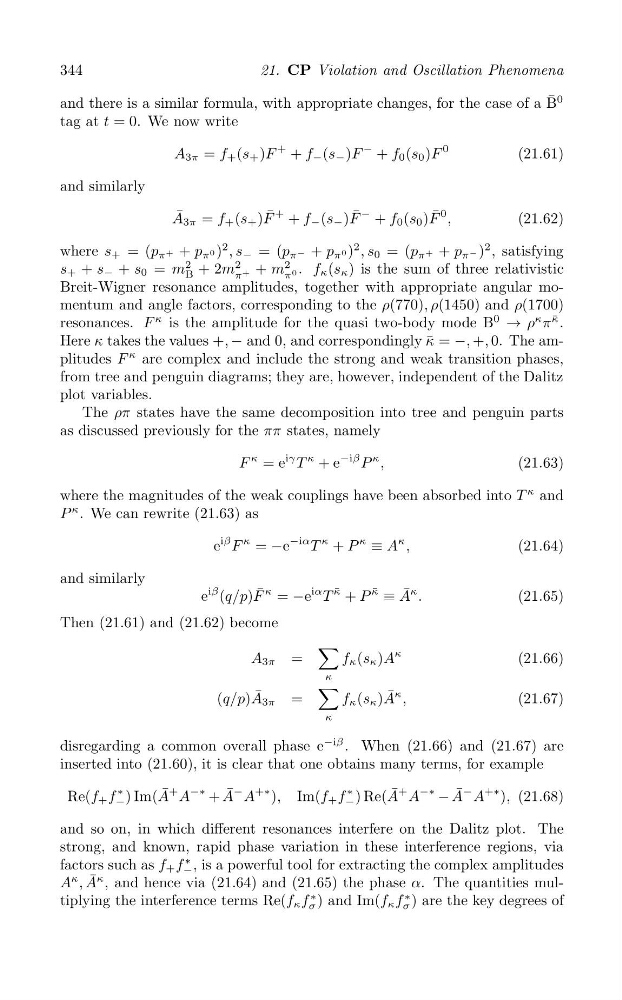
A 3π = f + (s + )F
+ + f (s )F
− + f 0 (s )
− −
0 F
0
(21.61)
and similarly
¯
¯
A
0
π = f
+
¯
¯
3
+ (s + )F + f (s )F
− + f
− −
0 (s 0 )F ,
(21.62)
where s + = (p π + + p π 0 )
2 , s = (p π − + p π 0 )
2 , s 0 = (p π + + p π − )
2 , satisfying
−
s + + s + s
−
0 = m
2
B + 2m
2
+ + m
2
0 . f κ (s κ ) is the sum of three relativistic
π
π
Breit-Wigner resonance amplitudes, together with appropriate angular momentum and angle factors, corresponding to the ρ(770), ρ(1450) and ρ(1700)
resonances. F
κ is the amplitude for the quasi two-body mode B
0
→ ρ
κ π
κ ¯ .
Here κ takes the values +,
κ
− and 0, and correspondingly κ ¯ = −, +, 0. The amplitudes F are complex and include the strong and weak transition phases,
from tree and penguin diagrams; they are, however, independent of the Dalitz
plot variables.
The ρπ states have the same decomposition into tree and penguin parts
as discussed previously for the ππ states, namely
F
κ = e
iγ T
κ + e
−iβ P
κ ,
(21.63)
where the magnitudes of the weak couplings have been absorbed into T
κ and
P
κ . We can rewrite (21.63) as
e
iβ F
κ = −e
−iα T
κ + P
κ
≡ A
κ ,
(21.64)
and similarly
e
iβ
¯
(q/p)F
κ = −e
iα T
κ ¯
¯
+ P
κ ¯
≡ A
κ .
(21.65)
Then (21.61) and (21.62) become
∑
A 3π =
f κ (s κ )A
κ
(21.66)
∑
κ
¯
¯
(q/p)A 3π =
f (s
κ
κ κ )A ,
(21.67)
κ
disregarding a common overall phase e
−iβ . When (21.66) and (21.67) are
inserted into (21.60), it is clear that one obtains many terms, for example
¯
Re(f f
∗ ) Im(A
+ −∗
¯
¯
+
A + A
− A
+∗
¯
), Im(f + f
∗ ) Re(A
+ A
−∗
− A
− A
+∗ ), (21.68)
−
−
and so on, in which different resonances interfere on the Dalitz plot. The
strong, and known, rapid phase variation in these interference regions, via
factors such as f + f
∗ , is a powerful tool for extracting the complex amplitudes
−
A
κ ¯
, A
κ , and hence via (21.64) and (21.65) the phase α. The quantities multiplying the interference terms Re(f κ f σ
∗ ) and Im(f κ f σ
∗ ) are the key degrees of