

343
21.2. CP violation in B meson oscillations
1
√
2
A +−
A 00
A +0
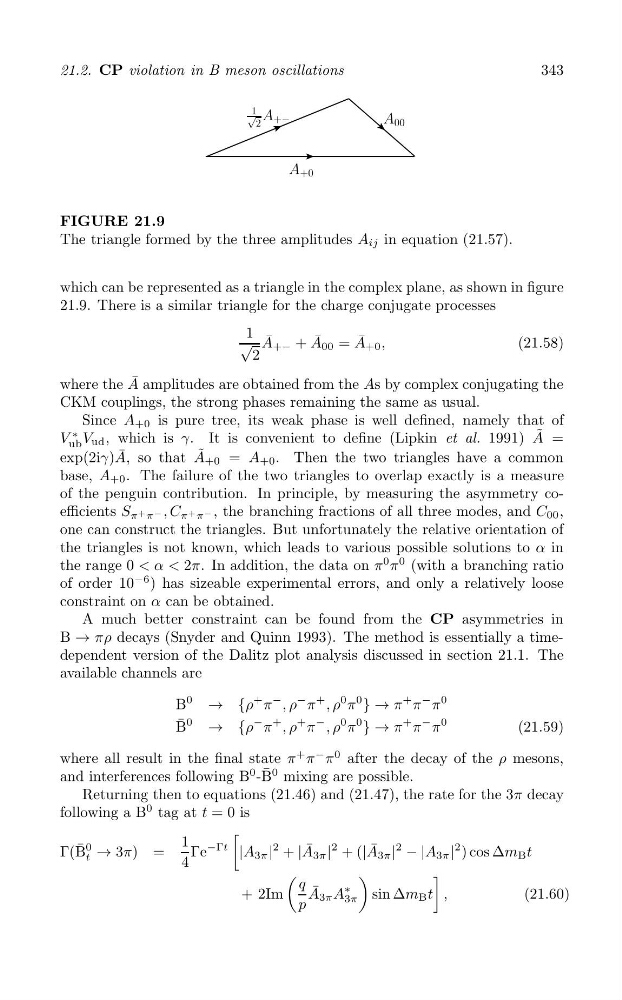
FIGURE 21.9
The triangle formed by the three amplitudes A ij in equation (21.57).
which can be represented as a triangle in the complex plane, as shown in figure
21.9. There is a similar triangle for the charge conjugate processes
¯
¯
√
1 A +− + A ¯ 00 = A +0 ,
(21.58)
2
where the A ¯ amplitudes are obtained from the As by complex conjugating the
CKM couplings, the strong phases remaining the same as usual.
Since A +0 is pure tree, its weak phase is well defined, namely that of
V
∗ V ud , which is γ. It is convenient to define (Lipkin et al. 1991) A ˜ =
ub
¯
exp(2iγ)A, so that A ˜ +0 = A +0 . Then the two triangles have a common
base, A +0 . The failure of the two triangles to overlap exactly is a measure
of the penguin contribution. In principle, by measuring the asymmetry coefficients S π + π − , C π + π − , the branching fractions of all three modes, and C 00 ,
one can construct the triangles. But unfortunately the relative orientation of
the triangles is not known, which leads to various possible solutions to α in
the range 0 < α < 2π. In addition, the data on π
0 π
0 (with a branching ratio
of order 10
−6 ) has sizeable experimental errors, and only a relatively loose
constraint on α can be obtained.
A much better constraint can be found from the CP asymmetries in
B → πρ decays (Snyder and Quinn 1993). The method is essentially a timedependent version of the Dalitz plot analysis discussed in section 21.1. The
available channels are
B
0
→ {ρ
+ π
− , ρ
− π
+ , ρ
0 π
0
} → π
+ π
− π
0
B ¯ 0 → {ρ
− π
+ , ρ
+ π
− , ρ
0 π
0
} → π
+ π
− π
0
(21.59)
where all result in the final state π
+ π
− π
0 after the decay of the ρ mesons,
¯
and interferences following B
0 -B
0 mixing are possible.
Returning then to equations (21.46) and (21.47), the rate for the 3π decay
following a B
0 tag at t = 0 is
[
2
Γ(B ¯ 0
t → 3π) =
1 Γe
−Γt
|A 3π | + |A ¯ 3π |
2 + (|A ¯ 3π |
2
− |A 3π |
2 ) cos Δm B t
4
)
(
]
q
∗
A 3π A
sin Δm B t ,
(21.60)
+ 2Im
¯
3π
p