

20.9
Problems
327
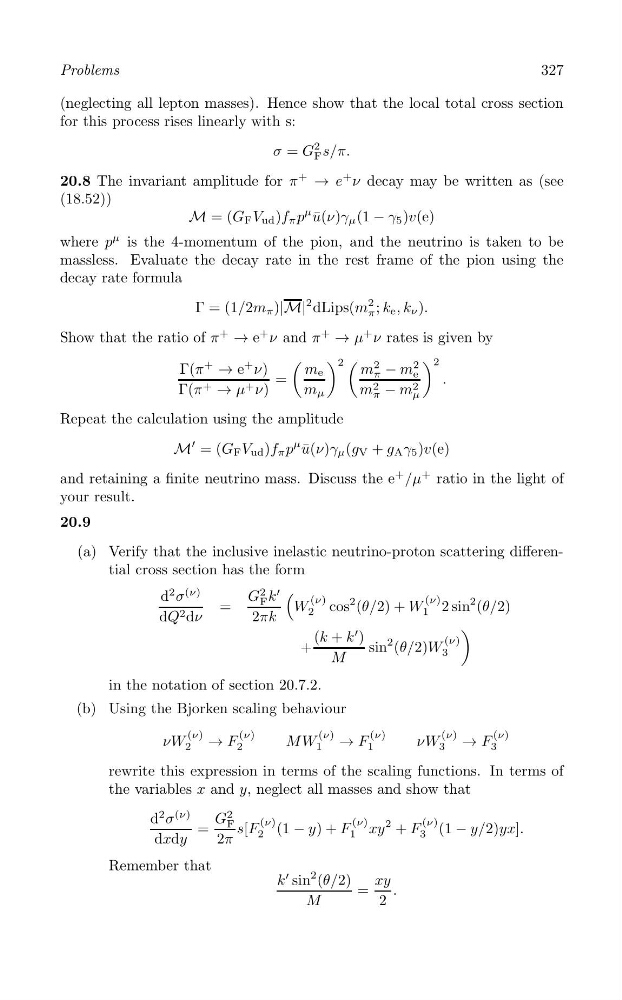
(neglecting all lepton masses). Hence show that the local total cross section
for this process rises linearly with s:
σ = G F
2 s/π.
20.8 The invariant amplitude for π
+
→ e
+ ν decay may be written as (see
(18.52))
M = (G F V ud )f π p
μ u ¯(ν)γ μ (1 − γ 5 )v(e)
μ
where p is the 4-momentum of the pion, and the neutrino is taken to be
massless. Evaluate the decay rate in the rest frame of the pion using the
decay rate formula
2
Γ = (1/2m π )|M|
2 dLips(m π ; k e , k ν ).
Show that the ratio of π
+
→ e
+ ν and π
+
→ μ
+ ν rates is given by
(
) 2 (
) 2
2
2
Γ(π
+
→ e
+ ν)
m e
m − m
π
e
=
.
Γ(π + → μ + ν)
m μ
m 2
π − m 2
μ
Repeat the calculation using the amplitude
M
′ = (G F V ud )f π p
μ u ¯(ν)γ μ (g V + g A γ 5 )v(e)
and retaining a finite neutrino mass. Discuss the e
+ /μ
+ ratio in the light of
your result.
(a) Verify that the inclusive inelastic neutrino-proton scattering differential cross section has the form
d
2 σ
(ν)
G
2 k
′ (
F
(ν)
(ν)
=
W cos
2 (θ/2) + W 2 sin
2 (θ/2)
2
1
dQ 2 dν
2πk
)
(k + k
′ )
+
sin
2 (θ/2)W
(ν)
3
M
in the notation of section 20.7.2.
(b) Using the Bjorken scaling behaviour
(ν)
(ν)
(ν)
(ν)
(ν)
(ν)
νW
→ F
M W
→ F
νW
→ F
2
2
1
1
3
3
rewrite this expression in terms of the scaling functions. In terms of
the variables x and y, neglect all masses and show that
d
2 σ
(ν)
G
2
F
(ν)
(ν)
2
(ν)
=
s[F (1 − y) + F xy + F (1 − y/2)yx].
2
1
3
dxdy
2π
Remember that
k
′ sin
2 (θ/2)
xy
=
.
M
2