

326
20. Introduction to the Phenomenology of Weak Interactions
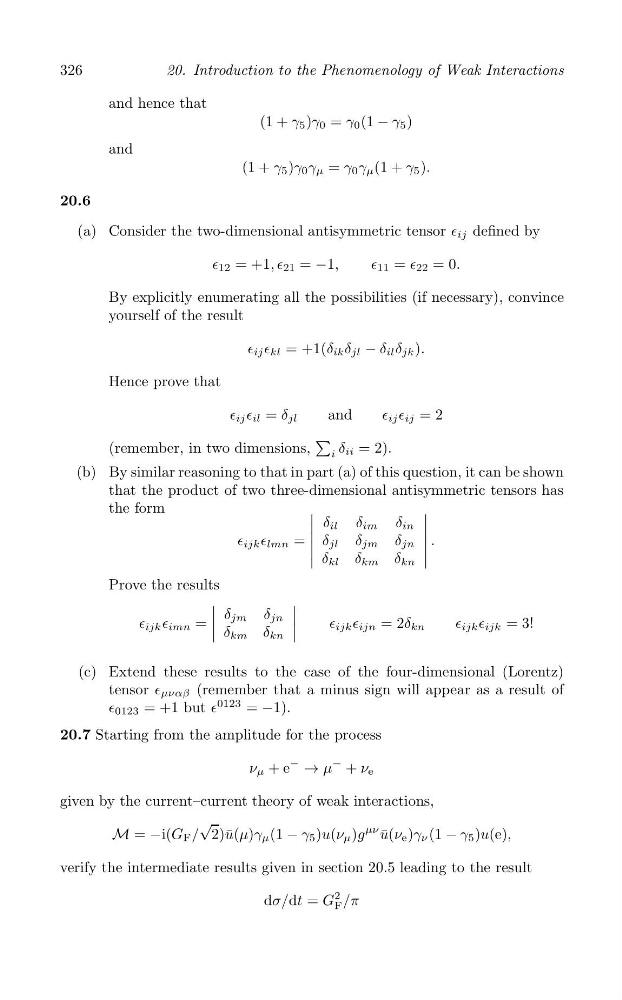
and hence that
(1 + γ 5 )γ 0 = γ 0 (1 − γ 5 )
and
(1 + γ 5 )γ 0 γ μ = γ 0 γ μ (1 + γ 5 ).
20.6
(a) Consider the two-dimensional antisymmetric tensor ∈ ij defined by
∈ 12 = +1, ∈ 21 = −1,
∈ 11 = ∈ 22 = 0.
By explicitly enumerating all the possibilities (if necessary), convince
yourself of the result
∈ ij ∈ kl = +1(δ ik δ jl − δ il δ jk ).
Hence prove that
∈ ij ∈ il = δ jl
and
∈ ij ∈ ij = 2
(remember, in two dimensions, i δ ii = 2).
(b) By similar reasoning to that in part (a) of this question, it can be shown
that the product of two three-dimensional antisymmetric tensors has
the form
|
|
|
| δ il δ im δ in |
|
∈ ijk ∈ lmn = |
| δ jl δ jm δ jn |
| .
| δ kl δ km δ kn |
Prove the results
|
|
|
∈ ijk ∈ imn = | δ jm δ jn |
|
|
|
∈ ijk ∈ ijn = 2δ kn
∈ ijk ∈
δ
δ
ijk = 3!
km
kn
(c) Extend these results to the case of the four-dimensional (Lorentz)
tensor ∈ μναβ (remember that a minus sign will appear as a result of
∈ 0123 = +1 but ∈
0123 = −1).
20.7 Starting from the amplitude for the process
ν μ + e
−
→ μ
− + ν e
given by the current–current theory of weak interactions,
M = −i(G F /
√
2)u ¯(μ)γ μ (1 − γ 5 )u(ν μ )g
μν u ¯(ν e )γ ν (1 − γ 5 )u(e),
verify the intermediate results given in section 20.5 leading to the result
dσ/dt = G
2
F /π