

322
20. Introduction to the Phenomenology of Weak Interactions
(¯ ρ, η ¯)
α = φ
z
z
2
1
2
γ = φ 3
β = φ 1
(0, 0)
(1, 0)
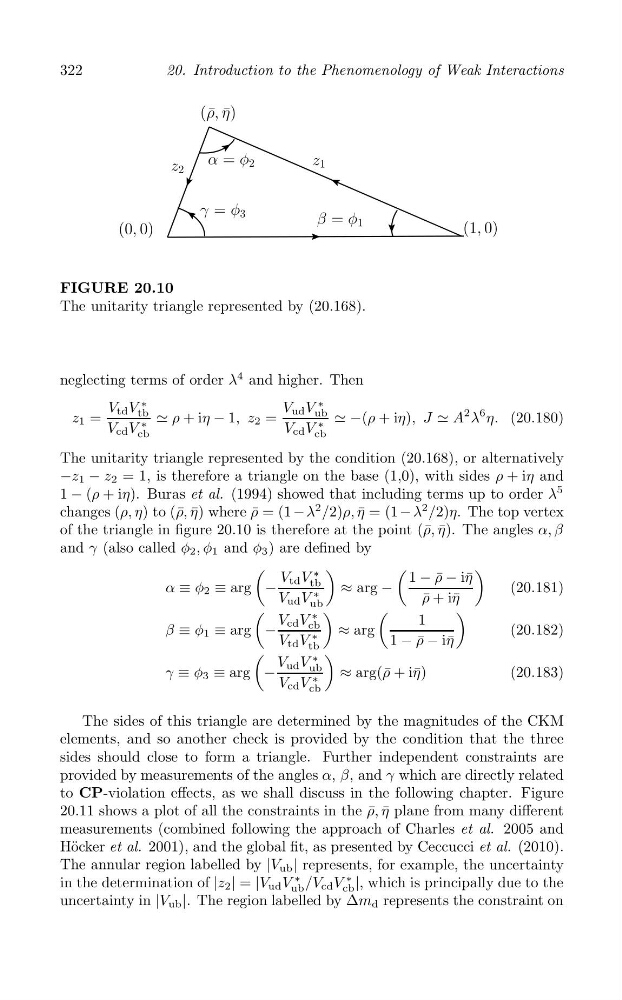
FIGURE 20.10
The unitarity triangle represented by (20.168).
neglecting terms of order λ
4 and higher. Then
V td V
∗
z 1 =
tb
V ud V
∗
⋍ ρ + iη − 1, z 2 =
ub
⋍ −(ρ + iη), J A
2 λ
6 η. (20.180)
V cd V cb
∗
V cd V cb
∗
⋍
The unitarity triangle represented by the condition (20.168), or alternatively
−z 1 − z 2 = 1, is therefore a triangle on the base (1,0), with sides ρ + iη and
1 − (ρ + iη). Buras et al. (1994) showed that including terms up to order λ
5
changes (ρ, η) to (ρ, ¯ η ¯) where ρ ¯ = (1− λ
2 /2)ρ, η ¯ = (1− λ
2 /2)η. The top vertex
of the triangle in figure 20.10 is therefore at the point (ρ, ¯ η ¯). The angles α, β
and γ (also called φ 2 , φ 1 and φ 3 ) are defined by
(
)
(
)
V
≡ φ ≡ arg −
td V
α
tb
∗
1
2
arg
− ρ ¯ − i¯ η
V ud V ub
∗
≈
−
(20.181)
ρ ¯ + iη ¯
(
)
(
)
V
β ≡ φ 1 ≡ arg −
cd V cb
∗
1
≈ arg
(20.182)
V V ∗
1 ρ ¯ i¯ η
(
td tb
)
− −
V
γ ≡ φ 3 ≡ arg −
ud V ub
∗
arg(ρ ¯ + iη ¯)
(20.183)
V cd V cb
∗
≈
The sides of this triangle are determined by the magnitudes of the CKM
elements, and so another check is provided by the condition that the three
sides should close to form a triangle. Further independent constraints are
provided by measurements of the angles α, β, and γ which are directly related
to CP-violation effects, as we shall discuss in the following chapter. Figure
20.11 shows a plot of all the constraints in the ρ, ¯ η ¯ plane from many different
measurements (combined following the approach of Charles et al. 2005 and
H¨ ocker et al. 2001), and the global fit, as presented by Ceccucci et al. (2010).
The annular region labelled by |V ub | represents, for example, the uncertainty
in the determination of |z 2 | = |V ud V ub
∗ /V cd V cb
∗
|, which is principally due to the
uncertainty in |V ub |. The region labelled by Δm d represents the constraint on