

20.7. Quark weak currents
321
But non-perturbative strong interaction effects enter into the amplitudes for
corresponding measured hadronic transitions, such as n → p + e
− + ¯
ν e or
π
−
→ π
0 + e
− + ¯
ν e . In many cases these hadronic factors in the matrix
elements can now be calculated by unquenched lattice QCD.
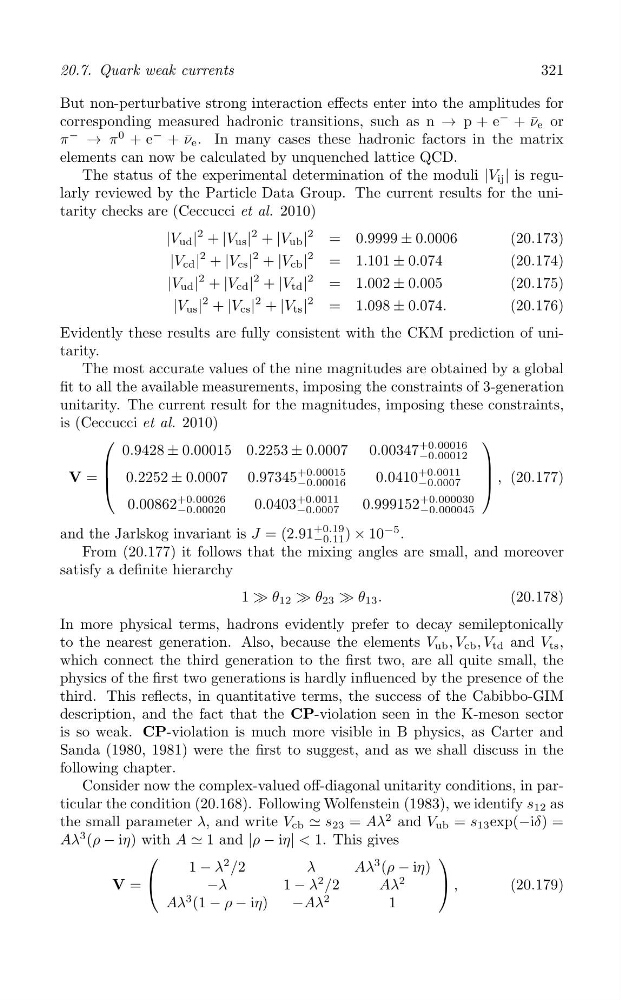
The status of the experimental determination of the moduli |V ij | is regularly reviewed by the Particle Data Group. The current results for the unitarity checks are (Ceccucci et al. 2010)
|V ud |
2 + |V us |
2 +
2
2
|V ub |
2 = 0.9999 ± 0.0006
(20.173)
|V cd | + |V cs | + |V cb |
2 = 1.101 ± 0.074
(20.174)
|V ud |
2 + V
2
cd + V
2
td
= 1.002 0.005
(20.175)
|V |
2
| |
| |
±
us + |V cs |
2 + |V ts |
2 = 1.098 ± 0.074.
(20.176)
Evidently these results are fully consistent with the CKM prediction of unitarity.
The most accurate values of the nine magnitudes are obtained by a global
fit to all the available measurements, imposing the constraints of 3-generation
unitarity. The current result for the magnitudes, imposing these constraints,
is (Ceccucci et al. 2010)
(
)
0.9428 ± 0.00015 0.2253 ± 0.0007 0.00347
+0.00016
|
−0.00012 |
V = |
+0.00015
+0.0011
|
( 0.2252 ± 0.0007 0.97345 −0.00016
0.0410
)
177)
−0.0007
, (20.
0.00862
+0.00026
0.0403
+0.0011
+0.000030
−0.00020
−0.0007
0.999152 −0.000045
and the Jarlskog invariant is J = (2.91
+0.19
−0.11 ) × 10
−5 .
From (20.177) it follows that the mixing angles are small, and moreover
satisfy a definite hierarchy
1 ≫ θ 12 ≫ θ 23 ≫ θ 13 .
(20.178)
In more physical terms, hadrons evidently prefer to decay semileptonically
to the nearest generation. Also, because the elements V ub , V cb , V td and V ts ,
which connect the third generation to the first two, are all quite small, the
physics of the first two generations is hardly influenced by the presence of the
third. This reflects, in quantitative terms, the success of the Cabibbo-GIM
description, and the fact that the CP-violation seen in the K-meson sector
is so weak. CP-violation is much more visible in B physics, as Carter and
Sanda (1980, 1981) were the first to suggest, and as we shall discuss in the
following chapter.
Consider now the complex-valued off-diagonal unitarity conditions, in particular the condition (20.168). Following Wolfenstein (1983), we identify s 12 as
the small parameter λ, and write V cb ⋍ s 23 = Aλ
2 and V ub = s 13 exp(−iδ) =
Aλ
3 (ρ − iη) with A ⋍ 1 and |ρ − iη| < 1. This gives
(
)
1 − λ
2 /2
λ
Aλ
3 (ρ − iη)
V = (
−λ
1 − λ
2 /2
Aλ
2
) ,
(20.179)
Aλ
3 (1 − ρ − iη)
−Aλ
2
1