

290
20. Introduction to the Phenomenology of Weak Interactions
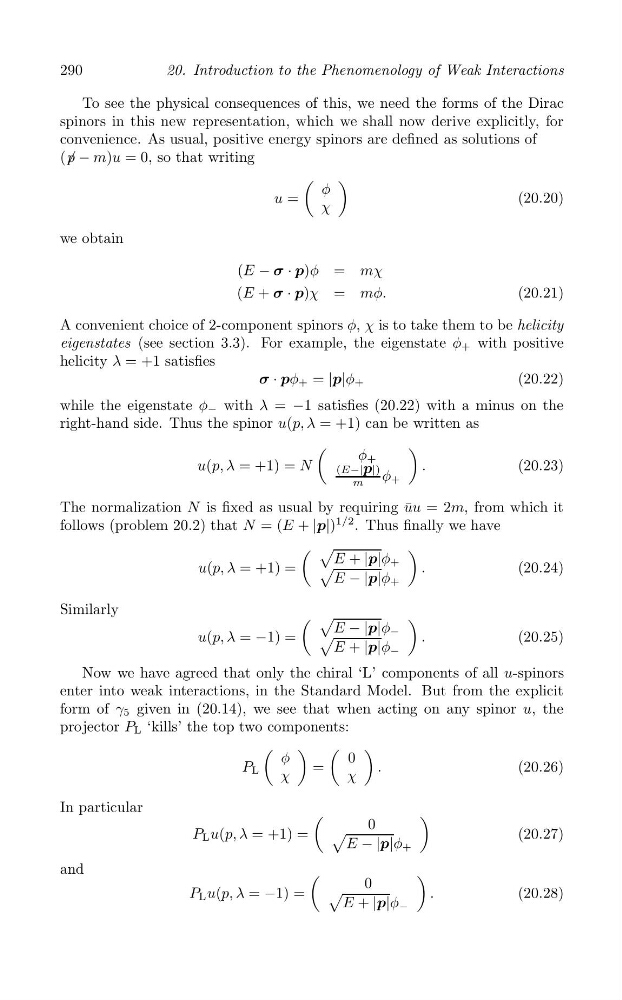
To see the physical consequences of this, we need the forms of the Dirac
spinors in this new representation, which we shall now derive explicitly, for
convenience. As usual, positive energy spinors are defined as solutions of
( p − m)u = 0, so that writing
(
)
φ
u =
(20.20)
χ
we obtain
(E − σ · p)φ = mχ
(E + σ · p)χ = mφ.
(20.21)
A convenient choice of 2-component spinors φ, χ is to take them to be helicity
eigenstates (see section 3.3). For example, the eigenstate φ + with positive
helicity λ = +1 satisfies
σ · pφ + = |p|φ +
(20.22)
while the eigenstate φ with λ = −1 satisfies (20.22) with a minus on the
−
right-hand side. Thus the spinor u(p, λ = +1) can be written as
(
)
φ +
u(p, λ = +1) = N
(E−|p|)
.
(20.23)
φ +
m
The normalization N is fixed as usual by requiring uu ¯ = 2m, from which it
follows (problem 20.2) that N = (E + |p|)
1/2 . Thus finally we have
( √
)
√ E + |p φ
u(p, λ = +1) =
| + .
(20.24)
E − |p|φ +
Similarly
( √
)
E
u(p, λ = −1) =
√ − |p|φ − .
(20.25)
E + |p|φ −
Now we have agreed that only the chiral ‘L’ components of all u-spinors
enter into weak interactions, in the Standard Model. But from the explicit
form of γ 5 given in (20.14), we see that when acting on any spinor u, the
projector P L ‘kills’ the top two components:
(
) (
)
φ
0
P L
=
.
(20.26)
χ
χ
In particular
(
)
0
P L u(p, λ = +1) =
√
(20.27)
E − |p|φ +
and
(
)
0
P L u(p, λ = 1) =
√
−
.
(20.28)
E + |p|φ −
/