

20.2. Parity violation in weak interactions, and V-A theory
289
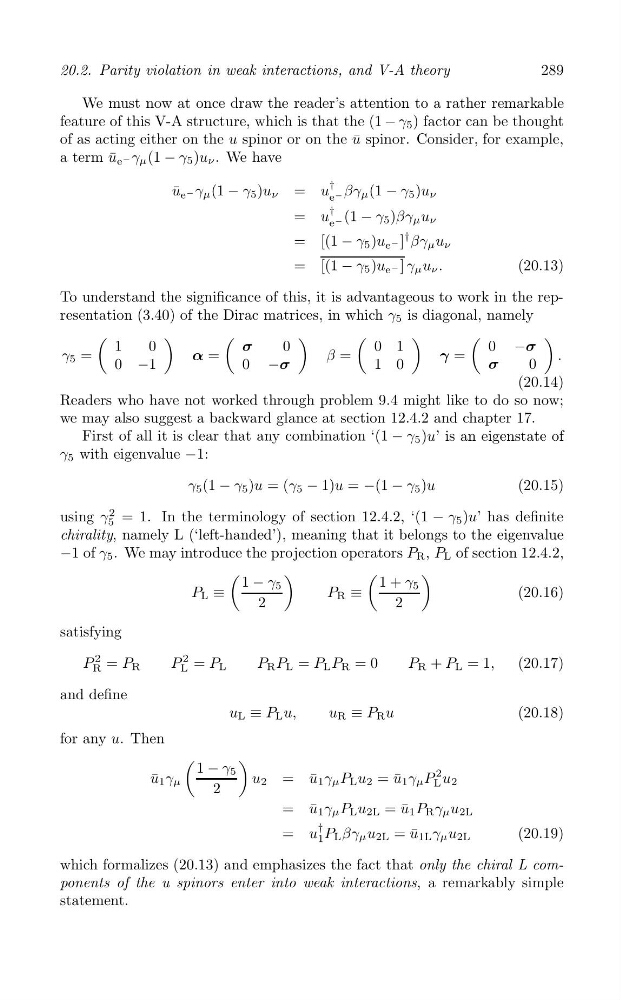
We must now at once draw the reader’s attention to a rather remarkable
feature of this V-A structure, which is that the (1 − γ 5 ) factor can be thought
of as acting either on the u spinor or on the u ¯ spinor. Consider, for example,
a term u ¯ e − γ μ (1 − γ 5 )u ν . We have
u ¯ e − γ μ (1 − γ 5 )u ν = u
† βγ μ (1 γ 5 )u ν
e −
−
= u
† (1
e −
− γ 5 )βγ μ u ν
= [(1 − γ 5 )u e − ]
† βγ μ u ν
= [(1 − γ 5 )u e − ] γ μ u ν .
(20.13)
To understand the significance of this, it is advantageous to work in the representation (3.40) of the Dirac matrices, in which γ 5 is diagonal, namely
(
)
(
)
(
)
(
)
1
0
σ
0
0 1
0
γ 5 =
α
β =
γ =
−σ
=
.
0 −1
0 −σ
1 0
σ
0
(20.14)
Readers who have not worked through problem 9.4 might like to do so now;
we may also suggest a backward glance at section 12.4.2 and chapter 17.
First of all it is clear that any combination ‘(1 − γ 5 )u’ is an eigenstate of
γ 5 with eigenvalue −1:
γ 5 (1 − γ 5 )u = (γ 5 − 1)u = −(1 − γ 5 )u
(20.15)
using γ
2
5 = 1. In the terminology of section 12.4.2, ‘(1 − γ 5 )u’ has definite
chirality, namely L (‘left-handed’), meaning that it belongs to the eigenvalue
−1 of γ 5 . We may introduce the projection operators P R , P L of section 12.4.2,
(
)
(
)
1
P L
− γ
≡
5
1 + γ
P R
2
≡
5
(20.16)
2
satisfying
P
2
R = P R
P
2
L = P L
P R P L = P L P R = 0
P R + P L = 1,
(20.17)
and define
u L ≡ P L u,
u R ≡ P R u
(20.18)
for any u. Then
(
)
1 γ
u ¯ 1 γ μ
− 5 u 2 = ¯
u 1 γ μ P L u 2 = ¯
u 1 γ μ P
2
2
L u 2
= ¯
u 1 γ μ P L u 2L = ¯
u 1 P R γ μ u 2L
= u
†
1 P L βγ μ u 2L = ¯
u 1L γ μ u 2L
(20.19)
which formalizes (20.13) and emphasizes the fact that only the chiral L components of the u spinors enter into weak interactions, a remarkably simple
statement.