

276
19. Spontaneously Broken Local Symmetry
where v/
√
2 =
√
2μ/λ
1/2 , which we already considered in the global case in
section 17.6. As pointed out there, (19.82) implies that the vacuum remains
invariant under the combined transformation of ‘U(1) + third component of
SU(2) isospin’ – that is, (19.82) implies
(
)
1
(
1 ) ‹ ˆ
+ t
2
2
3
0|φ|0› = 0
(19.83)
and hence
[ (
)]
1
‹ | ˆ
0 φ|0› →
|
2)
(‹ ˆ
(1/
ˆ
0 φ|0›)
′ = exp iα
+ t
φ
2
3
‹0| | ›
ˆ
0 = ‹0|φ|0›,
(19.84)
(1/2)
where as usual t 3
= τ 3 /2 (we are using lowercase t for isospin now, anticipating that it is the weak, rather than hadronic, isospin – see chapter 21).
We now need to consider oscillations about (19.82) in order to see the
physical particle spectrum. As in (17.107) we parametrize these conveniently
as
(
)
0
ˆ
ˆ
φ = exp(−iθ(x) · τ /2v)
(19.85)
ˆ
√ 1 (v + H(x))
2
(compare (19.45)). However this time, in contrast to (17.107) but just as in
ˆ
(19.55), we can reduce the phase fields θ to zero by an appropriate gauge
transformation, and it is simplest to examine the particle spectrum in this
(unitary) gauge. Substituting
(
)
0
ˆ
φ =
√ 1
(19.86)
ˆ
(v + H(x))
2
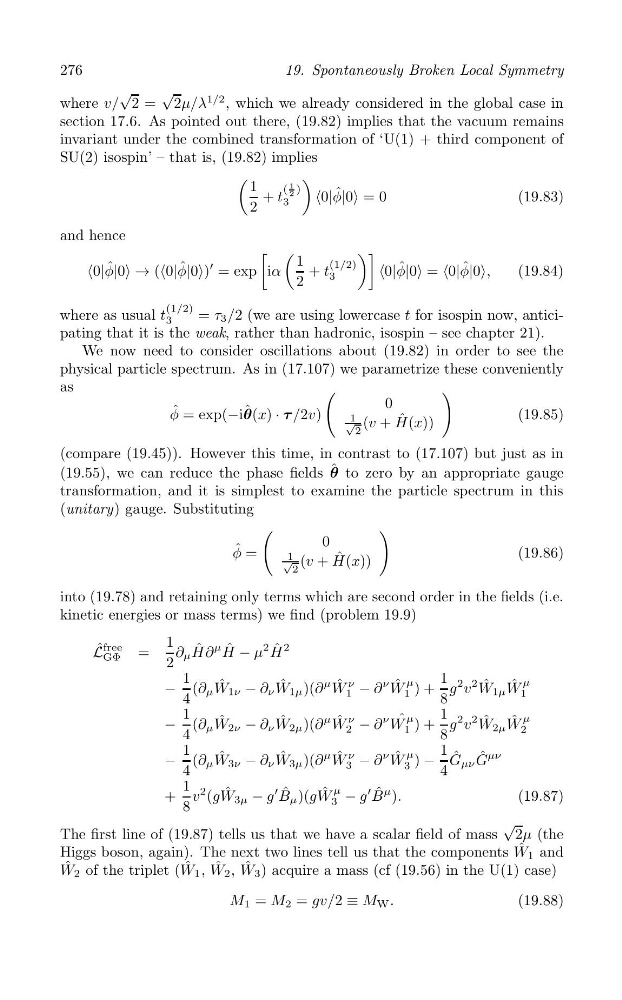
into (19.78) and retaining only terms which are second order in the fields (i.e.
kinetic energies or mass terms) we find (problem 19.9)
1
L ˆ free
ˆ
=
∂ H∂
μ ˆ
H − μ
2 ˆ
GΦ
μ
H
2
2
1
1
−
ˆ
ˆ
ˆ
ˆ μ
ˆ ˆ μ
(∂ W
μ
μ 1ν
∂ ν W 1μ )(∂ W
ν
∂
ν W ) + g
2 v
2 W 1μ W
4
−
1 −
1
8
1
1
−
ˆ
μ ˆ
(
−
ˆ
∂ W
∂ W )(∂ W
ν
− ∂
ν ˆ μ
1
ˆ ˆ μ
μ 2ν
ν 2μ
2
W 1 ) + g
2 v
2 W 2μ W
4
8
2
1
1
−
ˆ
ˆ
μ ˆ
ˆ
(∂
ν
ν
μ
ˆ ˆ
μ W 3ν − ∂ ν W 3μ )(∂ W 3 − ∂ W 3 ) − G μν G
μν
4
4
1
ˆ
+ v
2
ˆ
ˆ μ
ˆ
(gW
μ
3μ − g
′ B μ )(gW 3 − g
′ B ).
(19.87)
8
The first line of (19.87) tells us that we have a scalar field of mass
√
2μ (the
ˆ
Higgs boson, again). The next two lines tell us that the components W 1 and
ˆ
ˆ
ˆ ˆ
W 2 of the triplet (W 1 , W 2 , W 3 ) acquire a mass (cf (19.56) in the U(1) case)
M 1 = M 2 = gv/2 ≡ M W .
(19.88)