

262
19. Spontaneously Broken Local Symmetry
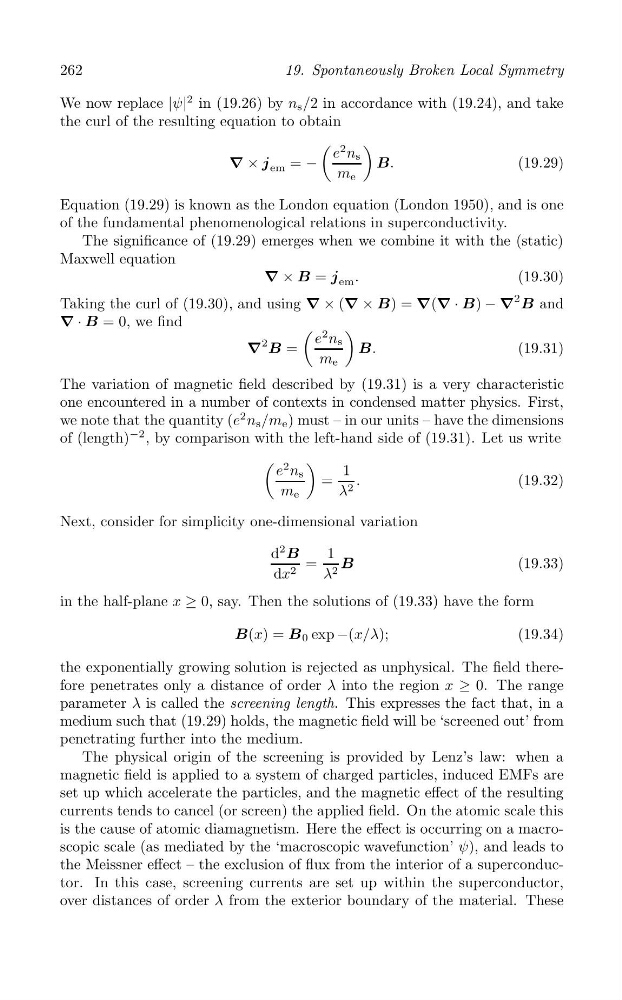
We now replace |ψ|
2 in (19.26) by n s /2 in accordance with (19.24), and take
the curl of the resulting equation to obtain
(
)
2
∇ × j = −
e n s B.
(19.29)
em
m e
Equation (19.29) is known as the London equation (London 1950), and is one
of the fundamental phenomenological relations in superconductivity.
The significance of (19.29) emerges when we combine it with the (static)
Maxwell equation
∇ × B = j .
(19.30)
em
Taking the curl of (19.30), and using ∇ × (∇ × B) = ∇(∇ · B) − ∇
2
B and
∇ · B = 0, we find
(
)
2
e
∇
2
B =
n s B.
(19.31)
m e
The variation of magnetic field described by (19.31) is a very characteristic
one encountered in a number of contexts in condensed matter physics. First,
2
we note that the quantity (e n s /m e ) must – in our units – have the dimensions
of (length)
−2 , by comparison with the left-hand side of (19.31). Let us write
(
)
e
2 n s
1
=
.
(19.32)
m e
λ 2
Next, consider for simplicity one-dimensional variation
d
2
B
1
=
B
(19.33)
dx 2
λ 2
in the half-plane x ≥ 0, say. Then the solutions of (19.33) have the form
B(x) = B 0 exp −(x/λ);
(19.34)
the exponentially growing solution is rejected as unphysical. The field therefore penetrates only a distance of order λ into the region x ≥ 0. The range
parameter λ is called the screening length. This expresses the fact that, in a
medium such that (19.29) holds, the magnetic field will be ‘screened out’ from
penetrating further into the medium.
The physical origin of the screening is provided by Lenz’s law: when a
magnetic field is applied to a system of charged particles, induced EMFs are
set up which accelerate the particles, and the magnetic effect of the resulting
currents tends to cancel (or screen) the applied field. On the atomic scale this
is the cause of atomic diamagnetism. Here the effect is occurring on a macroscopic scale (as mediated by the ‘macroscopic wavefunction’ ψ), and leads to
the Meissner effect – the exclusion of flux from the interior of a superconductor. In this case, screening currents are set up within the superconductor,
over distances of order λ from the exterior boundary of the material. These