

261
19.2. The generation of ‘photon mass’ in a superconductor
(at zero temperature) has been derived from a BCS-type model (Aitchison et
al. 1995). For the moment, we shall follow a more qualitative approach.
The Ginzburg–Landau field ψ is commonly referred to as the ‘macroscopic
wave function’. This terminology originates from the recognition that in the
BCS ground state a macroscopic number of Cooper pairs have ‘condensed’
into the state of lowest energy, a situation similar to that in the Bogoliubov
superfluid. Further, this state is highly coherent, all pairs having the same
total momentum (namely zero, in the case of (17.140)). These considerations
suggest that a successful phenomenology can be built by invoking the idea of
a macroscopic wavefunction ψ, describing the condensate. Note that ψ is a
‘bosonic’ quantity, referring essentially to paired electrons. Perhaps the single
most important property of ψ is that it is assumed to be normalized to the
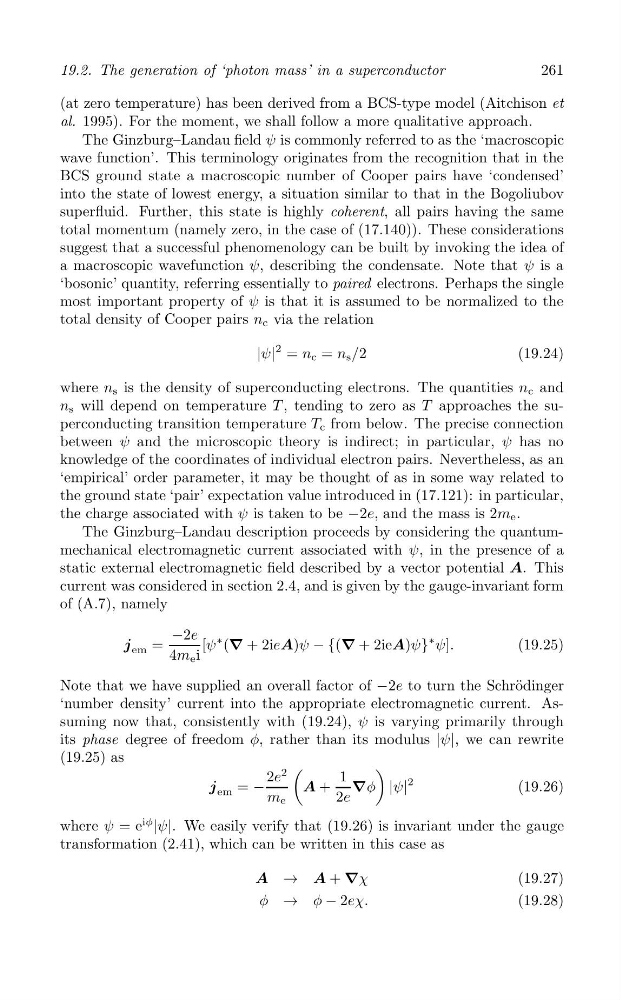
total density of Cooper pairs n c via the relation
2
|ψ| = n c = n s /2
(19.24)
where n s is the density of superconducting electrons. The quantities n c and
n s will depend on temperature T , tending to zero as T approaches the superconducting transition temperature T c from below. The precise connection
between ψ and the microscopic theory is indirect; in particular, ψ has no
knowledge of the coordinates of individual electron pairs. Nevertheless, as an
‘empirical’ order parameter, it may be thought of as in some way related to
the ground state ‘pair’ expectation value introduced in (17.121): in particular,
the charge associated with ψ is taken to be −2e, and the mass is 2m e .
The Ginzburg–Landau description proceeds by considering the quantummechanical electromagnetic current associated with ψ, in the presence of a
static external electromagnetic field described by a vector potential A. This
current was considered in section 2.4, and is given by the gauge-invariant form
of (A.7), namely
−2e
j =
[ψ
∗ (∇ + 2ieA)ψ − {(∇ + 2ieA)ψ}
∗ ψ].
(19.25)
em
4m e i
Note that we have supplied an overall factor of −2e to turn the Schr¨ odinger
‘number density’ current into the appropriate electromagnetic current. Assuming now that, consistently with (19.24), ψ is varying primarily through
its phase degree of freedom φ, rather than its modulus |ψ|, we can rewrite
(19.25) as
(
)
2
2e
1
2
j = −
A + ∇φ |ψ|
(19.26)
em
m e
2e
where ψ = e
iφ
|ψ|. We easily verify that (19.26) is invariant under the gauge
transformation (2.41), which can be written in this case as
A → A + ∇χ
(19.27)
φ → φ − 2eχ.
(19.28)