

252
18. Chiral Symmetry Breaking
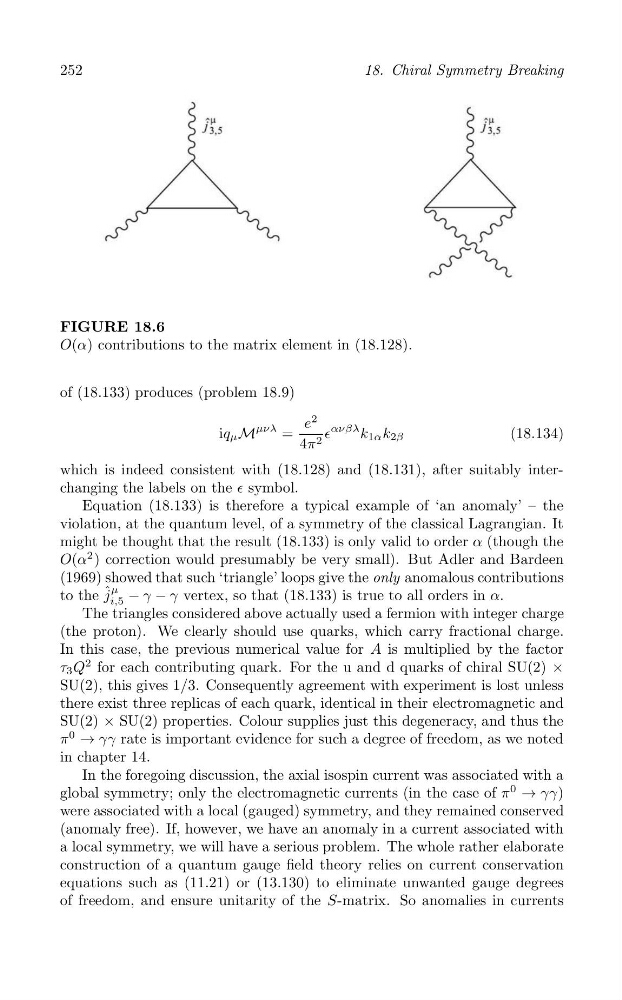
FIGURE 18.6
O(α) contributions to the matrix element in (18.128).
of (18.133) produces (problem 18.9)
2
e
iq μ M
μνλ
∈
ανβλ k 1α k 2β
=
(18.134)
4π 2
which is indeed consistent with (18.128) and (18.131), after suitably interchanging the labels on the ∈ symbol.
Equation (18.133) is therefore a typical example of ‘an anomaly’ – the
violation, at the quantum level, of a symmetry of the classical Lagrangian. It
might be thought that the result (18.133) is only valid to order α (though the
O(α
2 ) correction would presumably be very small). But Adler and Bardeen
(1969) showed that such ‘triangle’ loops give the only anomalous contributions
to the ˆ j
μ − γ − γ vertex, so that (18.133) is true to all orders in α.
i,5
The triangles considered above actually used a fermion with integer charge
(the proton). We clearly should use quarks, which carry fractional charge.
In this case, the previous numerical value for A is multiplied by the factor
τ 3 Q
2 for each contributing quark. For the u and d quarks of chiral SU(2) ×
SU(2), this gives 1/3. Consequently agreement with experiment is lost unless
there exist three replicas of each quark, identical in their electromagnetic and
SU(2) × SU(2) properties. Colour supplies just this degeneracy, and thus the
π
0
→ γγ rate is important evidence for such a degree of freedom, as we noted
in chapter 14.
In the foregoing discussion, the axial isospin current was associated with a
global symmetry; only the electromagnetic currents (in the case of π
0
→ γγ)
were associated with a local (gauged) symmetry, and they remained conserved
(anomaly free). If, however, we have an anomaly in a current associated with
a local symmetry, we will have a serious problem. The whole rather elaborate
construction of a quantum gauge field theory relies on current conservation
equations such as (11.21) or (13.130) to eliminate unwanted gauge degrees
of freedom, and ensure unitarity of the S-matrix. So anomalies in currents