

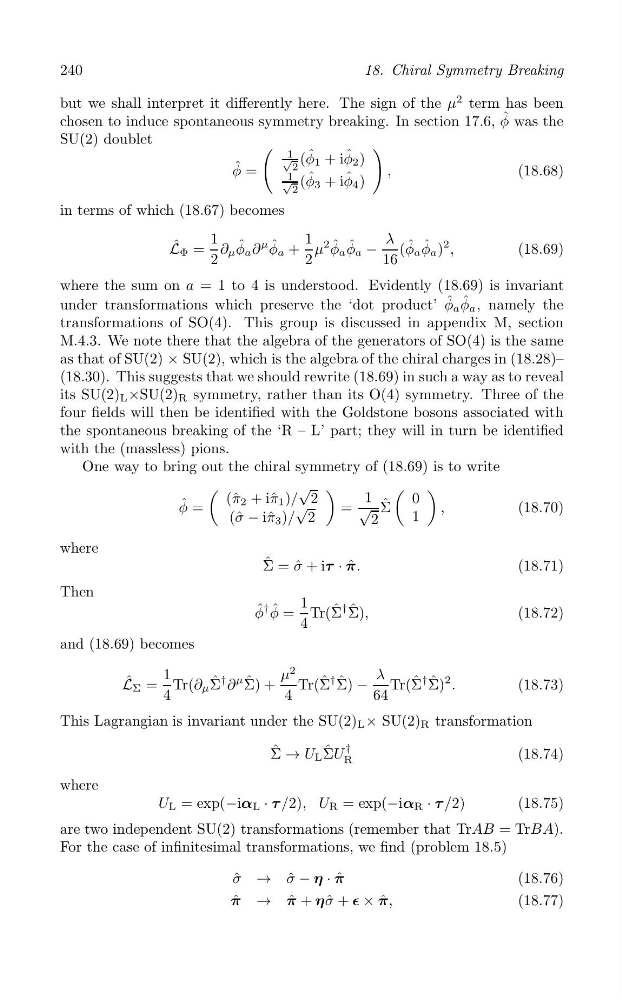
240
18. Chiral Symmetry Breaking
but we shall interpret it differently here. The sign of the μ
2 term has been
ˆ
chosen to induce spontaneous symmetry breaking. In section 17.6, φ was the
SU(2) doublet
(
)
1 ˆ
ˆ
ˆ
√ (φ 1 + iφ 2 )
φ =
2
√ 1
,
(18.68)
ˆ
ˆ
(φ 3 + iφ 4 )
2
in terms of which (18.67) becomes
1
1
λ
L ˆ
ˆ
∂ μ φ a ∂
μ ˆ
Φ =
φ + μ
2 ˆ ˆ
a
φ a φ a
2
2
−
ˆ ˆ
(φ a φ a )
2 ,
(18.69)
16
where the sum on a = 1 to 4 is understood. Evidently (18.69) is invariant
ˆ ˆ
under transformations which preserve the ‘dot product’ φ a φ a , namely the
transformations of SO(4). This group is discussed in appendix M, section
M.4.3. We note there that the algebra of the generators of SO(4) is the same
as that of SU(2) × SU(2), which is the algebra of the chiral charges in (18.28)–
(18.30). This suggests that we should rewrite (18.69) in such a way as to reveal
its SU(2) L ×SU(2) R symmetry, rather than its O(4) symmetry. Three of the
four fields will then be identified with the Goldstone bosons associated with
the spontaneous breaking of the ‘R – L’ part; they will in turn be identified
with the (massless) pions.
One way to bring out the chiral symmetry of (18.69) is to write
(
)
(
(ˆ π
ˆ
φ =
2 + iπ ˆ 1 )/
√
)
2
1
0
ˆ
=
Σ
,
(18.70)
(ˆ σ − iˆ π 3 )/
√
2
√
2
1
where
Σ =
ˆ σ ˆ + iτ · π ˆ .
(18.71)
Then
1
ˆ † ˆ
ˆ
φ φ = Tr(Σ
† ˆ
Σ),
(18.72)
4
and (18.69) becomes
1
μ
2
λ
L ˆ
ˆ
† ˆ
Tr(∂ Σ
† ∂
μ ˆ
ˆ
=
Σ) +
Tr(Σ
† ˆ
Σ) −
ˆ
Tr(Σ Σ)
2
Σ
μ
.
(18.73)
4
4
64
This Lagrangian is invariant under the SU(2) L × SU(2) R transformation
ˆ
Σ →
ˆ
U L ΣU R
†
(18.74)
where
U L = exp(−iα L · τ /2), U R = exp(−iα R · τ /2)
(18.75)
are two independent SU(2) transformations (remember that TrAB = TrBA).
For the case of infinitesimal transformations, we find (problem 18.5)
σ ˆ → σ ˆ − η · π ˆ
(18.76)
π ˆ → π ˆ + ησ ˆ + ∊ × π ˆ ,
(18.77)