

17.5. Spontaneously broken global U(1) symmetry: the Goldstone model 213
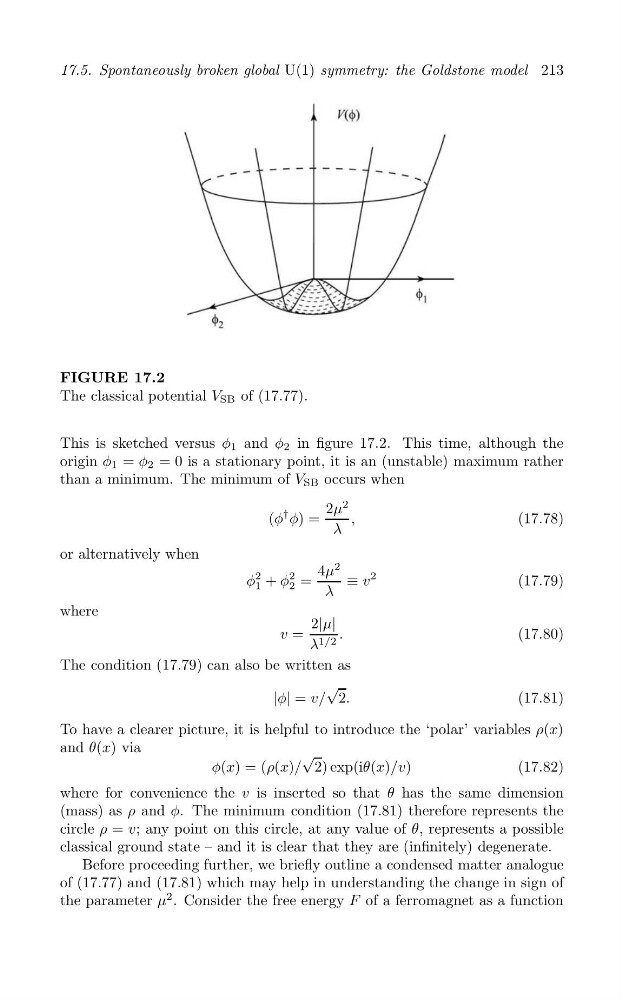
FIGURE 17.2
The classical potential V SB of (17.77).
This is sketched versus φ 1 and φ 2 in figure 17.2. This time, although the
origin φ 1 = φ 2 = 0 is a stationary point, it is an (unstable) maximum rather
than a minimum. The minimum of V SB occurs when
2μ
2
(φ
† φ) =
,
(17.78)
λ
or alternatively when
4μ
2
2
φ
2
1 + φ
2 =
≡ v
(17.79)
2
λ
where
2|μ|
v =
.
(17.80)
λ 1/2
The condition (17.79) can also be written as
√
|φ| = v/ 2.
(17.81)
To have a clearer picture, it is helpful to introduce the ‘polar’ variables ρ(x)
and θ(x) via
√
φ(x) = (ρ(x)/ 2) exp(iθ(x)/v)
(17.82)
where for convenience the v is inserted so that θ has the same dimension
(mass) as ρ and φ. The minimum condition (17.81) therefore represents the
circle ρ = v; any point on this circle, at any value of θ, represents a possible
classical ground state – and it is clear that they are (infinitely) degenerate.
Before proceeding further, we briefly outline a condensed matter analogue
of (17.77) and (17.81) which may help in understanding the change in sign of
the parameter μ
2 . Consider the free energy F of a ferromagnet as a function