

212
17. Spontaneously Broken Global Symmetry
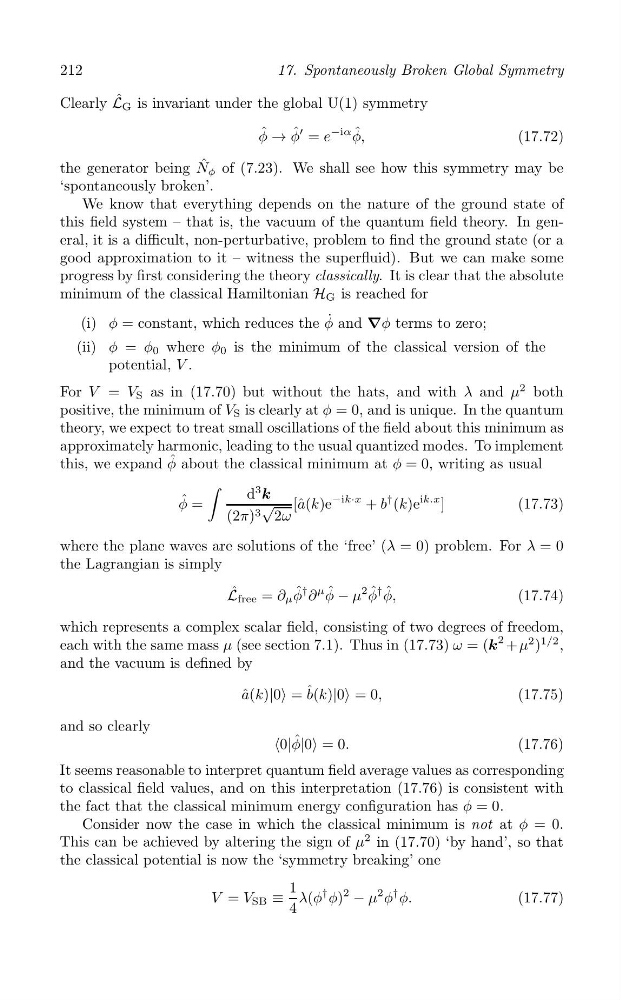
Clearly L ˆ G is invariant under the global U(1) symmetry
ˆ
φ → ˆ
φ
′ = e
−iα ˆ
φ,
(17.72)
ˆ
the generator being N φ of (7.23). We shall see how this symmetry may be
‘spontaneously broken’.
We know that everything depends on the nature of the ground state of
this field system – that is, the vacuum of the quantum field theory. In general, it is a difficult, non-perturbative, problem to find the ground state (or a
good approximation to it – witness the superfluid). But we can make some
progress by first considering the theory classically. It is clear that the absolute
minimum of the classical Hamiltonian H G is reached for
˙
(i) φ = constant, which reduces the φ and ∇φ terms to zero;
(ii) φ = φ 0 where φ 0 is the minimum of the classical version of the
potential, V .
For V = V S as in (17.70) but without the hats, and with λ and μ
2 both
positive, the minimum of V S is clearly at φ = 0, and is unique. In the quantum
theory, we expect to treat small oscillations of the field about this minimum as
approximately harmonic, leading to the usual quantized modes. To implement
ˆ
this, we expand φ about the classical minimum at φ = 0, writing as usual
∫
d
3
k
ˆ
φ =
√ [ˆ a(k)e
−ik·x + b
† (k)e
ik.x ]
(17.73)
(2π) 3 2ω
where the plane waves are solutions of the ‘free’ (λ = 0) problem. For λ = 0
the Lagrangian is simply
L ˆ
ˆ
= ∂ φ
† ∂
μ ˆ
φ − μ
2 ˆ
free
μ
φ
† ˆ
φ,
(17.74)
which represents a complex scalar field, consisting of two degrees of freedom,
each with the same mass μ (see section 7.1). Thus in (17.73) ω = (k
2 + μ
2 )
1/2 ,
and the vacuum is defined by
a ˆ(k)|0› ˆ
= b(k)|0› = 0,
(17.75)
and so clearly
‹0| ˆ
φ|0› = 0.
(17.76)
It seems reasonable to interpret quantum field average values as corresponding
to classical field values, and on this interpretation (17.76) is consistent with
the fact that the classical minimum energy configuration has φ = 0.
Consider now the case in which the classical minimum is not at φ = 0.
This can be achieved by altering the sign of μ
2 in (17.70) ‘by hand’, so that
the classical potential is now the ‘symmetry breaking’ one
1
V = V SB ≡ λ(φ
† φ)
2
− μ
2 φ
† φ.
(17.77)
4