

148
15. QCD II: Asymptotic Freedom, the Renormalization Group
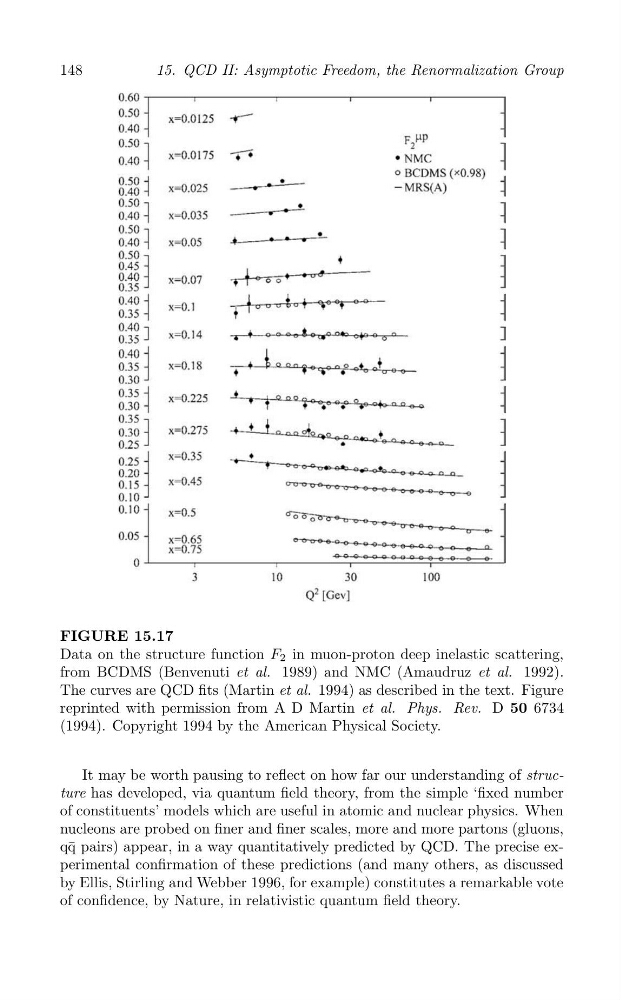
FIGURE 15.17
Data on the structure function F 2 in muon-proton deep inelastic scattering,
from BCDMS (Benvenuti et al. 1989) and NMC (Amaudruz et al. 1992).
The curves are QCD fits (Martin et al. 1994) as described in the text. Figure
reprinted with permission from A D Martin et al. Phys. Rev. D 50 6734
(1994). Copyright 1994 by the American Physical Society.
It may be worth pausing to reflect on how far our understanding of structure has developed, via quantum field theory, from the simple ‘fixed number
of constituents’ models which are useful in atomic and nuclear physics. When
nucleons are probed on finer and finer scales, more and more partons (gluons,
q¯ q pairs) appear, in a way quantitatively predicted by QCD. The precise experimental confirmation of these predictions (and many others, as discussed
by Ellis, Stirling and Webber 1996, for example) constitutes a remarkable vote
of confidence, by Nature, in relativistic quantum field theory.