

144
15. QCD II: Asymptotic Freedom, the Renormalization Group
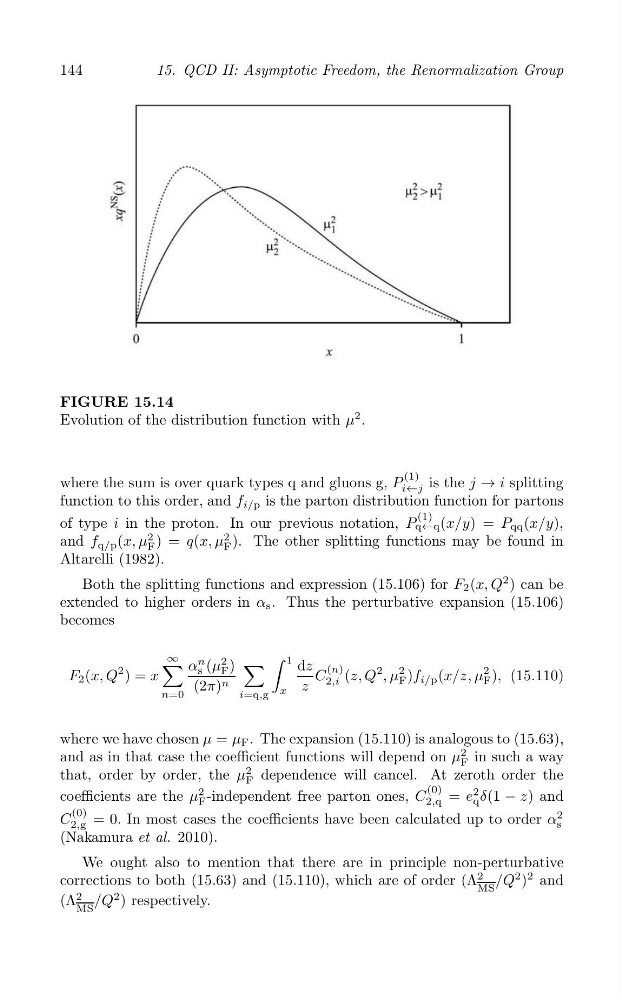
FIGURE 15.14
Evolution of the distribution function with μ
2 .
(1)
where the sum is over quark types q and gluons g, P i j is the j
←
→ i splitting
function to this order, and f i/p is the parton distribution function for partons
(1)
of type i in the proton. In our previous notation, P q q (x/y) = P qq (x/y),
←
and f q/p (x, μ
2
F ) = q(x, μ
2
F ). The other splitting functions may be found in
Altarelli (1982).
Both the splitting functions and expression (15.106) for F
2
2 (x, Q ) can be
extended to higher orders in α s . Thus the perturbative expansion (15.106)
becomes
∫
∑ ∞ α
n (μ
2 ) ∑ 1 dz (n)
F 2 (x, Q
2 ) = x
s
F
C 2,i (z, Q
2 , μ
2
F )f i/p (x/z, μ
2 ), (
(2π) n
F
15.110)
x z
n=0
i=q,g
where we have chosen μ = μ F . The expansion (15.110) is analogous to (15.63),
and as in that case the coefficient functions will depend on μ
2
F in such a way
that, order by order, the μ
2
F dependence will cancel. At zeroth order the
2
(0)
coefficients are the μ F -independent free parton ones, C 2,q = e
2
q δ(1 − z) and
(0)
C 2,g = 0. In most cases the coefficients have been calculated up to order α
2
s
(Nakamura et al. 2010).
We ought also to mention that there are in principle non-perturbative
corrections to both (15.63) and (15.110), which are of order (Λ
2 /Q
2 )
2 and
MS
(Λ
2 /Q
2 ) respectively.
MS