

142
15. QCD II: Asymptotic Freedom, the Renormalization Group
15.6.2
Factorization, and the order α s DGLAP equation
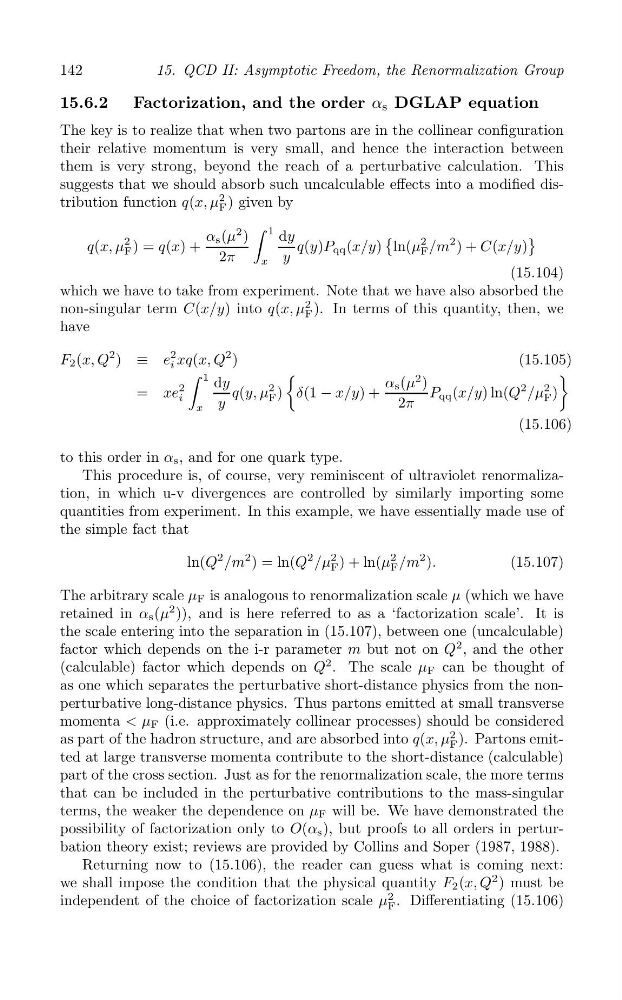
The key is to realize that when two partons are in the collinear configuration
their relative momentum is very small, and hence the interaction between
them is very strong, beyond the reach of a perturbative calculation. This
suggests that we should absorb such uncalculable effects into a modified distribution function q(x, μ
2 ) given by
F
∫ 1
α s (μ
2 )
dy
{
}
q(x, μ
2
q(y)P qq (x/y)
F /m
2 ) + C(x/y)
F ) = q(x) +
ln(μ
2
2π
y
x
(15.104)
which we have to take from experiment. Note that we have also absorbed the
non-singular term C(x/y) into q(x, μ
2 ). In terms of this quantity, then, we
F
have
2
F 2 (x, Q
2 ) ≡ e i xq(x, Q
2 )
(15.105)
∫
(
)
1 dy
(μ
2 )
2
α s
= xe
q(y, μ
2
F ) δ(1 − x/y) +
P qq (x/y) ln(Q
2 /μ
2
F )
i
y
2π
x
(15.106)
to this order in α s , and for one quark type.
This procedure is, of course, very reminiscent of ultraviolet renormalization, in which u-v divergences are controlled by similarly importing some
quantities from experiment. In this example, we have essentially made use of
the simple fact that
ln(Q
2 /m
2 ) =
F ) + ln(μ
2
(15.107)
ln(Q
2 /μ
2
F /m
2 ).
The arbitrary scale μ F is analogous to renormalization scale μ (which we have
retained in α s (μ
2 )), and is here referred to as a ‘factorization scale’. It is
the scale entering into the separation in (15.107), between one (uncalculable)
factor which depends on the i-r parameter m but not on Q
2 , and the other
(calculable) factor which depends on Q
2 . The scale μ F can be thought of
as one which separates the perturbative short-distance physics from the nonperturbative long-distance physics. Thus partons emitted at small transverse
momenta < μ F (i.e. approximately collinear processes) should be considered
as part of the hadron structure, and are absorbed into q(x, μ
2 ). Partons emitF
ted at large transverse momenta contribute to the short-distance (calculable)
part of the cross section. Just as for the renormalization scale, the more terms
that can be included in the perturbative contributions to the mass-singular
terms, the weaker the dependence on μ F will be. We have demonstrated the
possibility of factorization only to O(α s ), but proofs to all orders in perturbation theory exist; reviews are provided by Collins and Soper (1987, 1988).
Returning now to (15.106), the reader can guess what is coming next:
we shall impose the condition that the physical quantity F 2 (x, Q
2 ) must be
independent of the choice of factorization scale μ
2 . Differentiating (15.106)
F