

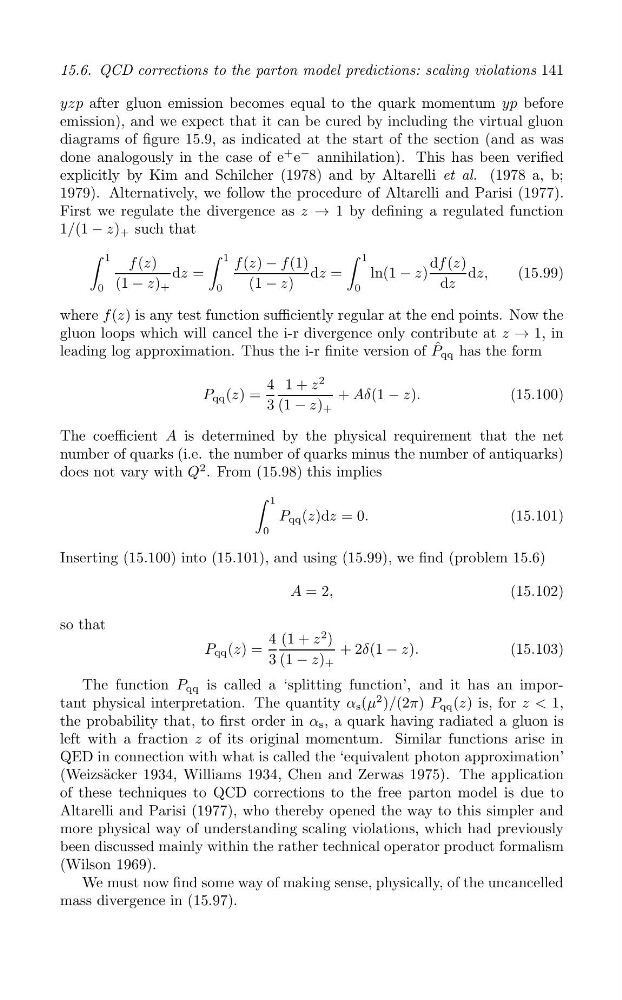
15.6. QCD corrections to the parton model predictions: scaling violations 141
yzp after gluon emission becomes equal to the quark momentum yp before
emission), and we expect that it can be cured by including the virtual gluon
diagrams of figure 15.9, as indicated at the start of the section (and as was
−
done analogously in the case of e
+ e annihilation). This has been verified
explicitly by Kim and Schilcher (1978) and by Altarelli et al. (1978 a, b;
1979). Alternatively, we follow the procedure of Altarelli and Parisi (1977).
First we regulate the divergence as z → 1 by defining a regulated function
1/(1 − z) + such that
∫
∫
∫
1
1
1
f (z)
f (z) − f (1)
df (z)
dz =
dz =
ln(1 − z)
dz,
(15.99)
(1 − z) +
(1 − z)
dz
0
0
0
where f (z) is any test function sufficiently regular at the end points. Now the
gluon loops which will cancel the i-r divergence only contribute at z → 1, in
leading log approximation. Thus the i-r finite version of P ˆ qq has the form
2
4 1 + z
P qq (z) =
+ Aδ(1 − z).
(15.100)
3 (1 − z) +
The coefficient A is determined by the physical requirement that the net
number of quarks (i.e. the number of quarks minus the number of antiquarks)
does not vary with Q
2 . From (15.98) this implies
∫ 1
P qq (z)dz = 0.
(15.101)
0
Inserting (15.100) into (15.101), and using (15.99), we find (problem 15.6)
A = 2,
(15.102)
so that
4 (1 + z
2 )
P qq (z) =
+ 2δ(1 − z).
(15.103)
3 (1 − z) +
The function P qq is called a ‘splitting function’, and it has an important physical interpretation. The quantity α s (μ
2 )/(2π) P qq (z) is, for z < 1,
the probability that, to first order in α s , a quark having radiated a gluon is
left with a fraction z of its original momentum. Similar functions arise in
QED in connection with what is called the ‘equivalent photon approximation’
(Weizs¨ acker 1934, Williams 1934, Chen and Zerwas 1975). The application
of these techniques to QCD corrections to the free parton model is due to
Altarelli and Parisi (1977), who thereby opened the way to this simpler and
more physical way of understanding scaling violations, which had previously
been discussed mainly within the rather technical operator product formalism
(Wilson 1969).
We must now find some way of making sense, physically, of the uncancelled
mass divergence in (15.97).