

15.6. QCD corrections to the parton model predictions: scaling violations 139
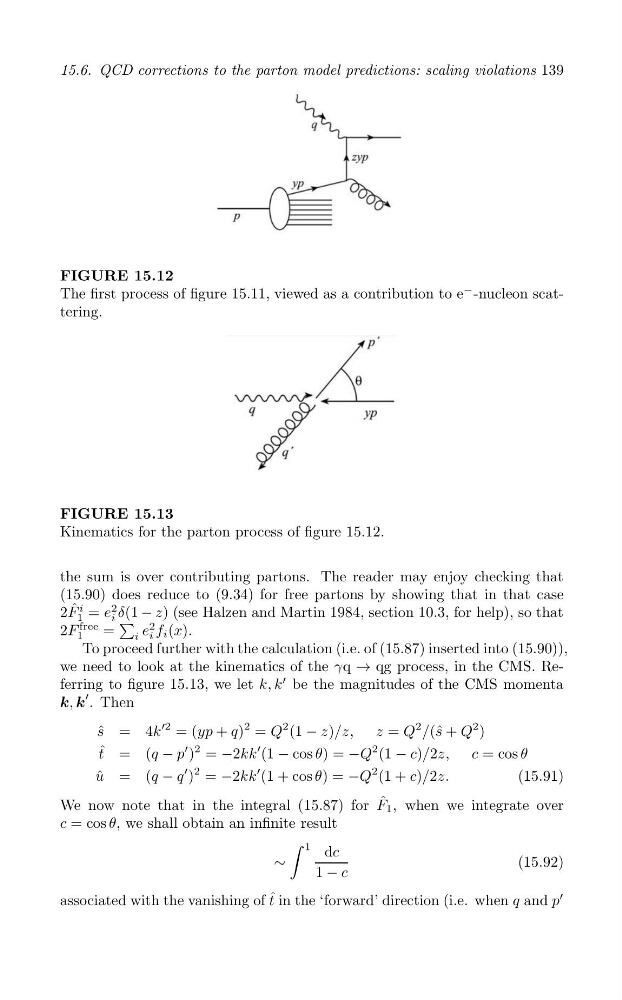
FIGURE 15.12
The first process of figure 15.11, viewed as a contribution to e
− -nucleon scattering.
FIGURE 15.13
Kinematics for the parton process of figure 15.12.
the sum is over contributing partons. The reader may enjoy checking that
(15.90) does reduce to (9.34) for free partons by showing that in that case
2F ˆ i = e
2
1
i δ (1 − z) (see Halzen and Martin 1984, section 10.3, for help), so that
2F
free
1
= i e
2
i f i (x).
To proceed further with the calculation (i.e. of (15.87) inserted into (15.90)),
we need to look at the kinematics of the γq → qg process, in the CMS. Referring to figure 15.13, we let k, k
′ be the magnitudes of the CMS momenta
k, k
′ . Then
s ˆ = 4k
′2 = (yp + q)
2 = Q
2 (1 z)/z, z = Q
2 /(ˆ s + Q
2 )
t ˆ = (q − p
′ )
2
−
= −2kk
′ (1 − cos θ) = −Q
2 (1 − c)/2z, c = cos θ
u ˆ = (q − q
′ )
2 = −2kk
′ (1 + cos θ) = −Q
2 (1 + c)/2z.
(15.91)
ˆ
We now note that in the integral (15.87) for F 1 , when we integrate over
c = cos θ, we shall obtain an infinite result
∫ 1 dc
∼
(15.92)
1 − c
associated with the vanishing of t ˆ in the ‘forward’ direction (i.e. when q and p
′