

138
15. QCD II: Asymptotic Freedom, the Renormalization Group
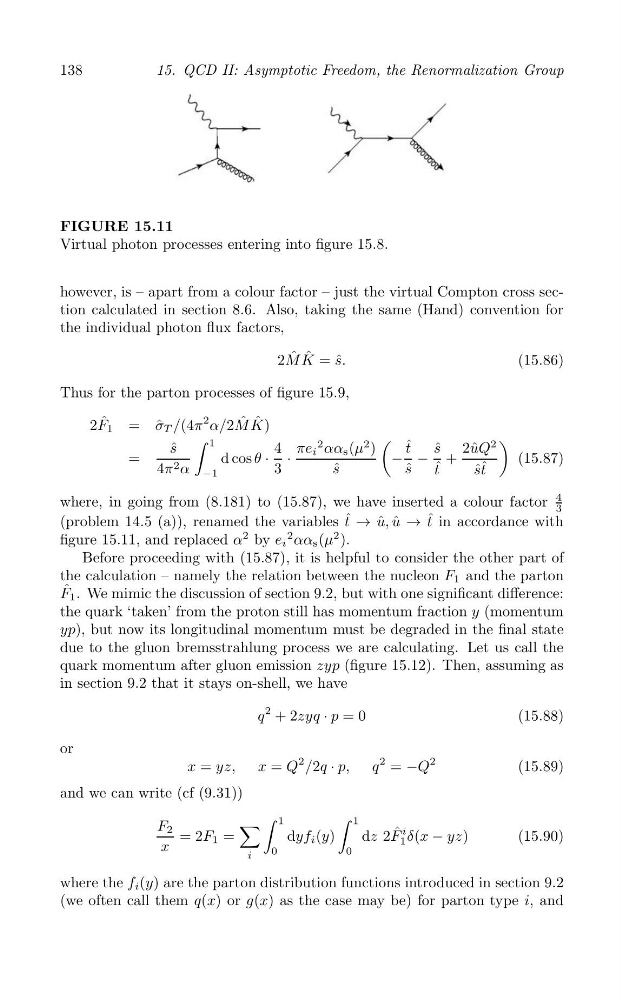
FIGURE 15.11
Virtual photon processes entering into figure 15.8.
however, is – apart from a colour factor – just the virtual Compton cross section calculated in section 8.6. Also, taking the same (Hand) convention for
the individual photon flux factors,
2M ˆ K ˆ = ˆ
s.
(15.86)
Thus for the parton processes of figure 15.9,
2F ˆ 1 = ˆ
σ T /(4π
2 α/2M ˆ K ˆ )
∫
(
)
1
s ˆ
4 πe i
2 αα s (μ
2 )
t ˆ s ˆ 2ˆ uQ
2
=
d cos θ · ·
− − +
(15.87)
4π 2 α −1
3
s ˆ
s ˆ t ˆ
s ˆt ˆ
4
where, in going from (8.181) to (15.87), we have inserted a colour factor 3
(problem 14.5 (a)), renamed the variables t ˆ → ˆ u → t ˆ in accordance with
u, ˆ
figure 15.11, and replaced α
2 by e i
2 αα s (μ
2 ).
Before proceeding with (15.87), it is helpful to consider the other part of
the calculation – namely the relation between the nucleon F 1 and the parton
ˆ
F 1 . We mimic the discussion of section 9.2, but with one significant difference:
the quark ‘taken’ from the proton still has momentum fraction y (momentum
yp), but now its longitudinal momentum must be degraded in the final state
due to the gluon bremsstrahlung process we are calculating. Let us call the
quark momentum after gluon emission zyp (figure 15.12). Then, assuming as
in section 9.2 that it stays on-shell, we have
q
2 + 2zyq · p = 0
(15.88)
or
2
x = yz, x = Q
2 /2q · p,
q = −Q
2
(15.89)
and we can write (cf (9.31))
∫
∫
∑ 1
1
F 2 = 2F 1 =
dyf i (y)
dz 2F ˆ
1
i δ(x − yz)
(15.90)
x
0
0
i
where the f i (y) are the parton distribution functions introduced in section 9.2
(we often call them q(x) or g(x) as the case may be) for parton type i, and