

14.2. The dynamics of colour
83
as in (13.58 ), and the vertex (14.27) becomes
λ
−
a
ig s γ
μ
(14.30)
2
as in (13.60). One motivation for this is the desire to make the colour dynamics
as much as possible like the highly successful theory of QED, and to derive
the dynamics from a gauge principle. As we have seen in the last chapter, this
involves the simple but deep step of supposing that the quark wave equation
is covariant under local SU(3) c transformations of the form
ψ → ψ
′ = exp(ig s α(x) · λ/2)ψ.
(14.31)
This is implemented by the replacement
λ
∂ μ →
a
∂ μ + ig s A aμ (x)
(14.32)
2
in the Dirac equation for the quarks, which leads immediately to (14.29) and
the vertex (14.30).
Of course, the assumption of local SU(3) c covariance leads to a great deal
more: for example, it implies that the gluons are massless vector (spin 1)
particles, and that they interact with themselves via three-gluon and fourgluon vertices, which are the SU(3) c analogues of the SU(2) vertices discussed
in section 13.3.2. The most compact way of summarizing all this structure is
via the Lagrangian, most of which we have already introduced in chapter 13.
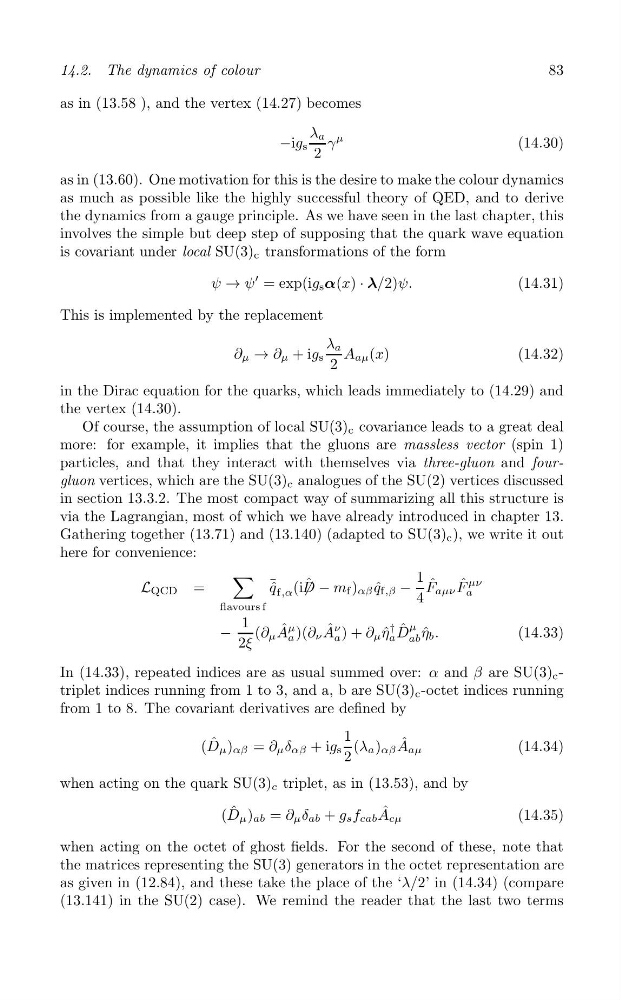
Gathering together (13.71) and (13.140) (adapted to SU(3) c ), we write it out
here for convenience:
∑
1
L
¯
ˆ
ˆ
ˆ
QCD
=
q ˆ
μν
f,α (iD m f ) αβ q ˆ f,β
F aμν F
4
a
flavours f
−
−
1
−
ˆ
ˆ
ˆ μ
(∂ μ A
μ
a )(∂ ν A
ν
2
a ) + ∂ μ η ˆ a
† D
ξ
ab η ˆ b .
(14.33)
In (14.33), repeated indices are as usual summed over: α and β are SU(3) c -
triplet indices running from 1 to 3, and a, b are SU(3) c -octet indices running
from 1 to 8. The covariant derivatives are defined by
1
ˆ
ˆ
(D μ ) αβ = ∂ μ δ αβ + ig s (λ a ) αβ A aμ
(14.34)
2
when acting on the quark SU(3) c triplet, as in (13.53), and by
ˆ
ˆ
(D μ ) ab = ∂ μ δ ab + g s f cab A cμ
(14.35)
when acting on the octet of ghost fields. For the second of these, note that
the matrices representing the SU(3) generators in the octet representation are
as given in (12.84), and these take the place of the ‘λ/2’ in (14.34) (compare
(13.141) in the SU(2) case). We remind the reader that the last two terms
/
83
as in (13.58 ), and the vertex (14.27) becomes
λ
−
a
ig s γ
μ
(14.30)
2
as in (13.60). One motivation for this is the desire to make the colour dynamics
as much as possible like the highly successful theory of QED, and to derive
the dynamics from a gauge principle. As we have seen in the last chapter, this
involves the simple but deep step of supposing that the quark wave equation
is covariant under local SU(3) c transformations of the form
ψ → ψ
′ = exp(ig s α(x) · λ/2)ψ.
(14.31)
This is implemented by the replacement
λ
∂ μ →
a
∂ μ + ig s A aμ (x)
(14.32)
2
in the Dirac equation for the quarks, which leads immediately to (14.29) and
the vertex (14.30).
Of course, the assumption of local SU(3) c covariance leads to a great deal
more: for example, it implies that the gluons are massless vector (spin 1)
particles, and that they interact with themselves via three-gluon and fourgluon vertices, which are the SU(3) c analogues of the SU(2) vertices discussed
in section 13.3.2. The most compact way of summarizing all this structure is
via the Lagrangian, most of which we have already introduced in chapter 13.
Gathering together (13.71) and (13.140) (adapted to SU(3) c ), we write it out
here for convenience:
∑
1
L
¯
ˆ
ˆ
ˆ
QCD
=
q ˆ
μν
f,α (iD m f ) αβ q ˆ f,β
F aμν F
4
a
flavours f
−
−
1
−
ˆ
ˆ
ˆ μ
(∂ μ A
μ
a )(∂ ν A
ν
2
a ) + ∂ μ η ˆ a
† D
ξ
ab η ˆ b .
(14.33)
In (14.33), repeated indices are as usual summed over: α and β are SU(3) c -
triplet indices running from 1 to 3, and a, b are SU(3) c -octet indices running
from 1 to 8. The covariant derivatives are defined by
1
ˆ
ˆ
(D μ ) αβ = ∂ μ δ αβ + ig s (λ a ) αβ A aμ
(14.34)
2
when acting on the quark SU(3) c triplet, as in (13.53), and by
ˆ
ˆ
(D μ ) ab = ∂ μ δ ab + g s f cab A cμ
(14.35)
when acting on the octet of ghost fields. For the second of these, note that
the matrices representing the SU(3) generators in the octet representation are
as given in (12.84), and these take the place of the ‘λ/2’ in (14.34) (compare
(13.141) in the SU(2) case). We remind the reader that the last two terms
/