

13.3. Local non-Abelian symmetries in Lagrangian quantum field theory 65
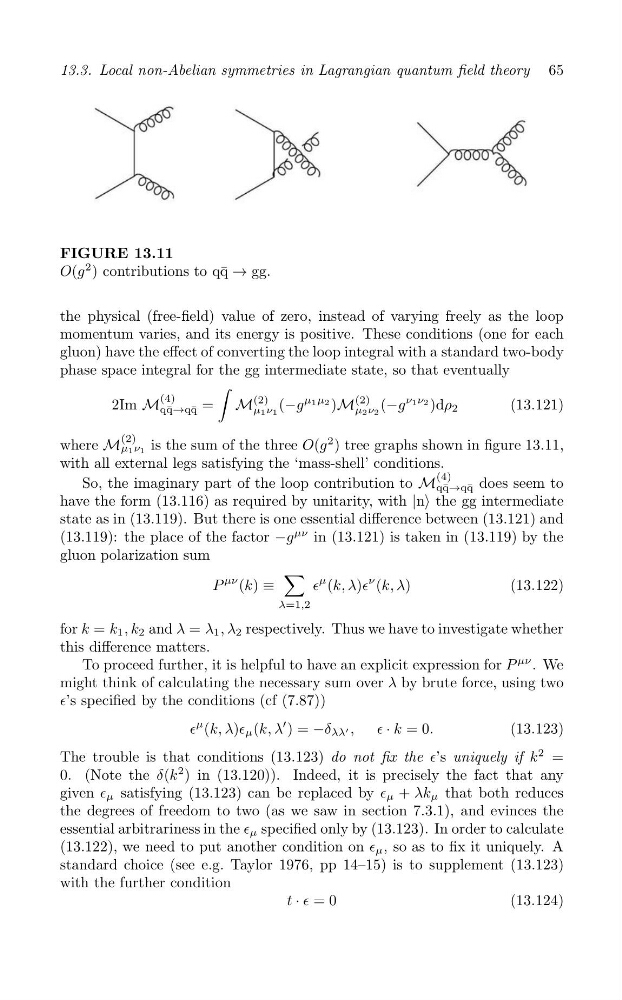
FIGURE 13.11
O(g
2 ) contributions to qq ¯ → gg.
the physical (free-field) value of zero, instead of varying freely as the loop
momentum varies, and its energy is positive. These conditions (one for each
gluon) have the effect of converting the loop integral with a standard two-body
phase space integral for the gg intermediate state, so that eventually
∫
2Im M
(4)
= M
(2) (−g
μ1μ2 )M
(2) (−g
ν1ν2
q¯ q→q¯ q
μ1ν1
μ2ν2
)dρ 2
(13.121)
where M
(2)
μ1ν1 is the sum of the three O(g
2 ) tree graphs shown in figure 13.11,
with all external legs satisfying the ‘mass-shell’ conditions.
(4)
So, the imaginary part of the loop contribution to M q¯ q q¯ q does seem to
→
have the form (13.116) as required by unitarity, with |n› the gg intermediate
state as in (13.119). But there is one essential difference between (13.121) and
(13.119): the place of the factor −g
μν in (13.121) is taken in (13.119) by the
gluon polarization sum
∑
P
μν (k) ≡
∈
μ (k, λ)∈
ν (k, λ)
(13.122)
λ=1,2
for k = k 1 , k 2 and λ = λ 1 , λ 2 respectively. Thus we have to investigate whether
this difference matters.
To proceed further, it is helpful to have an explicit expression for P
μν . We
might think of calculating the necessary sum over λ by brute force, using two
∈’s specified by the conditions (cf (7.87))
∈
μ (k, λ)∈ μ (k, λ
′ ) = −δ λλ ′ ,
∈· k = 0.
(13.123)
The trouble is that conditions (13.123) do not fix the ∈’s uniquely if k
2 =
0. (Note the δ(k
2 ) in (13.120)). Indeed, it is precisely the fact that any
given ∈ μ satisfying (13.123) can be replaced by ∈ μ + λk μ that both reduces
the degrees of freedom to two (as we saw in section 7.3.1), and evinces the
essential arbitrariness in the ∈ μ specified only by (13.123). In order to calculate
(13.122), we need to put another condition on ∈ μ , so as to fix it uniquely. A
standard choice (see e.g. Taylor 1976, pp 14–15) is to supplement (13.123)
with the further condition
t · ∈ = 0
(13.124)
FIGURE 13.11
O(g
2 ) contributions to qq ¯ → gg.
the physical (free-field) value of zero, instead of varying freely as the loop
momentum varies, and its energy is positive. These conditions (one for each
gluon) have the effect of converting the loop integral with a standard two-body
phase space integral for the gg intermediate state, so that eventually
∫
2Im M
(4)
= M
(2) (−g
μ1μ2 )M
(2) (−g
ν1ν2
q¯ q→q¯ q
μ1ν1
μ2ν2
)dρ 2
(13.121)
where M
(2)
μ1ν1 is the sum of the three O(g
2 ) tree graphs shown in figure 13.11,
with all external legs satisfying the ‘mass-shell’ conditions.
(4)
So, the imaginary part of the loop contribution to M q¯ q q¯ q does seem to
→
have the form (13.116) as required by unitarity, with |n› the gg intermediate
state as in (13.119). But there is one essential difference between (13.121) and
(13.119): the place of the factor −g
μν in (13.121) is taken in (13.119) by the
gluon polarization sum
∑
P
μν (k) ≡
∈
μ (k, λ)∈
ν (k, λ)
(13.122)
λ=1,2
for k = k 1 , k 2 and λ = λ 1 , λ 2 respectively. Thus we have to investigate whether
this difference matters.
To proceed further, it is helpful to have an explicit expression for P
μν . We
might think of calculating the necessary sum over λ by brute force, using two
∈’s specified by the conditions (cf (7.87))
∈
μ (k, λ)∈ μ (k, λ
′ ) = −δ λλ ′ ,
∈· k = 0.
(13.123)
The trouble is that conditions (13.123) do not fix the ∈’s uniquely if k
2 =
0. (Note the δ(k
2 ) in (13.120)). Indeed, it is precisely the fact that any
given ∈ μ satisfying (13.123) can be replaced by ∈ μ + λk μ that both reduces
the degrees of freedom to two (as we saw in section 7.3.1), and evinces the
essential arbitrariness in the ∈ μ specified only by (13.123). In order to calculate
(13.122), we need to put another condition on ∈ μ , so as to fix it uniquely. A
standard choice (see e.g. Taylor 1976, pp 14–15) is to supplement (13.123)
with the further condition
t · ∈ = 0
(13.124)