

13.3. Local non-Abelian symmetries in Lagrangian quantum field theory 63
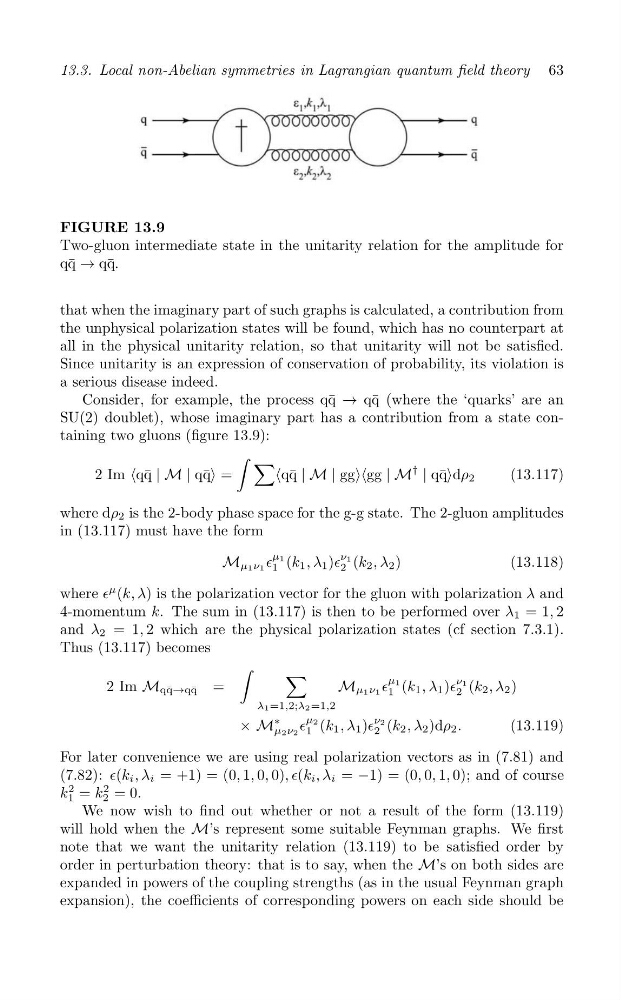
FIGURE 13.9
Two-gluon intermediate state in the unitarity relation for the amplitude for
q¯ q → q¯ q.
that when the imaginary part of such graphs is calculated, a contribution from
the unphysical polarization states will be found, which has no counterpart at
all in the physical unitarity relation, so that unitarity will not be satisfied.
Since unitarity is an expression of conservation of probability, its violation is
a serious disease indeed.
Consider, for example, the process qq ¯ → q¯ q (where the ‘quarks’ are an
SU(2) doublet), whose imaginary part has a contribution from a state containing two gluons (figure 13.9):
∫ ∑
2 Im ‹q¯ q | M | q¯ q› =
‹q¯ q | M | gg›‹gg | M
†
| q¯ q›dρ 2
(13.117)
where dρ 2 is the 2-body phase space for the g-g state. The 2-gluon amplitudes
in (13.117) must have the form
M
μ1
ν1
μ1ν1 ∈ 1 (k 1 , λ 1 )∈ 2 (k 2 , λ 2 )
(13.118)
where ∈
μ (k, λ) is the polarization vector for the gluon with polarization λ and
4-momentum k. The sum in (13.117) is then to be performed over λ 1 = 1, 2
and λ 2 = 1, 2 which are the physical polarization states (cf section 7.3.1).
Thus (13.117) becomes
∫
∑
2 Im M
ν
q¯ q→q¯ q =
M
μ
μ ν1 ∈
1
1
1
1 (k 1 , λ 1 )∈ 2 (k 2 , λ 2 )
λ1=1,2;λ2=1,2
× M
∗
μ
∈
2
μ2ν2 1 (k 1 , λ 1 )∈
ν2
2 (k 2 , λ 2 )dρ 2 .
(13.119)
For later convenience we are using real polarization vectors as in (7.81) and
(7.82): ∈(k i , λ i = +1) = (0, 1, 0, 0), ∈(k i , λ i = −1) = (0, 0, 1, 0); and of course
k
2
1 = k
2
2 = 0.
We now wish to find out whether or not a result of the form (13.119)
will hold when the M’s represent some suitable Feynman graphs. We first
note that we want the unitarity relation (13.119) to be satisfied order by
order in perturbation theory: that is to say, when the M’s on both sides are
expanded in powers of the coupling strengths (as in the usual Feynman graph
expansion), the coefficients of corresponding powers on each side should be
FIGURE 13.9
Two-gluon intermediate state in the unitarity relation for the amplitude for
q¯ q → q¯ q.
that when the imaginary part of such graphs is calculated, a contribution from
the unphysical polarization states will be found, which has no counterpart at
all in the physical unitarity relation, so that unitarity will not be satisfied.
Since unitarity is an expression of conservation of probability, its violation is
a serious disease indeed.
Consider, for example, the process qq ¯ → q¯ q (where the ‘quarks’ are an
SU(2) doublet), whose imaginary part has a contribution from a state containing two gluons (figure 13.9):
∫ ∑
2 Im ‹q¯ q | M | q¯ q› =
‹q¯ q | M | gg›‹gg | M
†
| q¯ q›dρ 2
(13.117)
where dρ 2 is the 2-body phase space for the g-g state. The 2-gluon amplitudes
in (13.117) must have the form
M
μ1
ν1
μ1ν1 ∈ 1 (k 1 , λ 1 )∈ 2 (k 2 , λ 2 )
(13.118)
where ∈
μ (k, λ) is the polarization vector for the gluon with polarization λ and
4-momentum k. The sum in (13.117) is then to be performed over λ 1 = 1, 2
and λ 2 = 1, 2 which are the physical polarization states (cf section 7.3.1).
Thus (13.117) becomes
∫
∑
2 Im M
ν
q¯ q→q¯ q =
M
μ
μ ν1 ∈
1
1
1
1 (k 1 , λ 1 )∈ 2 (k 2 , λ 2 )
λ1=1,2;λ2=1,2
× M
∗
μ
∈
2
μ2ν2 1 (k 1 , λ 1 )∈
ν2
2 (k 2 , λ 2 )dρ 2 .
(13.119)
For later convenience we are using real polarization vectors as in (7.81) and
(7.82): ∈(k i , λ i = +1) = (0, 1, 0, 0), ∈(k i , λ i = −1) = (0, 0, 1, 0); and of course
k
2
1 = k
2
2 = 0.
We now wish to find out whether or not a result of the form (13.119)
will hold when the M’s represent some suitable Feynman graphs. We first
note that we want the unitarity relation (13.119) to be satisfied order by
order in perturbation theory: that is to say, when the M’s on both sides are
expanded in powers of the coupling strengths (as in the usual Feynman graph
expansion), the coefficients of corresponding powers on each side should be