

13.3. Local non-Abelian symmetries in Lagrangian quantum field theory 61
This has the drawback that the limit ξ → 0 appears to be singular (though the
propagator (7.122) is well-behaved as ξ → 0). To avoid this unpleasantness,
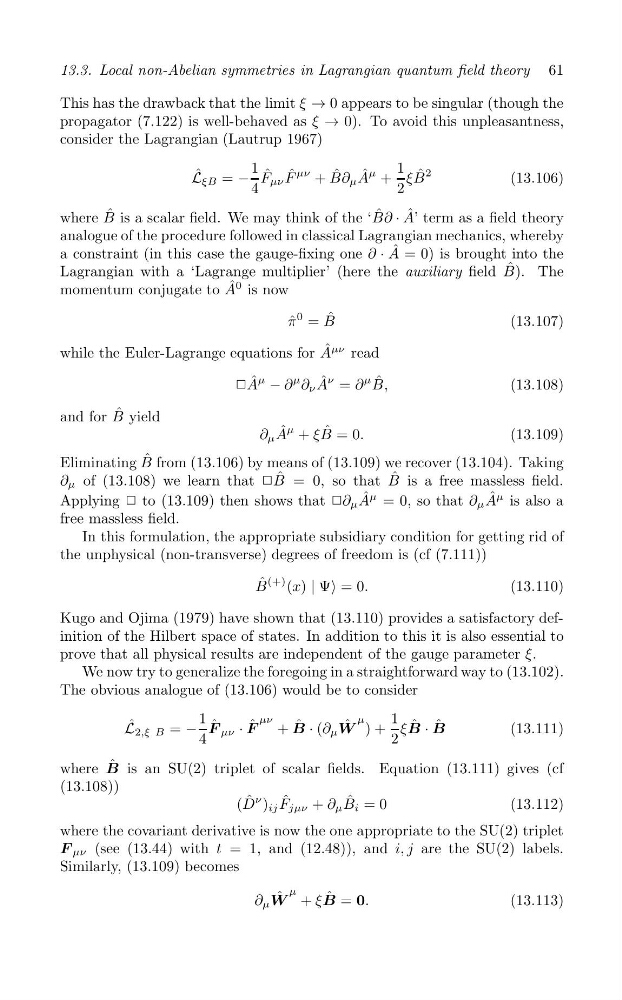
consider the Lagrangian (Lautrup 1967)
ˆ F ˆ μν + ˆ A ˆ μ
ˆ
L ξB = −
1 F μν
B∂ μ
+
1 ξB ˆ 2
(13.106)
4
2
ˆ · ˆ
where B ˆ is a scalar field. We may think of the ‘B∂ A’ term as a field theory
analogue of the procedure followed in classical Lagrangian mechanics, whereby
a constraint (in this case the gauge-fixing one ∂ · A ˆ = 0) is brought into the
Lagrangian with a ‘Lagrange multiplier’ (here the auxiliary field B ˆ ). The
momentum conjugate to A ˆ 0 is now
π
0
ˆ
ˆ = B
(13.107)
A
μν
while the Euler-Lagrange equations for ˆ read
❗A ˆ μ − ∂
μ ∂ ν A ˆ ν ∂
μ ˆ
= B,
(13.108)
and for B ˆ yield
A ˆ μ + ξ ˆ
∂ μ
B = 0.
(13.109)
Eliminating B ˆ from (13.106) by means of (13.109) we recover (13.104). Taking
∂ μ of (13.108) we learn that ❗B ˆ = 0, so that B ˆ is a free massless field.
A ˆ μ
A ˆ μ
Applying ❗ to (13.109) then shows that ❗∂ μ
= 0, so that ∂ μ
is also a
free massless field.
In this formulation, the appropriate subsidiary condition for getting rid of
the unphysical (non-transverse) degrees of freedom is (cf (7.111))
B ˆ (+) (x) | Ψ› = 0.
(13.110)
Kugo and Ojima (1979) have shown that (13.110) provides a satisfactory definition of the Hilbert space of states. In addition to this it is also essential to
prove that all physical results are independent of the gauge parameter ξ.
We now try to generalize the foregoing in a straightforward way to (13.102).
The obvious analogue of (13.106) would be to consider
1
μν
μ
1
ˆ
ˆ
ˆ + ˆ
ˆ
ξ ˆ ˆ
L 2,ξ B = − F μν · F
B · (∂ μ W ) + B · B
(13.111)
4
2
where B ˆ is an SU(2) triplet of scalar fields. Equation (13.111) gives (cf
(13.108))
ˆ
ˆ
(D ˆ ν ) ij F jμν + ∂ μ B i = 0
(13.112)
where the covariant derivative is now the one appropriate to the SU(2) triplet
F μν (see (13.44) with t = 1, and (12.48)), and i, j are the SU(2) labels.
Similarly, (13.109) becomes
μ
ˆ + ξ ˆ
∂ μ W
B = 0.
(13.113)
This has the drawback that the limit ξ → 0 appears to be singular (though the
propagator (7.122) is well-behaved as ξ → 0). To avoid this unpleasantness,
consider the Lagrangian (Lautrup 1967)
ˆ F ˆ μν + ˆ A ˆ μ
ˆ
L ξB = −
1 F μν
B∂ μ
+
1 ξB ˆ 2
(13.106)
4
2
ˆ · ˆ
where B ˆ is a scalar field. We may think of the ‘B∂ A’ term as a field theory
analogue of the procedure followed in classical Lagrangian mechanics, whereby
a constraint (in this case the gauge-fixing one ∂ · A ˆ = 0) is brought into the
Lagrangian with a ‘Lagrange multiplier’ (here the auxiliary field B ˆ ). The
momentum conjugate to A ˆ 0 is now
π
0
ˆ
ˆ = B
(13.107)
A
μν
while the Euler-Lagrange equations for ˆ read
❗A ˆ μ − ∂
μ ∂ ν A ˆ ν ∂
μ ˆ
= B,
(13.108)
and for B ˆ yield
A ˆ μ + ξ ˆ
∂ μ
B = 0.
(13.109)
Eliminating B ˆ from (13.106) by means of (13.109) we recover (13.104). Taking
∂ μ of (13.108) we learn that ❗B ˆ = 0, so that B ˆ is a free massless field.
A ˆ μ
A ˆ μ
Applying ❗ to (13.109) then shows that ❗∂ μ
= 0, so that ∂ μ
is also a
free massless field.
In this formulation, the appropriate subsidiary condition for getting rid of
the unphysical (non-transverse) degrees of freedom is (cf (7.111))
B ˆ (+) (x) | Ψ› = 0.
(13.110)
Kugo and Ojima (1979) have shown that (13.110) provides a satisfactory definition of the Hilbert space of states. In addition to this it is also essential to
prove that all physical results are independent of the gauge parameter ξ.
We now try to generalize the foregoing in a straightforward way to (13.102).
The obvious analogue of (13.106) would be to consider
1
μν
μ
1
ˆ
ˆ
ˆ + ˆ
ˆ
ξ ˆ ˆ
L 2,ξ B = − F μν · F
B · (∂ μ W ) + B · B
(13.111)
4
2
where B ˆ is an SU(2) triplet of scalar fields. Equation (13.111) gives (cf
(13.108))
ˆ
ˆ
(D ˆ ν ) ij F jμν + ∂ μ B i = 0
(13.112)
where the covariant derivative is now the one appropriate to the SU(2) triplet
F μν (see (13.44) with t = 1, and (12.48)), and i, j are the SU(2) labels.
Similarly, (13.109) becomes
μ
ˆ + ξ ˆ
∂ μ W
B = 0.
(13.113)