

13.3. Local non-Abelian symmetries in Lagrangian quantum field theory 51
μ, a
u i
¯
u f
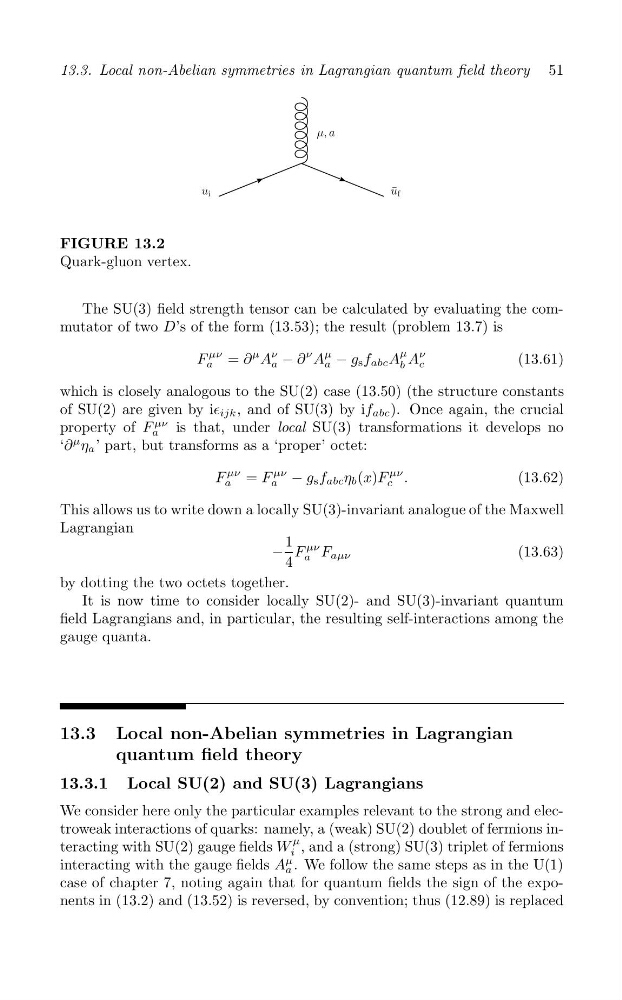
FIGURE 13.2
Quark-gluon vertex.
The SU(3) field strength tensor can be calculated by evaluating the commutator of two D’s of the form (13.53); the result (problem 13.7) is
F
μν
∂
μ A
ν
− ∂
ν A
μ
μ A
ν
=
− g s f abc A
(13.61)
a
a
a
b c
which is closely analogous to the SU(2) case (13.50) (the structure constants
of SU(2) are given by i∈ ijk , and of SU(3) by if abc ). Once again, the crucial
property of F
μν is that, under local SU(3) transformations it develops no
a
‘∂
μ η a ’ part, but transforms as a ‘proper’ octet:
F
μν
F
μν
a = a − g s f abc η b (x)F c
μν .
(13.62)
This allows us to write down a locally SU(3)-invariant analogue of the Maxwell
Lagrangian
1 F
μν
−
F aμν
(13.63)
a
4
by dotting the two octets together.
It is now time to consider locally SU(2)- and SU(3)-invariant quantum
field Lagrangians and, in particular, the resulting self-interactions among the
gauge quanta.
13.3 Local non-Abelian symmetries in Lagrangian
quantum field theory
13.3.1 Local SU(2) and SU(3) Lagrangians
We consider here only the particular examples relevant to the strong and electroweak interactions of quarks: namely, a (weak) SU(2) doublet of fermions inμ
teracting with SU(2) gauge fields W i , and a (strong) SU(3) triplet of fermions
interacting with the gauge fields A
μ . We follow the same steps as in the U(1)
a
case of chapter 7, noting again that for quantum fields the sign of the exponents in (13.2) and (13.52) is reversed, by convention; thus (12.89) is replaced
μ, a
u i
¯
u f
FIGURE 13.2
Quark-gluon vertex.
The SU(3) field strength tensor can be calculated by evaluating the commutator of two D’s of the form (13.53); the result (problem 13.7) is
F
μν
∂
μ A
ν
− ∂
ν A
μ
μ A
ν
=
− g s f abc A
(13.61)
a
a
a
b c
which is closely analogous to the SU(2) case (13.50) (the structure constants
of SU(2) are given by i∈ ijk , and of SU(3) by if abc ). Once again, the crucial
property of F
μν is that, under local SU(3) transformations it develops no
a
‘∂
μ η a ’ part, but transforms as a ‘proper’ octet:
F
μν
F
μν
a = a − g s f abc η b (x)F c
μν .
(13.62)
This allows us to write down a locally SU(3)-invariant analogue of the Maxwell
Lagrangian
1 F
μν
−
F aμν
(13.63)
a
4
by dotting the two octets together.
It is now time to consider locally SU(2)- and SU(3)-invariant quantum
field Lagrangians and, in particular, the resulting self-interactions among the
gauge quanta.
13.3 Local non-Abelian symmetries in Lagrangian
quantum field theory
13.3.1 Local SU(2) and SU(3) Lagrangians
We consider here only the particular examples relevant to the strong and electroweak interactions of quarks: namely, a (weak) SU(2) doublet of fermions inμ
teracting with SU(2) gauge fields W i , and a (strong) SU(3) triplet of fermions
interacting with the gauge fields A
μ . We follow the same steps as in the U(1)
a
case of chapter 7, noting again that for quantum fields the sign of the exponents in (13.2) and (13.52) is reversed, by convention; thus (12.89) is replaced