

45
13.1. Local SU(2) symmetry
1
2
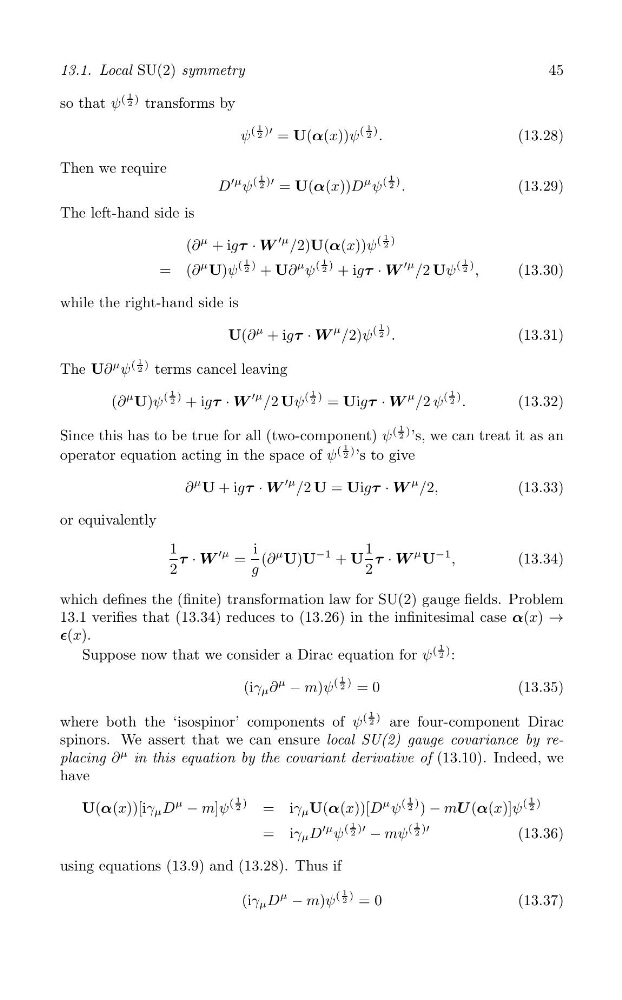
so that ψ
( ) transforms by
1
2
1
2
)′ = U(α(x))ψ
(
ψ
(
) .
(13.28)
Then we require
The left-hand side is
D
′μ ψ
(
1
2
1
2
)′ = U(α(x))D
μ ψ
( ) .
(13.29)
1
2
′μ
(∂
μ + igτ · W /2)U(α(x))ψ
( )
1
2
1
2
1
2
′μ /2 Uψ
(
= (∂
μ U)ψ
( ) + U∂
μ ψ
( ) + igτ
) ,
(13.30)
W
·
while the right-hand side is
1
2
U(∂
μ + igτ · W
μ /2)ψ
( ) .
(13.31)
1
2
The U∂
μ ψ
( ) terms cancel leaving
1
2
1
2
1
2
) + igτ · W
′μ /2 Uψ
(
W
μ
(∂
μ U)ψ
(
) = Uigτ
/2 ψ
( ) .
(13.32)
·
1
2
Since this has to be true for all (two-component) ψ
( ) ’s, we can treat it as an
1
2
operator equation acting in the space of ψ
( ) ’s to give
′μ
∂
μ U + igτ · W /2 U = Uigτ · W
μ /2,
(13.33)
or equivalently
1
i
1 W
μ U
−1
τ · W
′μ = (∂
μ U)U
−1 + U τ ·
,
(13.34)
2
g
2
which defines the (finite) transformation law for SU(2) gauge fields. Problem
13.1 verifies that (13.34) reduces to (13.26) in the infinitesimal case α(x) →
∊(x).
1
2
Suppose now that we consider a Dirac equation for ψ
( ) :
1
2
(iγ μ ∂
μ
− m)ψ
( ) = 0
(13.35)
1
2
where both the ‘isospinor’ components of ψ
( ) are four-component Dirac
spinors. We assert that we can ensure local SU(2) gauge covariance by replacing ∂
μ in this equation by the covariant derivative of (13.10). Indeed, we
have
1
2
1
2
1
2
U(α(x))[iγ μ D
μ
− m]ψ
( ) = iγ μ U(α(x))[D
μ ψ
( ) ) − mU (α(x)]ψ
( )
1
2
1
2
= iγ μ D
′μ ψ
( )′
− mψ
( )′
(13.36)
using equations (13.9) and (13.28). Thus if
(iγ μ D
μ
− m)ψ
(
1
2 ) = 0
(13.37)
13.1. Local SU(2) symmetry
1
2
so that ψ
( ) transforms by
1
2
1
2
)′ = U(α(x))ψ
(
ψ
(
) .
(13.28)
Then we require
The left-hand side is
D
′μ ψ
(
1
2
1
2
)′ = U(α(x))D
μ ψ
( ) .
(13.29)
1
2
′μ
(∂
μ + igτ · W /2)U(α(x))ψ
( )
1
2
1
2
1
2
′μ /2 Uψ
(
= (∂
μ U)ψ
( ) + U∂
μ ψ
( ) + igτ
) ,
(13.30)
W
·
while the right-hand side is
1
2
U(∂
μ + igτ · W
μ /2)ψ
( ) .
(13.31)
1
2
The U∂
μ ψ
( ) terms cancel leaving
1
2
1
2
1
2
) + igτ · W
′μ /2 Uψ
(
W
μ
(∂
μ U)ψ
(
) = Uigτ
/2 ψ
( ) .
(13.32)
·
1
2
Since this has to be true for all (two-component) ψ
( ) ’s, we can treat it as an
1
2
operator equation acting in the space of ψ
( ) ’s to give
′μ
∂
μ U + igτ · W /2 U = Uigτ · W
μ /2,
(13.33)
or equivalently
1
i
1 W
μ U
−1
τ · W
′μ = (∂
μ U)U
−1 + U τ ·
,
(13.34)
2
g
2
which defines the (finite) transformation law for SU(2) gauge fields. Problem
13.1 verifies that (13.34) reduces to (13.26) in the infinitesimal case α(x) →
∊(x).
1
2
Suppose now that we consider a Dirac equation for ψ
( ) :
1
2
(iγ μ ∂
μ
− m)ψ
( ) = 0
(13.35)
1
2
where both the ‘isospinor’ components of ψ
( ) are four-component Dirac
spinors. We assert that we can ensure local SU(2) gauge covariance by replacing ∂
μ in this equation by the covariant derivative of (13.10). Indeed, we
have
1
2
1
2
1
2
U(α(x))[iγ μ D
μ
− m]ψ
( ) = iγ μ U(α(x))[D
μ ψ
( ) ) − mU (α(x)]ψ
( )
1
2
1
2
= iγ μ D
′μ ψ
( )′
− mψ
( )′
(13.36)
using equations (13.9) and (13.28). Thus if
(iγ μ D
μ
− m)ψ
(
1
2 ) = 0
(13.37)