

43
13.1. Local SU(2) symmetry
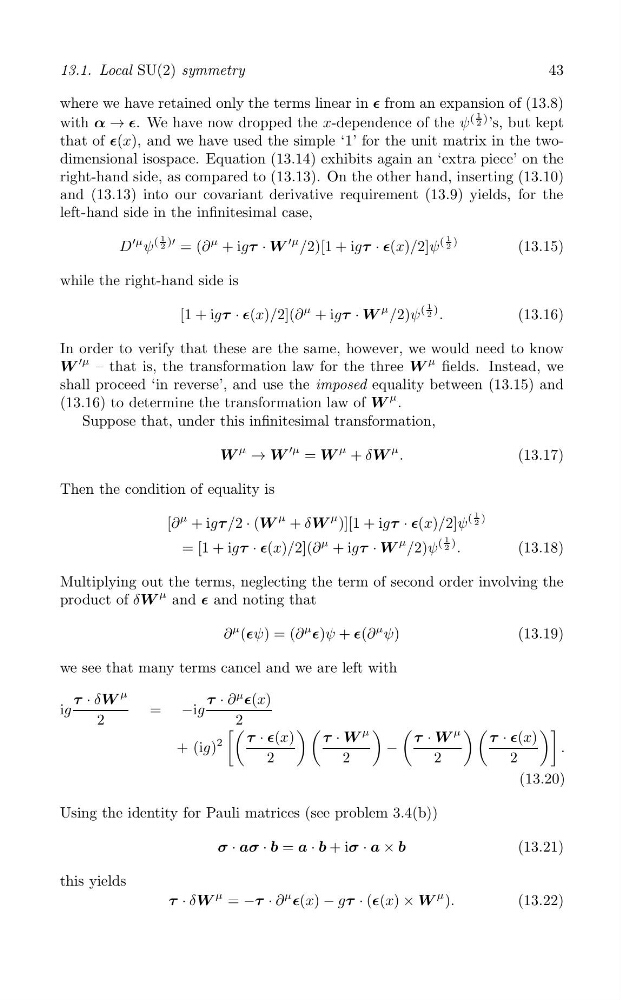
where we have retained only the terms linear in ∊ from an expansion of (13.8)
1
2
with α → ∊. We have now dropped the x-dependence of the ψ
( ) ’s, but kept
that of ∊(x), and we have used the simple ‘1’ for the unit matrix in the twodimensional isospace. Equation (13.14) exhibits again an ‘extra piece’ on the
right-hand side, as compared to (13.13). On the other hand, inserting (13.10)
and (13.13) into our covariant derivative requirement (13.9) yields, for the
left-hand side in the infinitesimal case,
1
2
1
2
′μ
D
′μ ψ
( )′ = (∂
μ + igτ
∊(x)/2]ψ
( )
(13.15)
· W /2)[1 + igτ ·
while the right-hand side is
1
2
∊(x)/2](∂
μ + igτ · W
μ /2)ψ
( ) .
(13.16)
[1 + igτ ·
In order to verify that these are the same, however, we would need to know
′μ
W – that is, the transformation law for the three W
μ fields. Instead, we
shall proceed ‘in reverse’, and use the imposed equality between (13.15) and
(13.16) to determine the transformation law of W
μ .
Suppose that, under this infinitesimal transformation,
′μ
W
μ
→ W = W
μ + δW
μ .
(13.17)
Then the condition of equality is
1
2
[∂
μ + igτ /2 · (W
μ + δW
μ )][1 + igτ · ∊(x)/2]ψ
( )
1
2
= [1 + igτ · ∊(x)/2](∂
μ + igτ · W
μ /2)ψ
( )
(13.18)
.
Multiplying out the terms, neglecting the term of second order involving the
product of δW
μ and ∊ and noting that
∂
μ (∊ψ) = (∂
μ
∊)ψ + ∊(∂
μ ψ)
(13.19)
we see that many terms cancel and we are left with
τ · δW
μ
τ · ∂
μ
∊(x)
ig
= −ig
2
2
+ (ig)
2
[( τ · ∊(x)
2
) ( τ W
·
2
μ )
−
( τ W
μ
·
2
) ( τ · ∊(x)
2
)]
.
(13.20)
Using the identity for Pauli matrices (see problem 3.4(b))
σ · aσ · b = a · b + iσ · a × b
(13.21)
this yields
τ · δW
μ = −τ · ∂
μ
∊(x) − gτ · (∊(x) × W
μ ).
(13.22)
13.1. Local SU(2) symmetry
where we have retained only the terms linear in ∊ from an expansion of (13.8)
1
2
with α → ∊. We have now dropped the x-dependence of the ψ
( ) ’s, but kept
that of ∊(x), and we have used the simple ‘1’ for the unit matrix in the twodimensional isospace. Equation (13.14) exhibits again an ‘extra piece’ on the
right-hand side, as compared to (13.13). On the other hand, inserting (13.10)
and (13.13) into our covariant derivative requirement (13.9) yields, for the
left-hand side in the infinitesimal case,
1
2
1
2
′μ
D
′μ ψ
( )′ = (∂
μ + igτ
∊(x)/2]ψ
( )
(13.15)
· W /2)[1 + igτ ·
while the right-hand side is
1
2
∊(x)/2](∂
μ + igτ · W
μ /2)ψ
( ) .
(13.16)
[1 + igτ ·
In order to verify that these are the same, however, we would need to know
′μ
W – that is, the transformation law for the three W
μ fields. Instead, we
shall proceed ‘in reverse’, and use the imposed equality between (13.15) and
(13.16) to determine the transformation law of W
μ .
Suppose that, under this infinitesimal transformation,
′μ
W
μ
→ W = W
μ + δW
μ .
(13.17)
Then the condition of equality is
1
2
[∂
μ + igτ /2 · (W
μ + δW
μ )][1 + igτ · ∊(x)/2]ψ
( )
1
2
= [1 + igτ · ∊(x)/2](∂
μ + igτ · W
μ /2)ψ
( )
(13.18)
.
Multiplying out the terms, neglecting the term of second order involving the
product of δW
μ and ∊ and noting that
∂
μ (∊ψ) = (∂
μ
∊)ψ + ∊(∂
μ ψ)
(13.19)
we see that many terms cancel and we are left with
τ · δW
μ
τ · ∂
μ
∊(x)
ig
= −ig
2
2
+ (ig)
2
[( τ · ∊(x)
2
) ( τ W
·
2
μ )
−
( τ W
μ
·
2
) ( τ · ∊(x)
2
)]
.
(13.20)
Using the identity for Pauli matrices (see problem 3.4(b))
σ · aσ · b = a · b + iσ · a × b
(13.21)
this yields
τ · δW
μ = −τ · ∂
μ
∊(x) − gτ · (∊(x) × W
μ ).
(13.22)