

34
12. Global Non-Abelian Symmetries
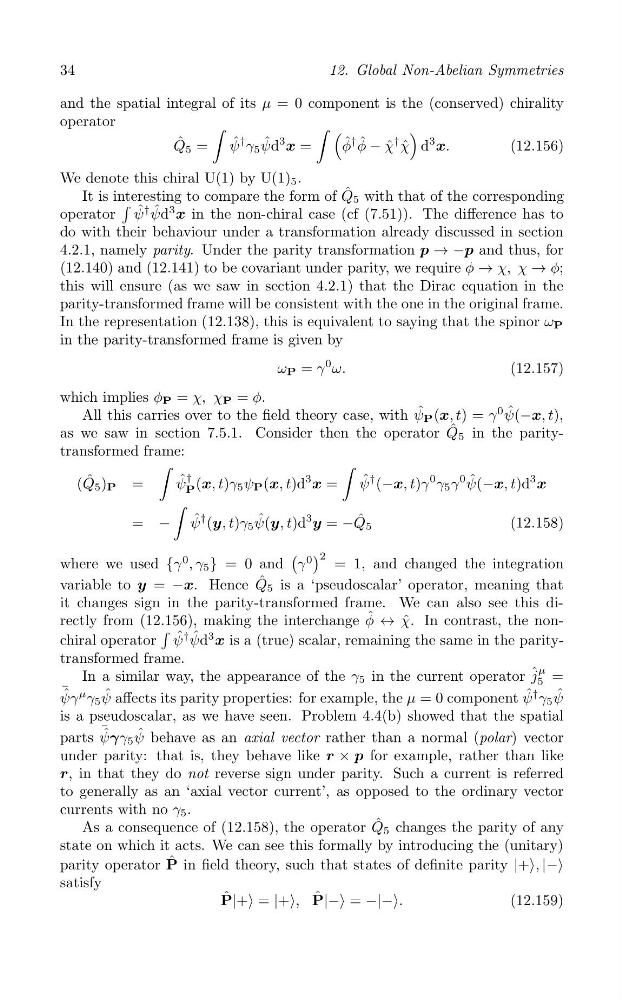
and the spatial integral of its μ = 0 component is the (conserved) chirality
operator
∫
∫ (
)
ˆ
ˆ
Q 5 = ψ
†
ˆ
ˆ ˆ
γ 5 ψd
3
x =
φ
† φ − χ ˆ
† χ ˆ d
3
x.
(12.156)
We denote this chiral U(1) by U(1) 5 .
ˆ
It is in ∫ teresting to compare the form of Q 5 with that of the corresponding
ˆ
operator ψ
† ˆ
ψd
3
x in the non-chiral case (cf (7.51)). The difference has to
do with their behaviour under a transformation already discussed in section
4.2.1, namely parity. Under the parity transformation p → −p and thus, for
(12.140) and (12.141) to be covariant under parity, we require φ → χ, χ → φ;
this will ensure (as we saw in section 4.2.1) that the Dirac equation in the
parity-transformed frame will be consistent with the one in the original frame.
In the representation (12.138), this is equivalent to saying that the spinor ω P
in the parity-transformed frame is given by
ω P = γ
0 ω.
(12.157)
which implies φ P = χ, χ P = φ.
ˆ
ˆ
All this carries over to the field theory case, with ψ P (x, t) = γ
0 ψ(−x, t),
ˆ
as we saw in section 7.5.1. Consider then the operator Q 5 in the paritytransformed frame:
∫
∫
ˆ
ˆ
(Q )
=
ψ
†
ˆ
(x, t)γ ψ (x, t)d
3
5 P
P
5 P
x = ψ
† (−
ˆ
x, t)γ
0 γ 5 γ
0 ψ(−x, t)d
3
x
∫
ˆ
ˆ
ˆ
= − ψ
† (y, t)γ 5 ψ(y, t)d
3
y = −Q 5
(12.158)
( ) 2
where we used {γ
0 , γ 5 } = 0 and γ
0
= 1, and changed the integration
ˆ
variable to y = −x. Hence Q 5 is a ‘pseudoscalar’ operator, meaning that
it changes sign in the parity-transformed frame. We can also see this diˆ
rectly from (12.
∫
156), making the interchange φ
χ ˆ. In contrast, the nonˆ† ˆ
↔
chiral operator ψ ψd
3
x is a (true) scalar, remaining the same in the paritytransformed frame.
μ
In a similar way, the appearance of the γ 5 in the current operator ˆ j 5 =
¯ ˆ μ ˆ
ˆ
ˆ
ψγ γ 5 ψ affects its parity properties: for example, the μ = 0 component ψ
† γ 5 ψ
is a pseudoscalar, as we have seen. Problem 4.4(b) showed that the spatial
¯ ˆ
ˆ
parts ψγγ 5 ψ behave as an axial vector rather than a normal (polar) vector
under parity: that is, they behave like r × p for example, rather than like
r, in that they do not reverse sign under parity. Such a current is referred
to generally as an ‘axial vector current’, as opposed to the ordinary vector
currents with no γ 5 .
ˆ
As a consequence of (12.158), the operator Q 5 changes the parity of any
state on which it acts. We can see this formally by introducing the (unitary)
ˆ
parity operator P in field theory, such that states of definite parity |+›, |−›
satisfy
ˆ | › | › ˆ
P + = + , P|−› = −|−›.
(12.159)
12. Global Non-Abelian Symmetries
and the spatial integral of its μ = 0 component is the (conserved) chirality
operator
∫
∫ (
)
ˆ
ˆ
Q 5 = ψ
†
ˆ
ˆ ˆ
γ 5 ψd
3
x =
φ
† φ − χ ˆ
† χ ˆ d
3
x.
(12.156)
We denote this chiral U(1) by U(1) 5 .
ˆ
It is in ∫ teresting to compare the form of Q 5 with that of the corresponding
ˆ
operator ψ
† ˆ
ψd
3
x in the non-chiral case (cf (7.51)). The difference has to
do with their behaviour under a transformation already discussed in section
4.2.1, namely parity. Under the parity transformation p → −p and thus, for
(12.140) and (12.141) to be covariant under parity, we require φ → χ, χ → φ;
this will ensure (as we saw in section 4.2.1) that the Dirac equation in the
parity-transformed frame will be consistent with the one in the original frame.
In the representation (12.138), this is equivalent to saying that the spinor ω P
in the parity-transformed frame is given by
ω P = γ
0 ω.
(12.157)
which implies φ P = χ, χ P = φ.
ˆ
ˆ
All this carries over to the field theory case, with ψ P (x, t) = γ
0 ψ(−x, t),
ˆ
as we saw in section 7.5.1. Consider then the operator Q 5 in the paritytransformed frame:
∫
∫
ˆ
ˆ
(Q )
=
ψ
†
ˆ
(x, t)γ ψ (x, t)d
3
5 P
P
5 P
x = ψ
† (−
ˆ
x, t)γ
0 γ 5 γ
0 ψ(−x, t)d
3
x
∫
ˆ
ˆ
ˆ
= − ψ
† (y, t)γ 5 ψ(y, t)d
3
y = −Q 5
(12.158)
( ) 2
where we used {γ
0 , γ 5 } = 0 and γ
0
= 1, and changed the integration
ˆ
variable to y = −x. Hence Q 5 is a ‘pseudoscalar’ operator, meaning that
it changes sign in the parity-transformed frame. We can also see this diˆ
rectly from (12.
∫
156), making the interchange φ
χ ˆ. In contrast, the nonˆ† ˆ
↔
chiral operator ψ ψd
3
x is a (true) scalar, remaining the same in the paritytransformed frame.
μ
In a similar way, the appearance of the γ 5 in the current operator ˆ j 5 =
¯ ˆ μ ˆ
ˆ
ˆ
ψγ γ 5 ψ affects its parity properties: for example, the μ = 0 component ψ
† γ 5 ψ
is a pseudoscalar, as we have seen. Problem 4.4(b) showed that the spatial
¯ ˆ
ˆ
parts ψγγ 5 ψ behave as an axial vector rather than a normal (polar) vector
under parity: that is, they behave like r × p for example, rather than like
r, in that they do not reverse sign under parity. Such a current is referred
to generally as an ‘axial vector current’, as opposed to the ordinary vector
currents with no γ 5 .
ˆ
As a consequence of (12.158), the operator Q 5 changes the parity of any
state on which it acts. We can see this formally by introducing the (unitary)
ˆ
parity operator P in field theory, such that states of definite parity |+›, |−›
satisfy
ˆ | › | › ˆ
P + = + , P|−› = −|−›.
(12.159)