

12.4. Non-Abelian global symmetries in Lagrangian quantum field theory 33
˜
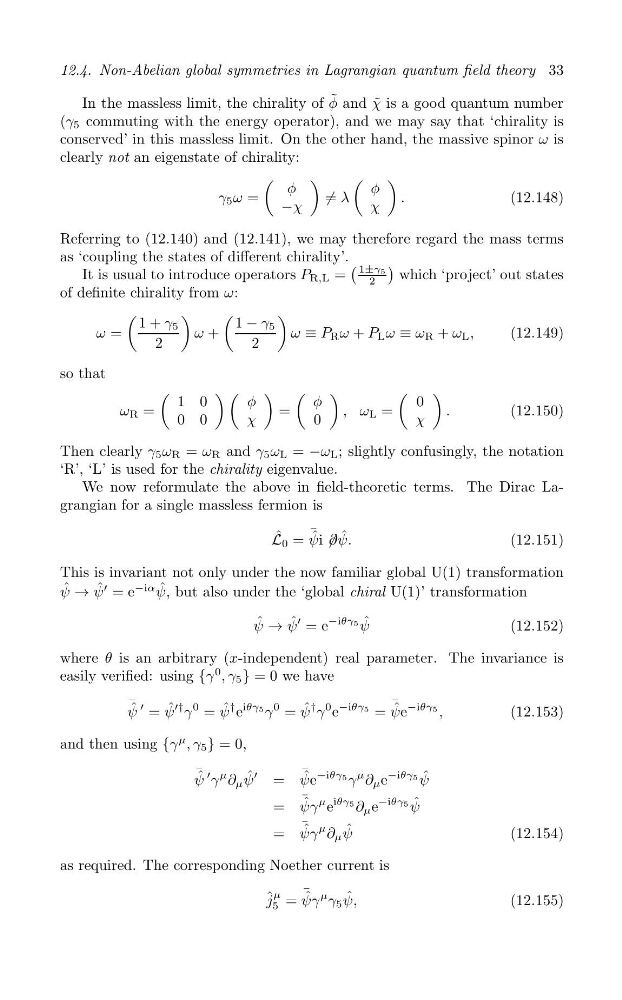
In the massless limit, the chirality of φ and χ ˜ is a good quantum number
(γ 5 commuting with the energy operator), and we may say that ‘chirality is
conserved’ in this massless limit. On the other hand, the massive spinor ω is
clearly not an eigenstate of chirality:
(
)
(
)
φ
φ
γ 5 ω =
= λ
.
(12.148)
−χ
χ
Referring to (12.140) and (12.141), we may therefore regard the mass terms
as ‘coupling the states of different chirality’. (
)
It is usual to introduce operators P
1
R L =
±γ5
,
which ‘project’ out states
2
of definite chirality from ω:
(
)
(
)
1 + γ 5
1
ω =
ω +
− γ 5 ω ≡ P R ω + P L ω
2
2
≡ ω R + ω L ,
(12.149)
so that
(
) (
) (
)
(
)
1 0
φ
φ
0
ω R =
=
, ω
0
L =
.
(12.150)
0 0
χ
χ
Then clearly γ 5 ω R = ω R and γ 5 ω L = −ω L ; slightly confusingly, the notation
‘R’, ‘L’ is used for the chirality eigenvalue.
We now reformulate the above in field-theoretic terms. The Dirac Lagrangian for a single massless fermion is
¯
L ˆ
ˆ ˆ
0 = ψi ∂ψ.
(12.151)
This is invariant not only under the now familiar global U(1) transformation
ˆ
ψ → ˆ
ψ
′ = e
−iα ˆ
ψ, but also under the ‘global chiral U(1)’ transformation
ˆ
ψ → ˆ
ψ
′
ˆ
= e
−iθγ5 ψ
(12.152)
where θ is an arbitrary (x-independent) real parameter. The invariance is
easily verified: using {γ
0 , γ 5 } = 0 we have
¯
¯
ˆ
ψ
′
ˆ
= ψ
′† 0
ˆ † iθγ5 0
ˆ † 0 −iθγ5
ˆ
γ = ψ e γ = ψ γ e
= ψe
−iθγ5 ,
(12.153)
and then using {γ
μ , γ 5 } = 0,
¯ ˆ
ψ
′ γ
μ
¯
ˆ
∂ μ ψ
′
ˆ
= ψe
−iθγ5 γ
μ
ˆ
∂ μ e
−iθγ5 ψ
¯ ˆ
= ψγ
μ e
iθγ5 ∂ μ e
−iθγ5 ˆ
ψ
¯ ˆ
ˆ
= ψγ
μ ∂ μ ψ
(12.154)
as required. The corresponding Noether current is
ˆ μ ¯ ˆ
j 5 = ψγ
μ
ˆ
γ 5 ψ,
(12.155)
/
/
˜
In the massless limit, the chirality of φ and χ ˜ is a good quantum number
(γ 5 commuting with the energy operator), and we may say that ‘chirality is
conserved’ in this massless limit. On the other hand, the massive spinor ω is
clearly not an eigenstate of chirality:
(
)
(
)
φ
φ
γ 5 ω =
= λ
.
(12.148)
−χ
χ
Referring to (12.140) and (12.141), we may therefore regard the mass terms
as ‘coupling the states of different chirality’. (
)
It is usual to introduce operators P
1
R L =
±γ5
,
which ‘project’ out states
2
of definite chirality from ω:
(
)
(
)
1 + γ 5
1
ω =
ω +
− γ 5 ω ≡ P R ω + P L ω
2
2
≡ ω R + ω L ,
(12.149)
so that
(
) (
) (
)
(
)
1 0
φ
φ
0
ω R =
=
, ω
0
L =
.
(12.150)
0 0
χ
χ
Then clearly γ 5 ω R = ω R and γ 5 ω L = −ω L ; slightly confusingly, the notation
‘R’, ‘L’ is used for the chirality eigenvalue.
We now reformulate the above in field-theoretic terms. The Dirac Lagrangian for a single massless fermion is
¯
L ˆ
ˆ ˆ
0 = ψi ∂ψ.
(12.151)
This is invariant not only under the now familiar global U(1) transformation
ˆ
ψ → ˆ
ψ
′ = e
−iα ˆ
ψ, but also under the ‘global chiral U(1)’ transformation
ˆ
ψ → ˆ
ψ
′
ˆ
= e
−iθγ5 ψ
(12.152)
where θ is an arbitrary (x-independent) real parameter. The invariance is
easily verified: using {γ
0 , γ 5 } = 0 we have
¯
¯
ˆ
ψ
′
ˆ
= ψ
′† 0
ˆ † iθγ5 0
ˆ † 0 −iθγ5
ˆ
γ = ψ e γ = ψ γ e
= ψe
−iθγ5 ,
(12.153)
and then using {γ
μ , γ 5 } = 0,
¯ ˆ
ψ
′ γ
μ
¯
ˆ
∂ μ ψ
′
ˆ
= ψe
−iθγ5 γ
μ
ˆ
∂ μ e
−iθγ5 ψ
¯ ˆ
= ψγ
μ e
iθγ5 ∂ μ e
−iθγ5 ˆ
ψ
¯ ˆ
ˆ
= ψγ
μ ∂ μ ψ
(12.154)
as required. The corresponding Noether current is
ˆ μ ¯ ˆ
j 5 = ψγ
μ
ˆ
γ 5 ψ,
(12.155)
/
/