

412
K. Example of a Cross Section Calculation
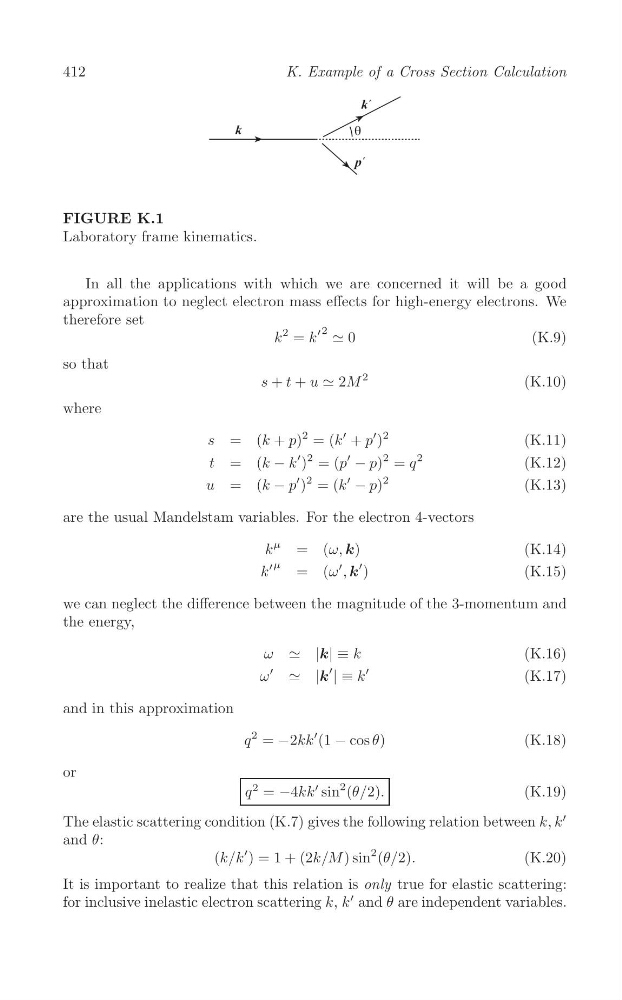
FIGURE K.1
Laboratory frame kinematics.
In all the applications with which we are concerned it will be a good
approximation to neglect electron mass effects for high-energy electrons. We
therefore set
k
2
k
′ 2
=
≃ 0
(K.9)
so that
s + t + u ≃ 2M
2
(K.10)
where
s = (k + p)
2 = (k
′ + p
′ )
2
(K.11)
′
2
t = (k − k
′ )
2 = (p − p)
2 = q
(K.12)
u = (k − p
′ )
2 = (k
′
− p)
2
(K.13)
are the usual Mandelstam variables. For the electron 4-vectors
k
μ = (ω, k)
(K.14)
k
′ μ = (ω
′ , k
′ )
(K.15)
we can neglect the difference between the magnitude of the 3-momentum and
the energy,
ω ≃ |k| ≡ k
(K.16)
ω
′
≃ |k
′
| ≡ k
′
(K.17)
and in this approximation
2
q = −2kk
′ (1 − cos θ)
(K.18)
or
2
q = −4kk
′ sin
2 (θ/2).
(K.19)
The elastic scattering condition (K.7) gives the following relation between k, k
′
and θ:
(k/k
′ ) = 1 + (2k/M ) sin
2 (θ/2).
(K.20)
It is important to realize that this relation is only true for elastic scattering:
for inclusive inelastic electron scattering k, k
′ and θ are independent variables.
K. Example of a Cross Section Calculation
FIGURE K.1
Laboratory frame kinematics.
In all the applications with which we are concerned it will be a good
approximation to neglect electron mass effects for high-energy electrons. We
therefore set
k
2
k
′ 2
=
≃ 0
(K.9)
so that
s + t + u ≃ 2M
2
(K.10)
where
s = (k + p)
2 = (k
′ + p
′ )
2
(K.11)
′
2
t = (k − k
′ )
2 = (p − p)
2 = q
(K.12)
u = (k − p
′ )
2 = (k
′
− p)
2
(K.13)
are the usual Mandelstam variables. For the electron 4-vectors
k
μ = (ω, k)
(K.14)
k
′ μ = (ω
′ , k
′ )
(K.15)
we can neglect the difference between the magnitude of the 3-momentum and
the energy,
ω ≃ |k| ≡ k
(K.16)
ω
′
≃ |k
′
| ≡ k
′
(K.17)
and in this approximation
2
q = −2kk
′ (1 − cos θ)
(K.18)
or
2
q = −4kk
′ sin
2 (θ/2).
(K.19)
The elastic scattering condition (K.7) gives the following relation between k, k
′
and θ:
(k/k
′ ) = 1 + (2k/M ) sin
2 (θ/2).
(K.20)
It is important to realize that this relation is only true for elastic scattering:
for inclusive inelastic electron scattering k, k
′ and θ are independent variables.