

402
H. Elements of Non-relativistic Scattering Theory
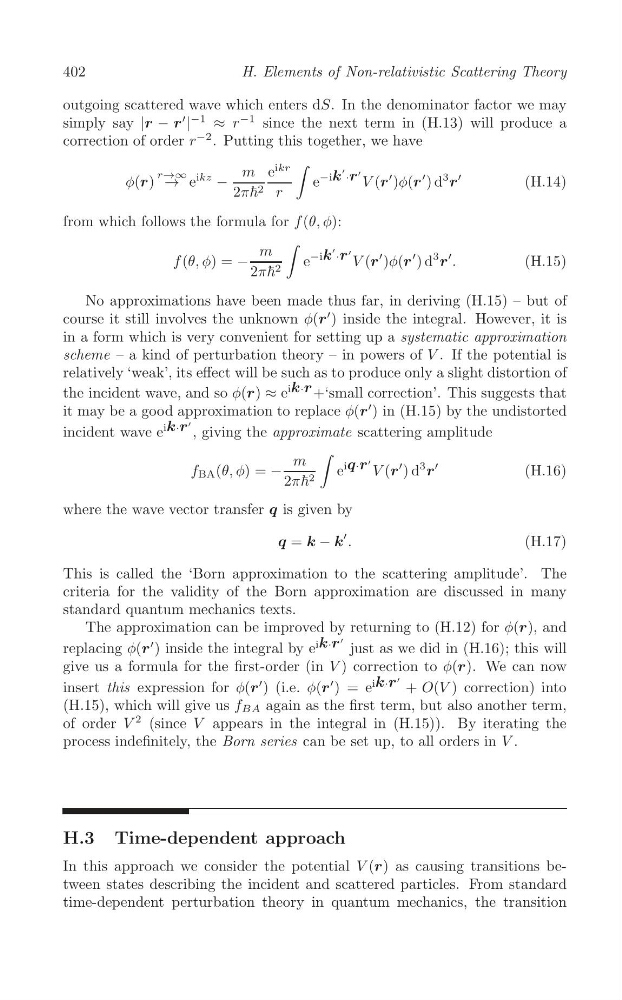
outgoing scattered wave which enters dS. In the denominator factor we may
simply say |r − r
′
|
−1
≈ r
−1 since the next term in (H.13) will produce a
correction of order r
−2 . Putting this together, we have
∫
ikr
m e
r→∞ ikz
−
−ik
' ·r
'
′
φ(r) → e
e
V (r
′ )φ(r
′ ) d
3
r
(H.14)
2πħ 2 r
from which follows the formula for f (θ, φ):
∫
m
−ik
' ·r
'
′
f (θ, φ) = −
e
V (r
′ )φ(r
′ ) d
3
r .
(H.15)
2πħ 2
No approximations have been made thus far, in deriving (H.15) – but of
course it still involves the unknown φ(r
′ ) inside the integral. However, it is
in a form which is very convenient for setting up a systematic approximation
scheme – a kind of perturbation theory – in powers of V . If the potential is
relatively ‘weak’, its effect will be such as to produce only a slight distortion of
the incident wave, and so φ(r) ≈ e
ik·r +‘small correction’. This suggests that
it may be a good approximation to replace φ(r
′ ) in (H.15) by the undistorted
incident wave e
ik·r
' , giving the approximate scattering amplitude
∫
m
iq·r
'
′
f BA (θ, φ) = −
e
V (r
′ ) d
3
r
(H.16)
2πħ 2
where the wave vector transfer q is given by
q = k − k
′ .
(H.17)
This is called the ‘Born approximation to the scattering amplitude’. The
criteria for the validity of the Born approximation are discussed in many
standard quantum mechanics texts.
The approximation can be improved by returning to (H.12) for φ(r), and
replacing φ(r
′ ) inside the integral by e
ik·r
' just as we did in (H.16); this will
give us a formula for the first-order (in V ) correction to φ(r). We can now
insert this expression for φ(r
′ ) (i.e. φ(r
′ ) = e
ik·r
' + O(V ) correction) into
(H.15), which will give us f BA again as the first term, but also another term,
of order V
2 (since V appears in the integral in (H.15)). By iterating the
process indefinitely, the Born series can be set up, to all orders in V .
H.3 Time-dependent approach
In this approach we consider the potential V (r) as causing transitions between states describing the incident and scattered particles. From standard
time-dependent perturbation theory in quantum mechanics, the transition
H. Elements of Non-relativistic Scattering Theory
outgoing scattered wave which enters dS. In the denominator factor we may
simply say |r − r
′
|
−1
≈ r
−1 since the next term in (H.13) will produce a
correction of order r
−2 . Putting this together, we have
∫
ikr
m e
r→∞ ikz
−
−ik
' ·r
'
′
φ(r) → e
e
V (r
′ )φ(r
′ ) d
3
r
(H.14)
2πħ 2 r
from which follows the formula for f (θ, φ):
∫
m
−ik
' ·r
'
′
f (θ, φ) = −
e
V (r
′ )φ(r
′ ) d
3
r .
(H.15)
2πħ 2
No approximations have been made thus far, in deriving (H.15) – but of
course it still involves the unknown φ(r
′ ) inside the integral. However, it is
in a form which is very convenient for setting up a systematic approximation
scheme – a kind of perturbation theory – in powers of V . If the potential is
relatively ‘weak’, its effect will be such as to produce only a slight distortion of
the incident wave, and so φ(r) ≈ e
ik·r +‘small correction’. This suggests that
it may be a good approximation to replace φ(r
′ ) in (H.15) by the undistorted
incident wave e
ik·r
' , giving the approximate scattering amplitude
∫
m
iq·r
'
′
f BA (θ, φ) = −
e
V (r
′ ) d
3
r
(H.16)
2πħ 2
where the wave vector transfer q is given by
q = k − k
′ .
(H.17)
This is called the ‘Born approximation to the scattering amplitude’. The
criteria for the validity of the Born approximation are discussed in many
standard quantum mechanics texts.
The approximation can be improved by returning to (H.12) for φ(r), and
replacing φ(r
′ ) inside the integral by e
ik·r
' just as we did in (H.16); this will
give us a formula for the first-order (in V ) correction to φ(r). We can now
insert this expression for φ(r
′ ) (i.e. φ(r
′ ) = e
ik·r
' + O(V ) correction) into
(H.15), which will give us f BA again as the first term, but also another term,
of order V
2 (since V appears in the integral in (H.15)). By iterating the
process indefinitely, the Born series can be set up, to all orders in V .
H.3 Time-dependent approach
In this approach we consider the potential V (r) as causing transitions between states describing the incident and scattered particles. From standard
time-dependent perturbation theory in quantum mechanics, the transition