

398
G. Green Functions
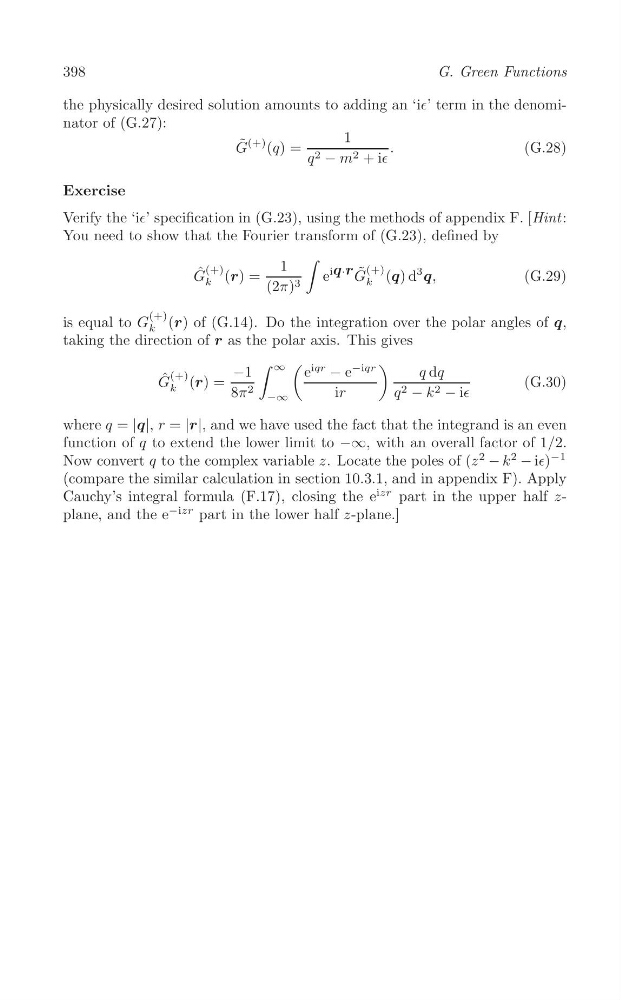
the physically desired solution amounts to adding an ‘i∈’ term in the denominator of (G.27):
G ˜ (+) (q) =
1
.
(G.28)
q 2 − m 2 + i∈
Exercise
Verify the ‘i∈’ specification in (G.23), using the methods of appendix F. [Hint :
You need to show that the Fourier transform of (G.23), defined by
∫
(+)
iq·r ˜ (+)
G ˆ (r) =
1
e
G (q) d
3
q,
(G.29)
k
k
(2π) 3
(+)
is equal to G (r) of (G.14). Do the integration over the polar angles of q,
k
taking the direction of r as the polar axis. This gives
∫
(
)
∞
iqr
−
−iqr
(+)
−1
e
e
q dq
ˆ
G (r) =
(G.30)
k
8π 2
ir
q 2 − k 2 − i∈
−∞
where q = |q|, r = |r|, and we have used the fact that the integrand is an even
function of q to extend the lower limit to −∞, with an overall factor of 1/2.
Now convert q to the complex variable z. Locate the poles of (z
2
− k
2
− i∈)
−1
(compare the similar calculation in section 10.3.1, and in appendix F). Apply
Cauchy’s integral formula (F.17), closing the e
izr part in the upper half zplane, and the e
−izr part in the lower half z-plane.]
G. Green Functions
the physically desired solution amounts to adding an ‘i∈’ term in the denominator of (G.27):
G ˜ (+) (q) =
1
.
(G.28)
q 2 − m 2 + i∈
Exercise
Verify the ‘i∈’ specification in (G.23), using the methods of appendix F. [Hint :
You need to show that the Fourier transform of (G.23), defined by
∫
(+)
iq·r ˜ (+)
G ˆ (r) =
1
e
G (q) d
3
q,
(G.29)
k
k
(2π) 3
(+)
is equal to G (r) of (G.14). Do the integration over the polar angles of q,
k
taking the direction of r as the polar axis. This gives
∫
(
)
∞
iqr
−
−iqr
(+)
−1
e
e
q dq
ˆ
G (r) =
(G.30)
k
8π 2
ir
q 2 − k 2 − i∈
−∞
where q = |q|, r = |r|, and we have used the fact that the integrand is an even
function of q to extend the lower limit to −∞, with an overall factor of 1/2.
Now convert q to the complex variable z. Locate the poles of (z
2
− k
2
− i∈)
−1
(compare the similar calculation in section 10.3.1, and in appendix F). Apply
Cauchy’s integral formula (F.17), closing the e
izr part in the upper half zplane, and the e
−izr part in the lower half z-plane.]