

385
E. Dirac δ-Function
Exercise
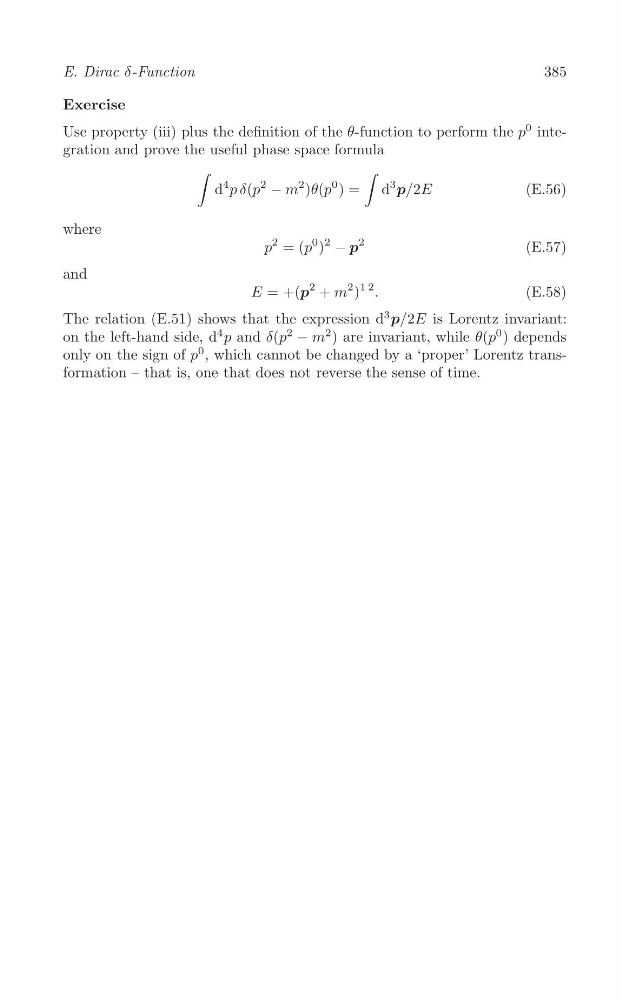
Use property (iii) plus the definition of the θ-function to perform the p
0 integration and prove the useful phase space formula
∫
∫
d
4 p δ(p
2
− m
2 )θ(p
0 ) = d
3
p/2E
(E.56)
where
2
p
2 = (p
0 )
2
− p
(E.57)
and
2
2 )
1 2
E = +(p + m
.
(E.58)
The relation (E.51) shows that the expression d
3
p/2E is Lorentz invariant:
on the left-hand side, d
4 p and δ(p
2
− m
2 ) are invariant, while θ(p
0 ) depends
only on the sign of p
0 , which cannot be changed by a ‘proper’ Lorentz transformation – that is, one that does not reverse the sense of time.
E. Dirac δ-Function
Exercise
Use property (iii) plus the definition of the θ-function to perform the p
0 integration and prove the useful phase space formula
∫
∫
d
4 p δ(p
2
− m
2 )θ(p
0 ) = d
3
p/2E
(E.56)
where
2
p
2 = (p
0 )
2
− p
(E.57)
and
2
2 )
1 2
E = +(p + m
.
(E.58)
The relation (E.51) shows that the expression d
3
p/2E is Lorentz invariant:
on the left-hand side, d
4 p and δ(p
2
− m
2 ) are invariant, while θ(p
0 ) depends
only on the sign of p
0 , which cannot be changed by a ‘proper’ Lorentz transformation – that is, one that does not reverse the sense of time.