

384
E. Dirac δ-Function
∫ ∞
(v)
f (x)δ
′ (x) dx = −f
′ (0)
(E.45)
−∞
where
′ (x
d
δ ) =
δ(x).
(E.46)
dx
Proof
∫
∫
∞
∞
f (x)δ
′ (x) dx = −
f
′ (x)δ(x) dx + [f (x)δ(x)]
∞
−∞
−∞
−∞
= −f
′ (0)
(E.47)
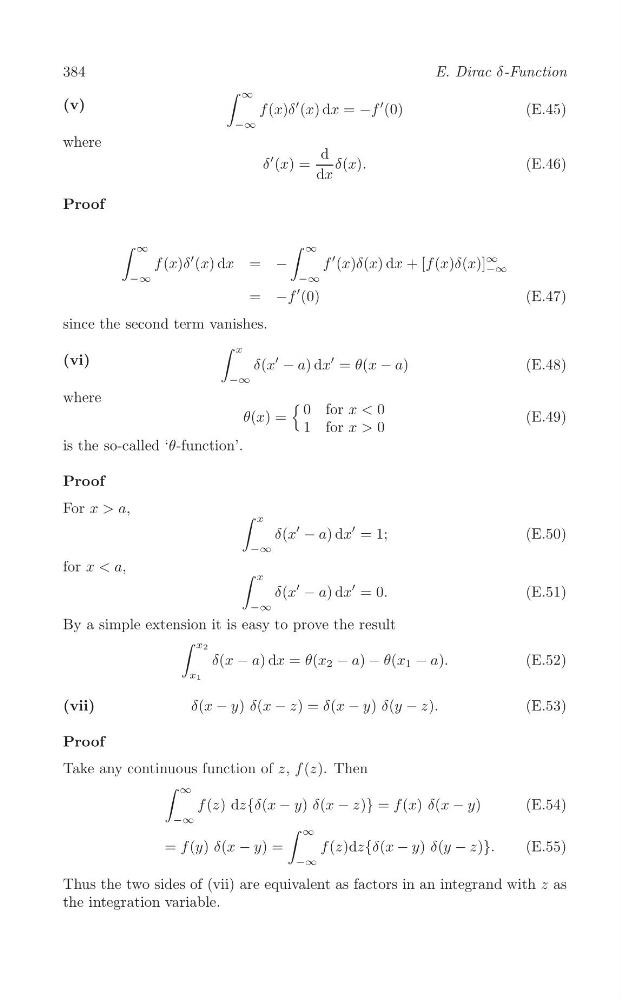
since the second term vanishes.
∫ x
(vi)
′
′
δ(x − a) dx = θ(x − a)
(E.48)
−∞
where
{ 0 for x < 0
θ(x) =
(E.49)
1 for x > 0
is the so-called ‘θ-function’.
Proof
For x > a,
∫ x
′
′
δ(x − a) dx = 1;
(E.50)
−∞
for x < a,
∫ x
′
′
δ(x − a) dx = 0.
(E.51)
−∞
By a simple extension it is easy to prove the result
∫ x2
δ(x − a) dx = θ(x 2 − a) − θ(x 1 − a).
(E.52)
x1
(vii)
δ(x − y) δ(x − z) = δ(x − y) δ(y − z).
(E.53)
Proof
Take any continuous function of z, f (z). Then
∫ ∞
f (z) dz{δ(x − y) δ(x − z)} = f (x) δ(x − y)
(E.54)
−∞
∫ ∞
= f (y) δ(x − y) =
f (z)dz{δ(x − y) δ(y − z)}.
(E.55)
−∞
Thus the two sides of (vii) are equivalent as factors in an integrand with z as
the integration variable.
E. Dirac δ-Function
∫ ∞
(v)
f (x)δ
′ (x) dx = −f
′ (0)
(E.45)
−∞
where
′ (x
d
δ ) =
δ(x).
(E.46)
dx
Proof
∫
∫
∞
∞
f (x)δ
′ (x) dx = −
f
′ (x)δ(x) dx + [f (x)δ(x)]
∞
−∞
−∞
−∞
= −f
′ (0)
(E.47)
since the second term vanishes.
∫ x
(vi)
′
′
δ(x − a) dx = θ(x − a)
(E.48)
−∞
where
{ 0 for x < 0
θ(x) =
(E.49)
1 for x > 0
is the so-called ‘θ-function’.
Proof
For x > a,
∫ x
′
′
δ(x − a) dx = 1;
(E.50)
−∞
for x < a,
∫ x
′
′
δ(x − a) dx = 0.
(E.51)
−∞
By a simple extension it is easy to prove the result
∫ x2
δ(x − a) dx = θ(x 2 − a) − θ(x 1 − a).
(E.52)
x1
(vii)
δ(x − y) δ(x − z) = δ(x − y) δ(y − z).
(E.53)
Proof
Take any continuous function of z, f (z). Then
∫ ∞
f (z) dz{δ(x − y) δ(x − z)} = f (x) δ(x − y)
(E.54)
−∞
∫ ∞
= f (y) δ(x − y) =
f (z)dz{δ(x − y) δ(y − z)}.
(E.55)
−∞
Thus the two sides of (vii) are equivalent as factors in an integrand with z as
the integration variable.