

380
E. Dirac δ-Function
Resum´ e of Fourier series and Fourier transforms
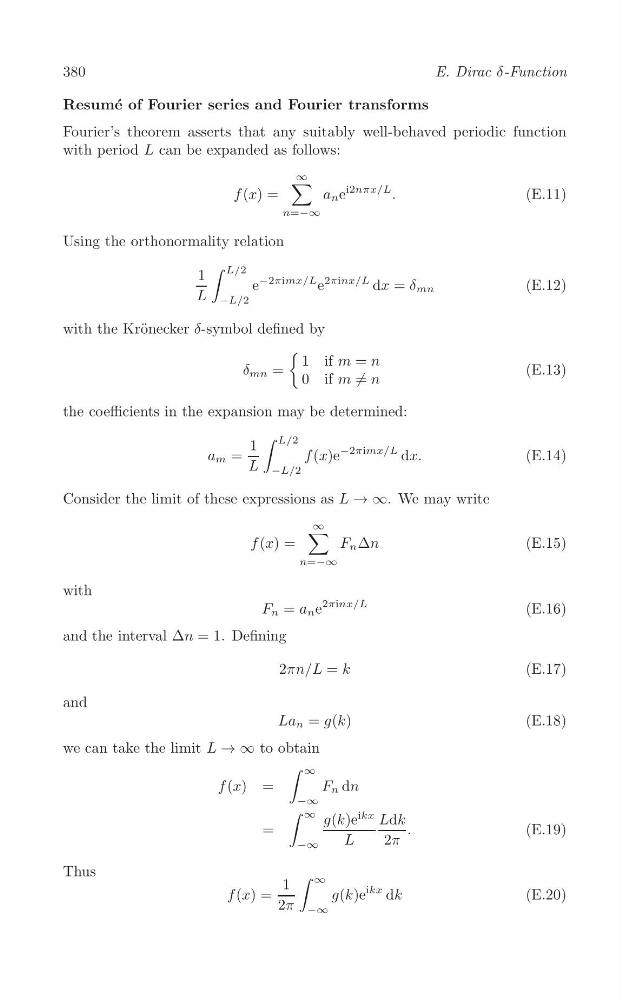
Fourier’s theorem asserts that any suitably well-behaved periodic function
with period L can be expanded as follows:
∞
∑
i2nπx/L
f (x) =
a n e
.
(E.11)
n=−∞
Using the orthonormality relation
∫ L/2
1
−2πimx/L 2πinx/L dx
e
e
= δ mn
(E.12)
L −L/2
with the Kr¨ onecker δ-symbol defined by
(
1 if m = n
δ mn =
(E.13)
0 if m / n
=
the coefficients in the expansion may be determined:
∫ L/2
1
f (x)e
−2πimx/L dx.
a m =
(E.14)
L −L/2
Consider the limit of these expressions as L → ∞. We may write
∞
∑
f (x) =
F n Δn
(E.15)
n=−∞
with
2πinx/L
F n = a n e
(E.16)
and the interval Δn = 1. Defining
2πn/L = k
(E.17)
and
La n = g(k)
(E.18)
we can take the limit L → ∞ to obtain
∫ ∞
f (x) =
F n dn
−∞
∫ ∞ g(k)e
ikx Ldk
=
.
(E.19)
L
2π
−∞
Thus
∫ ∞
f (x) =
1
g(k)e
ikx dk
(E.20)
2π −∞
E. Dirac δ-Function
Resum´ e of Fourier series and Fourier transforms
Fourier’s theorem asserts that any suitably well-behaved periodic function
with period L can be expanded as follows:
∞
∑
i2nπx/L
f (x) =
a n e
.
(E.11)
n=−∞
Using the orthonormality relation
∫ L/2
1
−2πimx/L 2πinx/L dx
e
e
= δ mn
(E.12)
L −L/2
with the Kr¨ onecker δ-symbol defined by
(
1 if m = n
δ mn =
(E.13)
0 if m / n
=
the coefficients in the expansion may be determined:
∫ L/2
1
f (x)e
−2πimx/L dx.
a m =
(E.14)
L −L/2
Consider the limit of these expressions as L → ∞. We may write
∞
∑
f (x) =
F n Δn
(E.15)
n=−∞
with
2πinx/L
F n = a n e
(E.16)
and the interval Δn = 1. Defining
2πn/L = k
(E.17)
and
La n = g(k)
(E.18)
we can take the limit L → ∞ to obtain
∫ ∞
f (x) =
F n dn
−∞
∫ ∞ g(k)e
ikx Ldk
=
.
(E.19)
L
2π
−∞
Thus
∫ ∞
f (x) =
1
g(k)e
ikx dk
(E.20)
2π −∞