

363
A. Non-relativistic Quantum Mechanics
Time-dependent perturbation theory:
H ˆ = H ˆ 0 + V ˆ
(A.19)
∂ψ
ˆ
Hψ = i
.
(A.20)
∂t
Unperturbed problem:
ˆ
H 0 u n = E n u n .
(A.21)
Completeness:
∑
ψ(x, t) =
a n (t)u n (x)e
−iEnt .
(A.22)
n
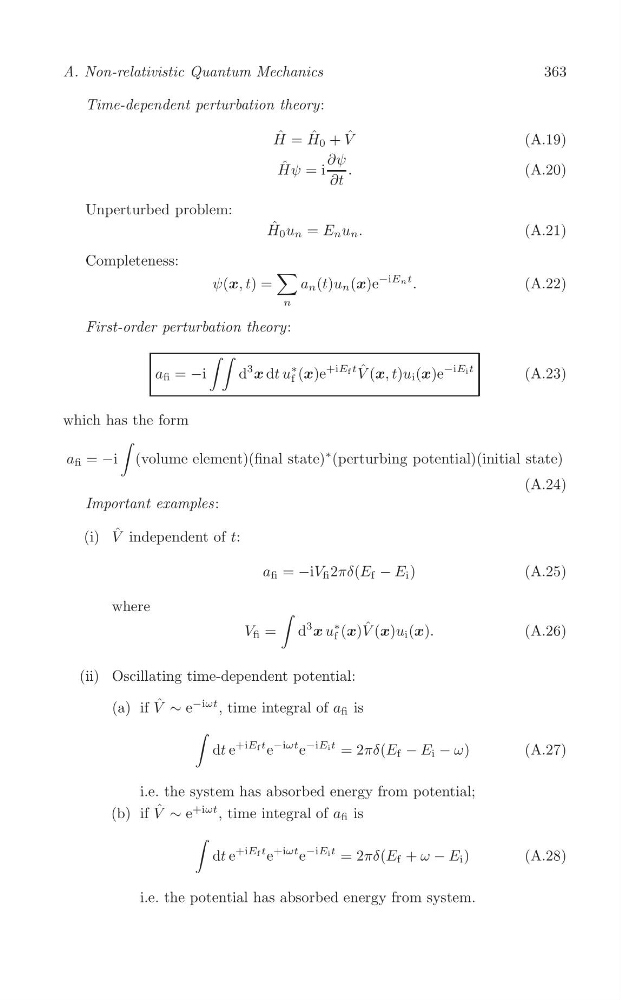
First-order perturbation theory:
∫ ∫
∗
a fi = −i
d
3
x dt u f (x)e
+iE f t V ˆ (x, t)u i (x)e
−iEit
(A.23)
which has the form
∫
a fi = −i (volume element)(final state)
∗ (perturbing potential)(initial state)
(A.24)
Important examples:
ˆ
(i) V independent of t:
a fi = −iV fi 2πδ(E f − E i )
(A.25)
where
∫
∗
V fi = d
3
x u f (x)V ˆ (x)u i (x).
(A.26)
(ii) Oscillating time-dependent potential:
(a) if V ˆ ∼ e
−iωt , time integral of a fi is
∫
+iE f t −iωt
dt e
e
e
−iEit = 2πδ(E f − E i − ω)
(A.27)
i.e. the system has absorbed energy from potential;
(b) if V ˆ ∼ e
+iωt , time integral of a fi is
∫
+iE f t +iωt
dt e
e
e
−iEit = 2πδ(E f + ω − E i )
(A.28)
i.e. the potential has absorbed energy from system.
A. Non-relativistic Quantum Mechanics
Time-dependent perturbation theory:
H ˆ = H ˆ 0 + V ˆ
(A.19)
∂ψ
ˆ
Hψ = i
.
(A.20)
∂t
Unperturbed problem:
ˆ
H 0 u n = E n u n .
(A.21)
Completeness:
∑
ψ(x, t) =
a n (t)u n (x)e
−iEnt .
(A.22)
n
First-order perturbation theory:
∫ ∫
∗
a fi = −i
d
3
x dt u f (x)e
+iE f t V ˆ (x, t)u i (x)e
−iEit
(A.23)
which has the form
∫
a fi = −i (volume element)(final state)
∗ (perturbing potential)(initial state)
(A.24)
Important examples:
ˆ
(i) V independent of t:
a fi = −iV fi 2πδ(E f − E i )
(A.25)
where
∫
∗
V fi = d
3
x u f (x)V ˆ (x)u i (x).
(A.26)
(ii) Oscillating time-dependent potential:
(a) if V ˆ ∼ e
−iωt , time integral of a fi is
∫
+iE f t −iωt
dt e
e
e
−iEit = 2πδ(E f − E i − ω)
(A.27)
i.e. the system has absorbed energy from potential;
(b) if V ˆ ∼ e
+iωt , time integral of a fi is
∫
+iE f t +iωt
dt e
e
e
−iEit = 2πδ(E f + ω − E i )
(A.28)
i.e. the potential has absorbed energy from system.