

352
11. Loops and Renormalization II: QED
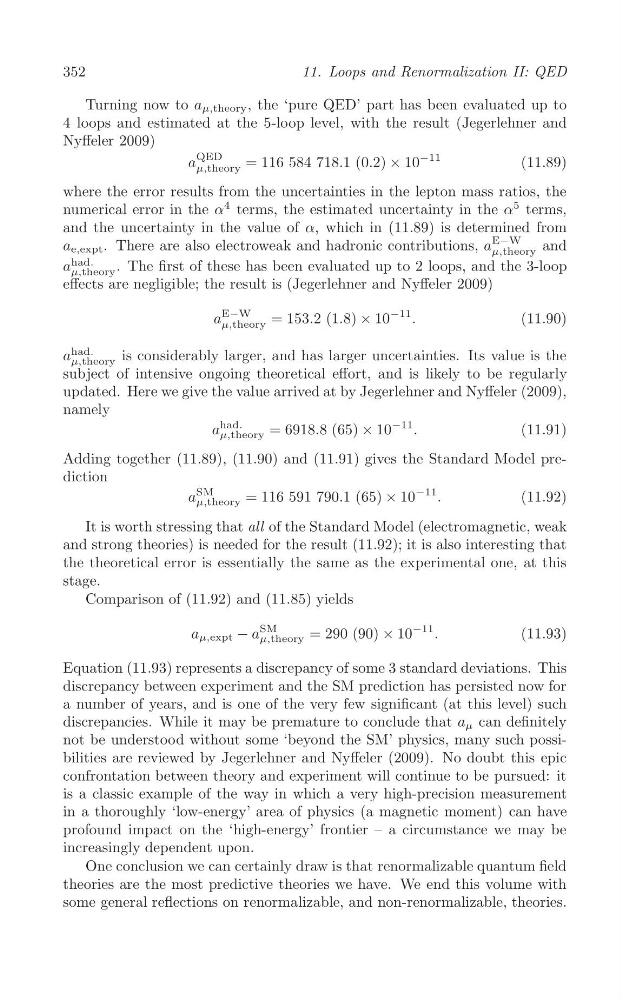
Turning now to a μ,theory , the ‘pure QED’ part has been evaluated up to
4 loops and estimated at the 5-loop level, with the result (Jegerlehner and
Nyffeler 2009)
QED
a
= 116 584 718.1 (0.2) × 10
−11
(11.89)
μ,theory
where the error results from the uncertainties in the lepton mass ratios, the
numerical error in the α
4 terms, the estimated uncertainty in the α
5 terms,
and the uncertainty in the value of α, which in (11.89) is determined from
E−W
a e,expt . There are also electroweak and hadronic contributions, a
and
μ,theory
had.
a
. The first of these has been evaluated up to 2 loops, and the 3-loop
μ,theory
effects are negligible; the result is (Jegerlehner and Nyffeler 2009)
E−W
a
= 153.2 (1.8) × 10
−11 .
(11.90)
μ,theory
had.
a
is considerably larger, and has larger uncertainties. Its value is the
μ,theory
subject of intensive ongoing theoretical effort, and is likely to be regularly
updated. Here we give the value arrived at by Jegerlehner and Nyffeler (2009),
namely
had.
a μ,theory = 6918.8 (65) × 10
−11 .
(11.91)
Adding together (11.89), (11.90) and (11.91) gives the Standard Model prediction
SM
a μ,theory = 116 591 790.1 (65) × 10
−11 .
(11.92)
It is worth stressing that all of the Standard Model (electromagnetic, weak
and strong theories) is needed for the result (11.92); it is also interesting that
the theoretical error is essentially the same as the experimental one, at this
stage.
Comparison of (11.92) and (11.85) yields
SM
a μ,expt − a μ,theory = 290 (90) × 10
−11 .
(11.93)
Equation (11.93) represents a discrepancy of some 3 standard deviations. This
discrepancy between experiment and the SM prediction has persisted now for
a number of years, and is one of the very few significant (at this level) such
discrepancies. While it may be premature to conclude that a μ can definitely
not be understood without some ‘beyond the SM’ physics, many such possibilities are reviewed by Jegerlehner and Nyffeler (2009). No doubt this epic
confrontation between theory and experiment will continue to be pursued: it
is a classic example of the way in which a very high-precision measurement
in a thoroughly ‘low-energy’ area of physics (a magnetic moment) can have
profound impact on the ‘high-energy’ frontier – a circumstance we may be
increasingly dependent upon.
One conclusion we can certainly draw is that renormalizable quantum field
theories are the most predictive theories we have. We end this volume with
some general reflections on renormalizable, and non-renormalizable, theories.
11. Loops and Renormalization II: QED
Turning now to a μ,theory , the ‘pure QED’ part has been evaluated up to
4 loops and estimated at the 5-loop level, with the result (Jegerlehner and
Nyffeler 2009)
QED
a
= 116 584 718.1 (0.2) × 10
−11
(11.89)
μ,theory
where the error results from the uncertainties in the lepton mass ratios, the
numerical error in the α
4 terms, the estimated uncertainty in the α
5 terms,
and the uncertainty in the value of α, which in (11.89) is determined from
E−W
a e,expt . There are also electroweak and hadronic contributions, a
and
μ,theory
had.
a
. The first of these has been evaluated up to 2 loops, and the 3-loop
μ,theory
effects are negligible; the result is (Jegerlehner and Nyffeler 2009)
E−W
a
= 153.2 (1.8) × 10
−11 .
(11.90)
μ,theory
had.
a
is considerably larger, and has larger uncertainties. Its value is the
μ,theory
subject of intensive ongoing theoretical effort, and is likely to be regularly
updated. Here we give the value arrived at by Jegerlehner and Nyffeler (2009),
namely
had.
a μ,theory = 6918.8 (65) × 10
−11 .
(11.91)
Adding together (11.89), (11.90) and (11.91) gives the Standard Model prediction
SM
a μ,theory = 116 591 790.1 (65) × 10
−11 .
(11.92)
It is worth stressing that all of the Standard Model (electromagnetic, weak
and strong theories) is needed for the result (11.92); it is also interesting that
the theoretical error is essentially the same as the experimental one, at this
stage.
Comparison of (11.92) and (11.85) yields
SM
a μ,expt − a μ,theory = 290 (90) × 10
−11 .
(11.93)
Equation (11.93) represents a discrepancy of some 3 standard deviations. This
discrepancy between experiment and the SM prediction has persisted now for
a number of years, and is one of the very few significant (at this level) such
discrepancies. While it may be premature to conclude that a μ can definitely
not be understood without some ‘beyond the SM’ physics, many such possibilities are reviewed by Jegerlehner and Nyffeler (2009). No doubt this epic
confrontation between theory and experiment will continue to be pursued: it
is a classic example of the way in which a very high-precision measurement
in a thoroughly ‘low-energy’ area of physics (a magnetic moment) can have
profound impact on the ‘high-energy’ frontier – a circumstance we may be
increasingly dependent upon.
One conclusion we can certainly draw is that renormalizable quantum field
theories are the most predictive theories we have. We end this volume with
some general reflections on renormalizable, and non-renormalizable, theories.