

351
11.7. The anomalous magnetic moment and tests of QED
e
e
Z
0
γ
(a)
(b)
e
e
hadronic
γ
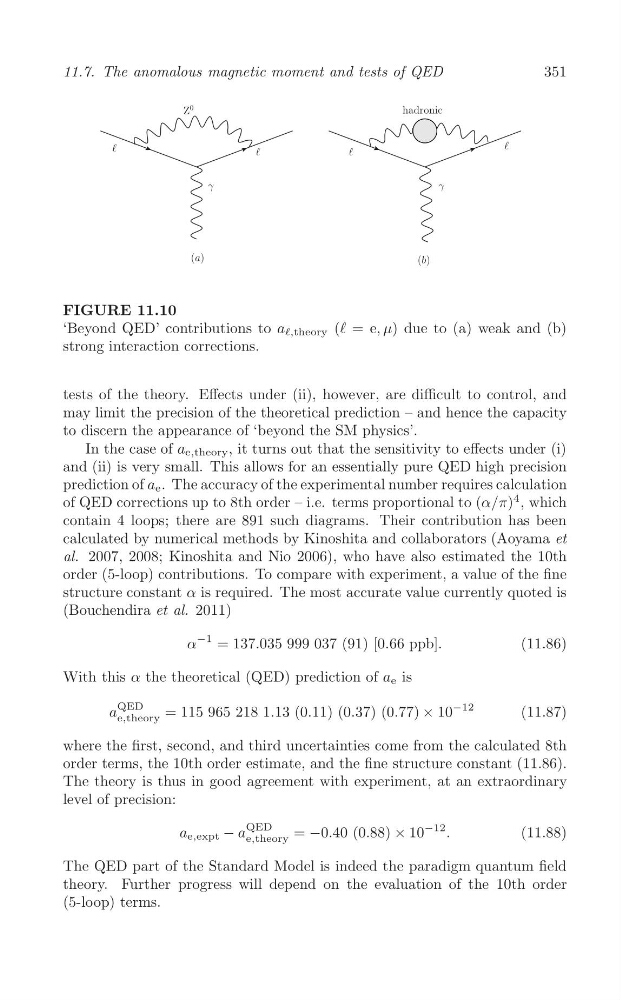
FIGURE 11.10
‘Beyond QED’ contributions to a e,theory (e = e, μ) due to (a) weak and (b)
strong interaction corrections.
tests of the theory. Effects under (ii), however, are difficult to control, and
may limit the precision of the theoretical prediction – and hence the capacity
to discern the appearance of ‘beyond the SM physics’.
In the case of a e,theory , it turns out that the sensitivity to effects under (i)
and (ii) is very small. This allows for an essentially pure QED high precision
prediction of a e . The accuracy of the experimental number requires calculation
of QED corrections up to 8th order – i.e. terms proportional to (α/π)
4 , which
contain 4 loops; there are 891 such diagrams. Their contribution has been
calculated by numerical methods by Kinoshita and collaborators (Aoyama et
al. 2007, 2008; Kinoshita and Nio 2006), who have also estimated the 10th
order (5-loop) contributions. To compare with experiment, a value of the fine
structure constant α is required. The most accurate value currently quoted is
(Bouchendira et al. 2011)
α
−1 = 137.035 999 037 (91) [0.66 ppb].
(11.86)
With this α the theoretical (QED) prediction of a e is
QED
a
= 115 965 218 1.13 (0.11) (0.37) (0.77) × 10
−12
(11.87)
e,theory
where the first, second, and third uncertainties come from the calculated 8th
order terms, the 10th order estimate, and the fine structure constant (11.86).
The theory is thus in good agreement with experiment, at an extraordinary
level of precision:
QED
a e,expt − a
= −0.40 (0.88) × 10
−12 .
(11.88)
e,theory
The QED part of the Standard Model is indeed the paradigm quantum field
theory. Further progress will depend on the evaluation of the 10th order
(5-loop) terms.
11.7. The anomalous magnetic moment and tests of QED
e
e
Z
0
γ
(a)
(b)
e
e
hadronic
γ
FIGURE 11.10
‘Beyond QED’ contributions to a e,theory (e = e, μ) due to (a) weak and (b)
strong interaction corrections.
tests of the theory. Effects under (ii), however, are difficult to control, and
may limit the precision of the theoretical prediction – and hence the capacity
to discern the appearance of ‘beyond the SM physics’.
In the case of a e,theory , it turns out that the sensitivity to effects under (i)
and (ii) is very small. This allows for an essentially pure QED high precision
prediction of a e . The accuracy of the experimental number requires calculation
of QED corrections up to 8th order – i.e. terms proportional to (α/π)
4 , which
contain 4 loops; there are 891 such diagrams. Their contribution has been
calculated by numerical methods by Kinoshita and collaborators (Aoyama et
al. 2007, 2008; Kinoshita and Nio 2006), who have also estimated the 10th
order (5-loop) contributions. To compare with experiment, a value of the fine
structure constant α is required. The most accurate value currently quoted is
(Bouchendira et al. 2011)
α
−1 = 137.035 999 037 (91) [0.66 ppb].
(11.86)
With this α the theoretical (QED) prediction of a e is
QED
a
= 115 965 218 1.13 (0.11) (0.37) (0.77) × 10
−12
(11.87)
e,theory
where the first, second, and third uncertainties come from the calculated 8th
order terms, the 10th order estimate, and the fine structure constant (11.86).
The theory is thus in good agreement with experiment, at an extraordinary
level of precision:
QED
a e,expt − a
= −0.40 (0.88) × 10
−12 .
(11.88)
e,theory
The QED part of the Standard Model is indeed the paradigm quantum field
theory. Further progress will depend on the evaluation of the 10th order
(5-loop) terms.