

11.6. The O(e
2 ) vertex correction, and Z 1 = Z 2
347
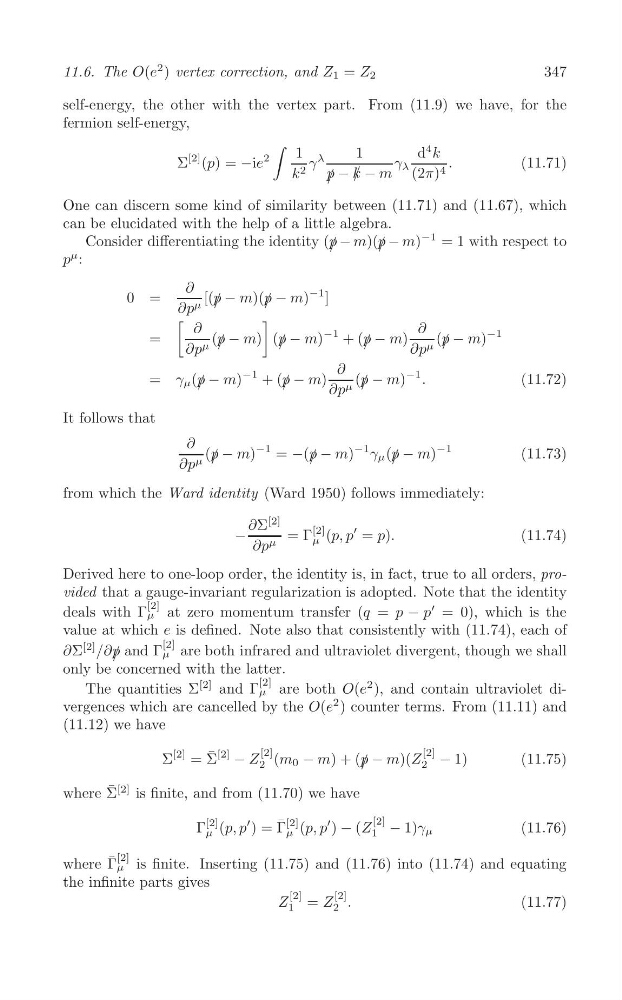
self-energy, the other with the vertex part. From (11.9) we have, for the
fermion self-energy,
∫
[2]
2
1
4
λ
k
Σ (p
−
1
d
) = ie
γ
γ
.
(11.71)
k 2 p / − k / −
λ
m (2π) 4
One can discern some kind of similarity between (11.71) and (11.67), which
can be elucidated with the help of a little algebra.
Consider differentiating the identity (p − m)( / p − m)
−1
/
= 1 with respect to
p
μ :
∂
0 =
[(p −
)
−1
/ m)(p / − m ]
∂p μ
[
]
∂
∂
=
( / p − m) (p
μ
/
∂p
−
−
−
m
1
) + (p / − m)
( / p m)
−1
∂p μ
∂
= γ ( / p − m)
−1 + ( / p − m)
( / p − m)
−1
μ
.
(11.72)
∂p μ
It follows that
∂
m)
−1
(
μ / p
/
∂p
−
= −(p − m)
−1 γ μ (p / − m)
−1
(11.73)
from which the Ward identity (Ward 1950) follows immediately:
∂Σ
[2]
−
= Γ
[2]
μ (p, p
′ = p).
(11.74)
∂p μ
Derived here to one-loop order, the identity is, in fact, true to all orders, provided that a gauge-invariant regularization is adopted. Note that the identity
[2]
deals with Γ
m
μ at zero omentum transfer (q = p − p
′ = 0), which is the
value at which e is defined. Note also that consistently with (11.74), each of
∂Σ
[2]
[2]
/∂ / p and Γ μ are both infrared and ultraviolet divergent, though we shall
only be concerned with the latter.
[2]
The quantities Σ
[2] and Γ μ are both O(e
2 ), and contain ultraviolet divergences which are cancelled by the O(e
2 ) counter terms. From (11.11) and
(11.12) we have
Σ
[2]
¯
[2]
[2]
= Σ
[2]
− Z 2 (m 0 − m) + ( / p − m)(Z 2 − 1)
(11.75)
¯
where Σ
[2] is finite, and from (11.70) we have
Γ
[2]
μ (p, p
′
¯
Γ
[2]
[2]
) =
(p, p
′ ) −
μ
(Z 1 − 1)γ μ
(11.76)
¯ [2]
where Γ μ is finite. Inserting (11.75) and (11.76) into (11.74) and equating
the infinite parts gives
[2]
[2]
Z 1 = Z 2 .
(11.77)
2 ) vertex correction, and Z 1 = Z 2
347
self-energy, the other with the vertex part. From (11.9) we have, for the
fermion self-energy,
∫
[2]
2
1
4
λ
k
Σ (p
−
1
d
) = ie
γ
γ
.
(11.71)
k 2 p / − k / −
λ
m (2π) 4
One can discern some kind of similarity between (11.71) and (11.67), which
can be elucidated with the help of a little algebra.
Consider differentiating the identity (p − m)( / p − m)
−1
/
= 1 with respect to
p
μ :
∂
0 =
[(p −
)
−1
/ m)(p / − m ]
∂p μ
[
]
∂
∂
=
( / p − m) (p
μ
/
∂p
−
−
−
m
1
) + (p / − m)
( / p m)
−1
∂p μ
∂
= γ ( / p − m)
−1 + ( / p − m)
( / p − m)
−1
μ
.
(11.72)
∂p μ
It follows that
∂
m)
−1
(
μ / p
/
∂p
−
= −(p − m)
−1 γ μ (p / − m)
−1
(11.73)
from which the Ward identity (Ward 1950) follows immediately:
∂Σ
[2]
−
= Γ
[2]
μ (p, p
′ = p).
(11.74)
∂p μ
Derived here to one-loop order, the identity is, in fact, true to all orders, provided that a gauge-invariant regularization is adopted. Note that the identity
[2]
deals with Γ
m
μ at zero omentum transfer (q = p − p
′ = 0), which is the
value at which e is defined. Note also that consistently with (11.74), each of
∂Σ
[2]
[2]
/∂ / p and Γ μ are both infrared and ultraviolet divergent, though we shall
only be concerned with the latter.
[2]
The quantities Σ
[2] and Γ μ are both O(e
2 ), and contain ultraviolet divergences which are cancelled by the O(e
2 ) counter terms. From (11.11) and
(11.12) we have
Σ
[2]
¯
[2]
[2]
= Σ
[2]
− Z 2 (m 0 − m) + ( / p − m)(Z 2 − 1)
(11.75)
¯
where Σ
[2] is finite, and from (11.70) we have
Γ
[2]
μ (p, p
′
¯
Γ
[2]
[2]
) =
(p, p
′ ) −
μ
(Z 1 − 1)γ μ
(11.76)
¯ [2]
where Γ μ is finite. Inserting (11.75) and (11.76) into (11.74) and equating
the infinite parts gives
[2]
[2]
Z 1 = Z 2 .
(11.77)