

346
11. Loops and Renormalization II: QED
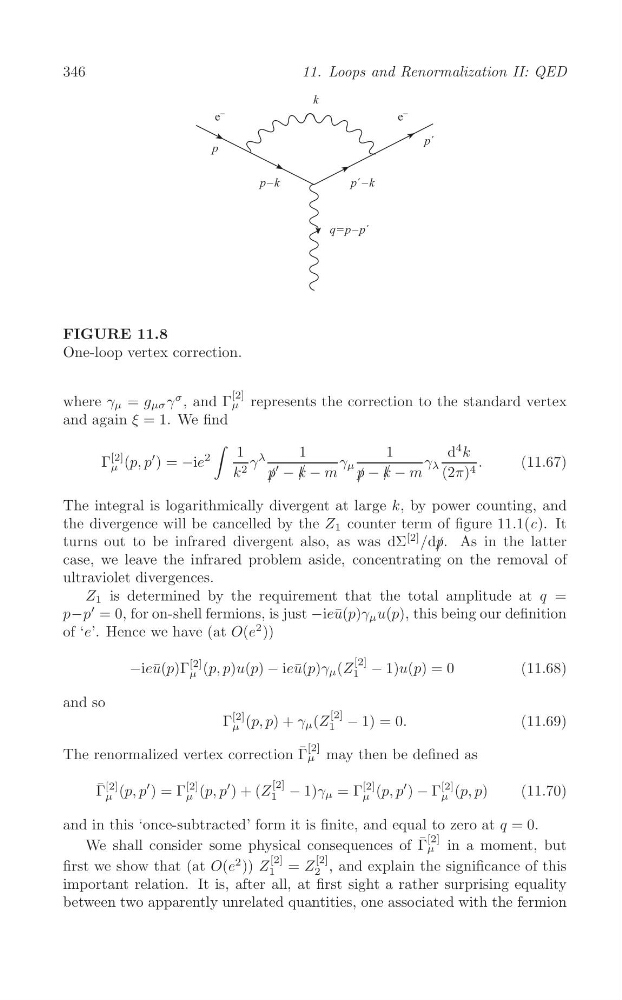
FIGURE 11.8
One-loop vertex correction.
[2]
where γ μ = g μσ γ
σ , and Γ μ represents the correction to the standard vertex
and again ξ = 1. We find
∫ 1
1
1
d
4 k
Γ
[2]
2
γ
λ
μ (p, p
′ ) = −ie
k 2
γ μ
γ λ
.
(11.67)
′
/ p − k / − m / p − k / − m (2π) 4
The integral is logarithmically divergent at large k, by power counting, and
the divergence will be cancelled by the Z 1 counter term of figure 11.1(c). It
turns out to be infrared divergent also, as was dΣ
[2] /d / p. As in the latter
case, we leave the infrared problem aside, concentrating on the removal of
ultraviolet divergences.
Z 1 is determined by the requirement that the total amplitude at q =
′
p−p = 0, for on-shell fermions, is just −ieu ¯(p)γ μ u(p), this being our definition
of ‘e’. Hence we have (at O(e
2 ))
u(p)Γ
[2]
[2]
−ie¯
(p, p)u(p) − ieu ¯(p)γ μ (Z − 1)u(p) = 0
(11.68)
μ
1
and so
Γ
[2]
[2]
(p, p) + γ μ (Z − 1) = 0.
(11.69)
μ
1
[2]
The renormalized vertex correction Γ ¯ μ may then be defined as
Γ ¯ [2]
[2] − 1)γ μ = Γ
[2]
′ ) − Γ
[2]
(p, p
′ ) = Γ
[2] (p, p
′ ) + (Z
(p, p
(p, p)
(11.70)
μ
μ
1
μ
μ
and in this ‘once-subtracted’ form it is finite, and equal to zero at q = 0.
[2]
We shall consider some physical consequences of Γ ¯ μ in a moment, but
[2]
[2]
first we show that (at O(e
2 )) Z = Z , and explain the significance of this
1
2
important relation. It is, after all, at first sight a rather surprising equality
between two apparently unrelated quantities, one associated with the fermion
11. Loops and Renormalization II: QED
FIGURE 11.8
One-loop vertex correction.
[2]
where γ μ = g μσ γ
σ , and Γ μ represents the correction to the standard vertex
and again ξ = 1. We find
∫ 1
1
1
d
4 k
Γ
[2]
2
γ
λ
μ (p, p
′ ) = −ie
k 2
γ μ
γ λ
.
(11.67)
′
/ p − k / − m / p − k / − m (2π) 4
The integral is logarithmically divergent at large k, by power counting, and
the divergence will be cancelled by the Z 1 counter term of figure 11.1(c). It
turns out to be infrared divergent also, as was dΣ
[2] /d / p. As in the latter
case, we leave the infrared problem aside, concentrating on the removal of
ultraviolet divergences.
Z 1 is determined by the requirement that the total amplitude at q =
′
p−p = 0, for on-shell fermions, is just −ieu ¯(p)γ μ u(p), this being our definition
of ‘e’. Hence we have (at O(e
2 ))
u(p)Γ
[2]
[2]
−ie¯
(p, p)u(p) − ieu ¯(p)γ μ (Z − 1)u(p) = 0
(11.68)
μ
1
and so
Γ
[2]
[2]
(p, p) + γ μ (Z − 1) = 0.
(11.69)
μ
1
[2]
The renormalized vertex correction Γ ¯ μ may then be defined as
Γ ¯ [2]
[2] − 1)γ μ = Γ
[2]
′ ) − Γ
[2]
(p, p
′ ) = Γ
[2] (p, p
′ ) + (Z
(p, p
(p, p)
(11.70)
μ
μ
1
μ
μ
and in this ‘once-subtracted’ form it is finite, and equal to zero at q = 0.
[2]
We shall consider some physical consequences of Γ ¯ μ in a moment, but
[2]
[2]
first we show that (at O(e
2 )) Z = Z , and explain the significance of this
1
2
important relation. It is, after all, at first sight a rather surprising equality
between two apparently unrelated quantities, one associated with the fermion