

344
11. Loops and Renormalization II: QED
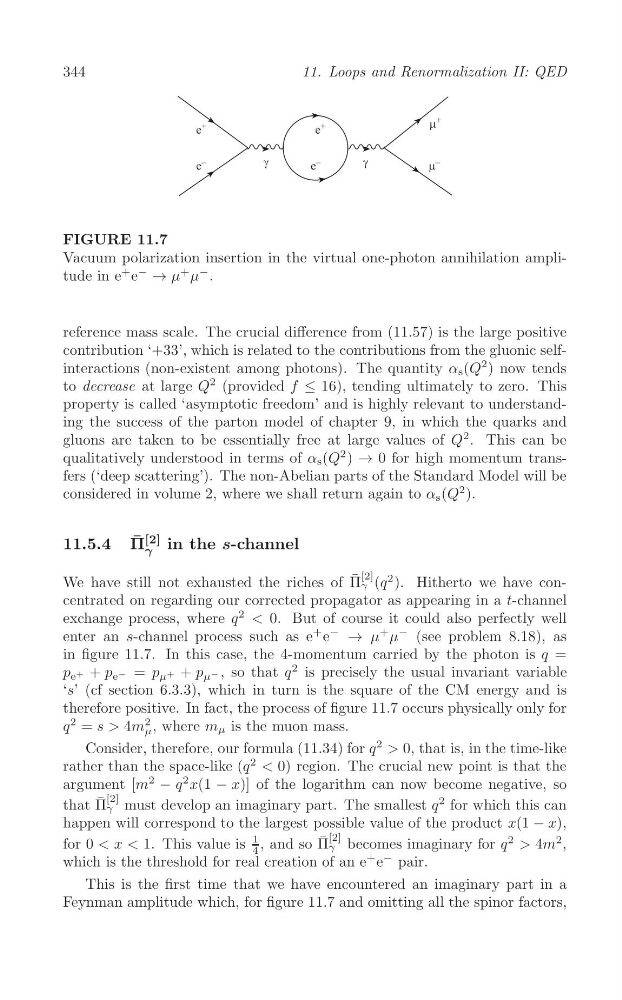
FIGURE 11.7
Vacuum polarization insertion in the virtual one-photon annihilation ampli+ μ
−
tude in e
+ e
−
→ μ
.
reference mass scale. The crucial difference from (11.57) is the large positive
contribution ‘+33’, which is related to the contributions from the gluonic selfinteractions (non-existent among photons). The quantity α s (Q
2 ) now tends
2
to decrease at large Q (provided f ≤ 16), tending ultimately to zero. This
property is called ‘asymptotic freedom’ and is highly relevant to understanding the success of the parton model of chapter 9, in which the quarks and
gluons are taken to be essentially free at large values of Q
2 . This can be
qualitatively understood in terms of α s (Q
2 ) → 0 for high momentum transfers (‘deep scattering’). The non-Abelian parts of the Standard Model will be
considered in volume 2, where we shall return again to α s (Q
2 ).
Π [2]
11.5.4 ¯ γ in the s-channel
[2]
We have still not exhausted the riches of Π ¯ γ (q
2 ). Hitherto we have concentrated on regarding our corrected propagator as appearing in a t-channel
2
exchange process, where q < 0. But of course it could also perfectly well
−
−
enter an s-channel process such as e
+ e → μ
+ μ (see problem 8.18), as
in figure 11.7. In this case, the 4-momentum carried by the photon is q =
2
p e + + p − = p μ + + p μ − , so that q is precisely the usual invariant variable
‘s’ (cf section 6.3.3), which in turn is the square of the CM energy and is
therefore positive. In fact, the process of figure 11.7 occurs physically only for
e
2
2
q = s > 4m μ , where m μ is the muon mass.
2
Consider, therefore, our formula (11.34) for q > 0, that is, in the time-like
2
rather than the space-like (q < 0) region. The crucial new point is that the
2
argument [m
2
− q x(1 − x)] of the logarithm can now become negative, so
[2]
that Π ¯ γ must develop an imaginary part. The smallest q
2 for which this can
happen will correspond to the largest possible value of the product x(1 − x),
[2]
2
2
for 0 < x < 1. This value is
1 , and so Π ¯ γ becomes imaginary for q > 4m ,
4
which is the threshold for real creation of an e
+ e
− pair.
This is the first time that we have encountered an imaginary part in a
Feynman amplitude which, for figure 11.7 and omitting all the spinor factors,
11. Loops and Renormalization II: QED
FIGURE 11.7
Vacuum polarization insertion in the virtual one-photon annihilation ampli+ μ
−
tude in e
+ e
−
→ μ
.
reference mass scale. The crucial difference from (11.57) is the large positive
contribution ‘+33’, which is related to the contributions from the gluonic selfinteractions (non-existent among photons). The quantity α s (Q
2 ) now tends
2
to decrease at large Q (provided f ≤ 16), tending ultimately to zero. This
property is called ‘asymptotic freedom’ and is highly relevant to understanding the success of the parton model of chapter 9, in which the quarks and
gluons are taken to be essentially free at large values of Q
2 . This can be
qualitatively understood in terms of α s (Q
2 ) → 0 for high momentum transfers (‘deep scattering’). The non-Abelian parts of the Standard Model will be
considered in volume 2, where we shall return again to α s (Q
2 ).
Π [2]
11.5.4 ¯ γ in the s-channel
[2]
We have still not exhausted the riches of Π ¯ γ (q
2 ). Hitherto we have concentrated on regarding our corrected propagator as appearing in a t-channel
2
exchange process, where q < 0. But of course it could also perfectly well
−
−
enter an s-channel process such as e
+ e → μ
+ μ (see problem 8.18), as
in figure 11.7. In this case, the 4-momentum carried by the photon is q =
2
p e + + p − = p μ + + p μ − , so that q is precisely the usual invariant variable
‘s’ (cf section 6.3.3), which in turn is the square of the CM energy and is
therefore positive. In fact, the process of figure 11.7 occurs physically only for
e
2
2
q = s > 4m μ , where m μ is the muon mass.
2
Consider, therefore, our formula (11.34) for q > 0, that is, in the time-like
2
rather than the space-like (q < 0) region. The crucial new point is that the
2
argument [m
2
− q x(1 − x)] of the logarithm can now become negative, so
[2]
that Π ¯ γ must develop an imaginary part. The smallest q
2 for which this can
happen will correspond to the largest possible value of the product x(1 − x),
[2]
2
2
for 0 < x < 1. This value is
1 , and so Π ¯ γ becomes imaginary for q > 4m ,
4
which is the threshold for real creation of an e
+ e
− pair.
This is the first time that we have encountered an imaginary part in a
Feynman amplitude which, for figure 11.7 and omitting all the spinor factors,