

[2]
11.5. The physics of Π ¯ γ (q
2 )
343
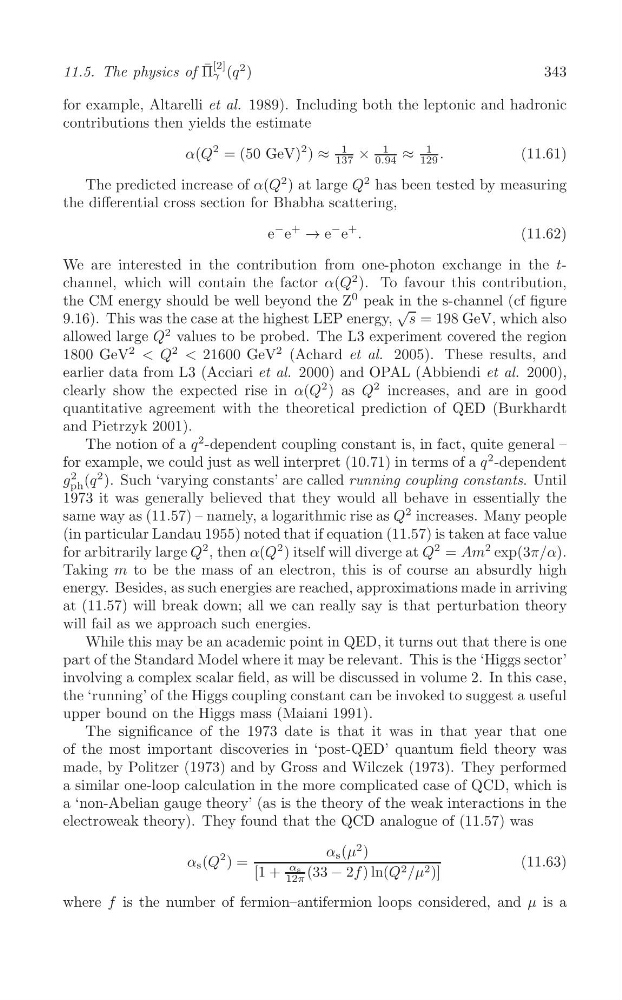
for example, Altarelli et al. 1989). Including both the leptonic and hadronic
contributions then yields the estimate
1
1
1
α(Q
2 = (50 GeV)
2 ) ≈
×
≈
(11.61)
137
0.94
129 .
The predicted increase of α(Q
2 ) at large Q
2 has been tested by measuring
the differential cross section for Bhabha scattering,
−
− +
e e
+
→ e e .
(11.62)
We are interested in the contribution from one-photon exchange in the tchannel, which will contain the factor α(Q
2 ). To favour this contribution,
the CM energy should be well beyond the Z
0 peak in the s-channel (cf figure
√
9.16). This was the case at the highest LEP energy, s = 198 GeV, which also
allowed large Q
2 values to be probed. The L3 experiment covered the region
1800 GeV
2 < Q
2 < 21600 GeV
2 (Achard et al. 2005). These results, and
earlier data from L3 (Acciari et al. 2000) and OPAL (Abbiendi et al. 2000),
clearly show the expected rise in α(Q
2 ) as Q
2 increases, and are in good
quantitative agreement with the theoretical prediction of QED (Burkhardt
and Pietrzyk 2001).
The notion of a q
2 -dependent coupling constant is, in fact, quite general –
for example, we could just as well interpret (10.71) in terms of a q
2 -dependent
2
g ph (q
2 ). Such ‘varying constants’ are called running coupling constants. Until
1973 it was generally believed that they would all behave in essentially the
same way as (11.57) – namely, a logarithmic rise as Q
2 increases. Many people
(in particular Landau 1955) noted that if equation (11.57) is taken at face value
for arbitrarily large Q
2 , then α(Q
2 ) itself will diverge at Q
2 = Am
2 exp(3π/α).
Taking m to be the mass of an electron, this is of course an absurdly high
energy. Besides, as such energies are reached, approximations made in arriving
at (11.57) will break down; all we can really say is that perturbation theory
will fail as we approach such energies.
While this may be an academic point in QED, it turns out that there is one
part of the Standard Model where it may be relevant. This is the ‘Higgs sector’
involving a complex scalar field, as will be discussed in volume 2. In this case,
the ‘running’ of the Higgs coupling constant can be invoked to suggest a useful
upper bound on the Higgs mass (Maiani 1991).
The significance of the 1973 date is that it was in that year that one
of the most important discoveries in ‘post-QED’ quantum field theory was
made, by Politzer (1973) and by Gross and Wilczek (1973). They performed
a similar one-loop calculation in the more complicated case of QCD, which is
a ‘non-Abelian gauge theory’ (as is the theory of the weak interactions in the
electroweak theory). They found that the QCD analogue of (11.57) was
α s (μ
2 )
α s (Q
2 ) =
(11.63)
[1 +
αs (33 − 2f ) ln(Q 2 /μ 2 )]
12π
where f is the number of fermion–antifermion loops considered, and μ is a
11.5. The physics of Π ¯ γ (q
2 )
343
for example, Altarelli et al. 1989). Including both the leptonic and hadronic
contributions then yields the estimate
1
1
1
α(Q
2 = (50 GeV)
2 ) ≈
×
≈
(11.61)
137
0.94
129 .
The predicted increase of α(Q
2 ) at large Q
2 has been tested by measuring
the differential cross section for Bhabha scattering,
−
− +
e e
+
→ e e .
(11.62)
We are interested in the contribution from one-photon exchange in the tchannel, which will contain the factor α(Q
2 ). To favour this contribution,
the CM energy should be well beyond the Z
0 peak in the s-channel (cf figure
√
9.16). This was the case at the highest LEP energy, s = 198 GeV, which also
allowed large Q
2 values to be probed. The L3 experiment covered the region
1800 GeV
2 < Q
2 < 21600 GeV
2 (Achard et al. 2005). These results, and
earlier data from L3 (Acciari et al. 2000) and OPAL (Abbiendi et al. 2000),
clearly show the expected rise in α(Q
2 ) as Q
2 increases, and are in good
quantitative agreement with the theoretical prediction of QED (Burkhardt
and Pietrzyk 2001).
The notion of a q
2 -dependent coupling constant is, in fact, quite general –
for example, we could just as well interpret (10.71) in terms of a q
2 -dependent
2
g ph (q
2 ). Such ‘varying constants’ are called running coupling constants. Until
1973 it was generally believed that they would all behave in essentially the
same way as (11.57) – namely, a logarithmic rise as Q
2 increases. Many people
(in particular Landau 1955) noted that if equation (11.57) is taken at face value
for arbitrarily large Q
2 , then α(Q
2 ) itself will diverge at Q
2 = Am
2 exp(3π/α).
Taking m to be the mass of an electron, this is of course an absurdly high
energy. Besides, as such energies are reached, approximations made in arriving
at (11.57) will break down; all we can really say is that perturbation theory
will fail as we approach such energies.
While this may be an academic point in QED, it turns out that there is one
part of the Standard Model where it may be relevant. This is the ‘Higgs sector’
involving a complex scalar field, as will be discussed in volume 2. In this case,
the ‘running’ of the Higgs coupling constant can be invoked to suggest a useful
upper bound on the Higgs mass (Maiani 1991).
The significance of the 1973 date is that it was in that year that one
of the most important discoveries in ‘post-QED’ quantum field theory was
made, by Politzer (1973) and by Gross and Wilczek (1973). They performed
a similar one-loop calculation in the more complicated case of QCD, which is
a ‘non-Abelian gauge theory’ (as is the theory of the weak interactions in the
electroweak theory). They found that the QCD analogue of (11.57) was
α s (μ
2 )
α s (Q
2 ) =
(11.63)
[1 +
αs (33 − 2f ) ln(Q 2 /μ 2 )]
12π
where f is the number of fermion–antifermion loops considered, and μ is a