

340
11. Loops and Renormalization II: QED
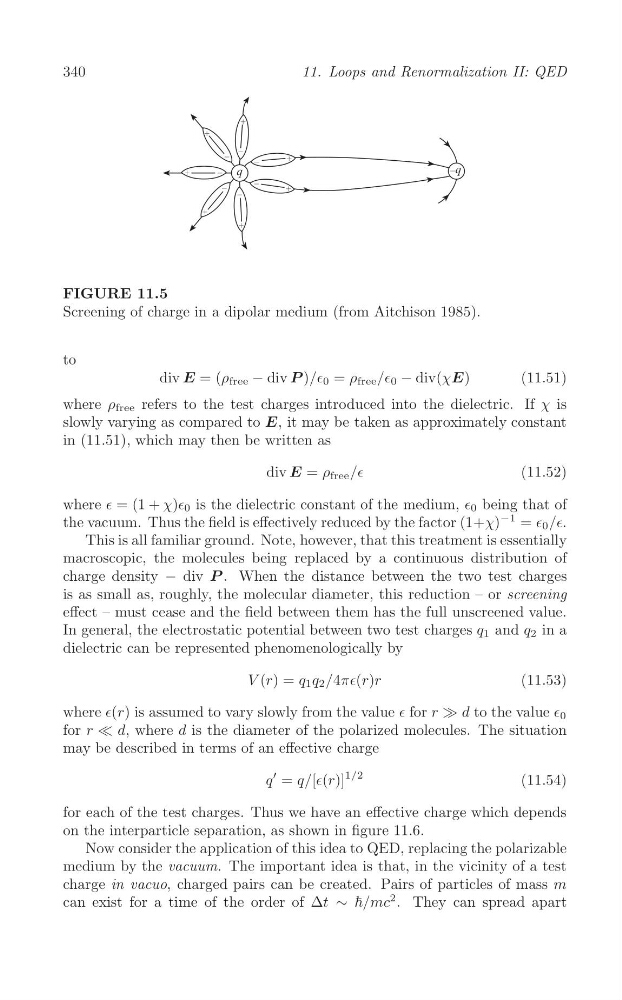
FIGURE 11.5
Screening of charge in a dipolar medium (from Aitchison 1985).
to
div E = (ρ free − div P )/∈ 0 = ρ free /∈ 0 − div(χE)
(11.51)
where ρ free refers to the test charges introduced into the dielectric. If χ is
slowly varying as compared to E, it may be taken as approximately constant
in (11.51), which may then be written as
div E = ρ free /∈
(11.52)
where ∈ = (1 + χ)∈ 0 is the dielectric constant of the medium, ∈ 0 being that of
the vacuum. Thus the field is effectively reduced by the factor (1+χ)
−1 = ∈ 0 /∈.
This is all familiar ground. Note, however, that this treatment is essentially
macroscopic, the molecules being replaced by a continuous distribution of
charge density − div P . When the distance between the two test charges
is as small as, roughly, the molecular diameter, this reduction – or screening
effect – must cease and the field between them has the full unscreened value.
In general, the electrostatic potential between two test charges q 1 and q 2 in a
dielectric can be represented phenomenologically by
V (r) = q 1 q 2 /4π∈(r)r
(11.53)
where ∈(r) is assumed to vary slowly from the value ∈ for r ≫ d to the value ∈ 0
for r ≪ d, where d is the diameter of the polarized molecules. The situation
may be described in terms of an effective charge
′
q = q/[∈(r)]
1/2
(11.54)
for each of the test charges. Thus we have an effective charge which depends
on the interparticle separation, as shown in figure 11.6.
Now consider the application of this idea to QED, replacing the polarizable
medium by the vacuum. The important idea is that, in the vicinity of a test
charge in vacuo, charged pairs can be created. Pairs of particles of mass m
can exist for a time of the order of Δt ∼ ħ/mc
2 . They can spread apart
11. Loops and Renormalization II: QED
FIGURE 11.5
Screening of charge in a dipolar medium (from Aitchison 1985).
to
div E = (ρ free − div P )/∈ 0 = ρ free /∈ 0 − div(χE)
(11.51)
where ρ free refers to the test charges introduced into the dielectric. If χ is
slowly varying as compared to E, it may be taken as approximately constant
in (11.51), which may then be written as
div E = ρ free /∈
(11.52)
where ∈ = (1 + χ)∈ 0 is the dielectric constant of the medium, ∈ 0 being that of
the vacuum. Thus the field is effectively reduced by the factor (1+χ)
−1 = ∈ 0 /∈.
This is all familiar ground. Note, however, that this treatment is essentially
macroscopic, the molecules being replaced by a continuous distribution of
charge density − div P . When the distance between the two test charges
is as small as, roughly, the molecular diameter, this reduction – or screening
effect – must cease and the field between them has the full unscreened value.
In general, the electrostatic potential between two test charges q 1 and q 2 in a
dielectric can be represented phenomenologically by
V (r) = q 1 q 2 /4π∈(r)r
(11.53)
where ∈(r) is assumed to vary slowly from the value ∈ for r ≫ d to the value ∈ 0
for r ≪ d, where d is the diameter of the polarized molecules. The situation
may be described in terms of an effective charge
′
q = q/[∈(r)]
1/2
(11.54)
for each of the test charges. Thus we have an effective charge which depends
on the interparticle separation, as shown in figure 11.6.
Now consider the application of this idea to QED, replacing the polarizable
medium by the vacuum. The important idea is that, in the vicinity of a test
charge in vacuo, charged pairs can be created. Pairs of particles of mass m
can exist for a time of the order of Δt ∼ ħ/mc
2 . They can spread apart