

338
11. Loops and Renormalization II: QED
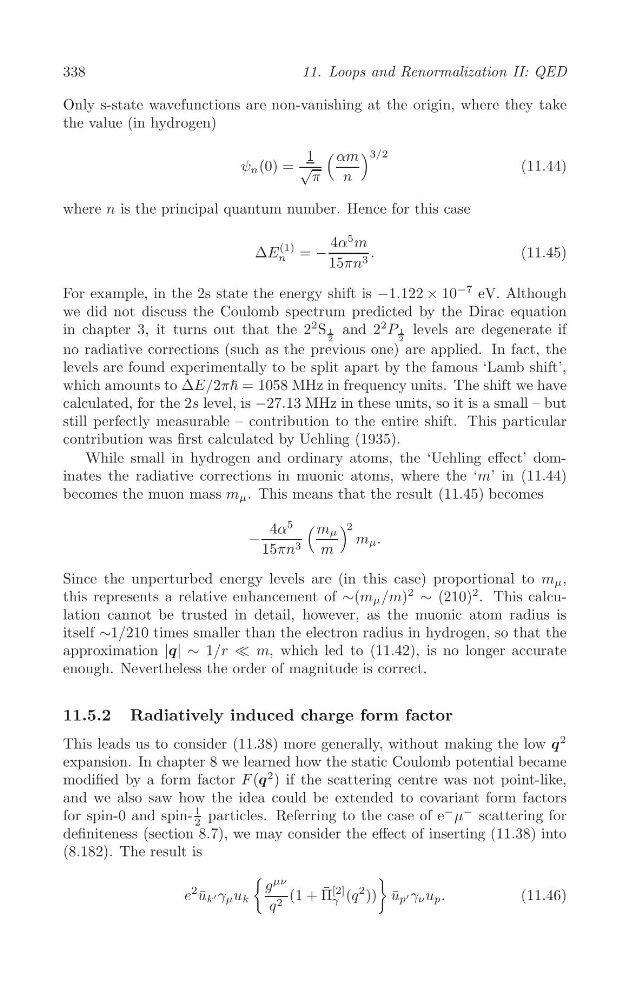
Only s-state wavefunctions are non-vanishing at the origin, where they take
the value (in hydrogen)
(
) 3/2
1 αm
ψ n (0) = √
(11.44)
π
n
where n is the principal quantum number. Hence for this case
4α
5 m
ΔE
(1) = −
.
(11.45)
n
15πn 3
For example, in the 2s state the energy shift is −1.122 × 10
−7 eV. Although
we did not discuss the Coulomb spectrum predicted by the Dirac equation
in chapter 3, it turns out that the 2
2 S and 2
2 P levels are degenerate if
1
2
1
2
no radiative corrections (such as the previous one) are applied. In fact, the
levels are found experimentally to be split apart by the famous ‘Lamb shift’,
which amounts to ΔE/2πħ = 1058 MHz in frequency units. The shift we have
calculated, for the 2s level, is −27.13 MHz in these units, so it is a small – but
still perfectly measurable – contribution to the entire shift. This particular
contribution was first calculated by Uehling (1935).
While small in hydrogen and ordinary atoms, the ‘Uehling effect’ dominates the radiative corrections in muonic atoms, where the ‘m’ in (11.44)
becomes the muon mass m μ . This means that the result (11.45) becomes
(
) 2
4α
5
m μ
−
m μ .
15πn 3 m
Since the unperturbed energy levels are (in this case) proportional to m μ ,
this represents a relative enhancement of ∼(m μ /m)
2
∼ (210)
2 . This calculation cannot be trusted in detail, however, as the muonic atom radius is
itself ∼1/210 times smaller than the electron radius in hydrogen, so that the
approximation |q| ∼ 1/r ≪ m, which led to (11.42), is no longer accurate
enough. Nevertheless the order of magnitude is correct.
11.5.2 Radiatively induced charge form factor
2
This leads us to consider (11.38) more generally, without making the low q
expansion. In chapter 8 we learned how the static Coulomb potential became
modified by a form factor F (q
2 ) if the scattering centre was not point-like,
and we also saw how the idea could be extended to covariant form factors
for spin-0 and spin1 particles. Referring to the case of e
− μ
− scattering for
2
definiteness (section 8.7), we may consider the effect of inserting (11.38) into
(8.182). The result is
(
)
μν
Π
[2]
2 ¯
e u k ' γ μ u k
g (1 + ¯ (q
2 )) u ¯ p ' γ ν u p .
(11.46)
γ
q 2
11. Loops and Renormalization II: QED
Only s-state wavefunctions are non-vanishing at the origin, where they take
the value (in hydrogen)
(
) 3/2
1 αm
ψ n (0) = √
(11.44)
π
n
where n is the principal quantum number. Hence for this case
4α
5 m
ΔE
(1) = −
.
(11.45)
n
15πn 3
For example, in the 2s state the energy shift is −1.122 × 10
−7 eV. Although
we did not discuss the Coulomb spectrum predicted by the Dirac equation
in chapter 3, it turns out that the 2
2 S and 2
2 P levels are degenerate if
1
2
1
2
no radiative corrections (such as the previous one) are applied. In fact, the
levels are found experimentally to be split apart by the famous ‘Lamb shift’,
which amounts to ΔE/2πħ = 1058 MHz in frequency units. The shift we have
calculated, for the 2s level, is −27.13 MHz in these units, so it is a small – but
still perfectly measurable – contribution to the entire shift. This particular
contribution was first calculated by Uehling (1935).
While small in hydrogen and ordinary atoms, the ‘Uehling effect’ dominates the radiative corrections in muonic atoms, where the ‘m’ in (11.44)
becomes the muon mass m μ . This means that the result (11.45) becomes
(
) 2
4α
5
m μ
−
m μ .
15πn 3 m
Since the unperturbed energy levels are (in this case) proportional to m μ ,
this represents a relative enhancement of ∼(m μ /m)
2
∼ (210)
2 . This calculation cannot be trusted in detail, however, as the muonic atom radius is
itself ∼1/210 times smaller than the electron radius in hydrogen, so that the
approximation |q| ∼ 1/r ≪ m, which led to (11.42), is no longer accurate
enough. Nevertheless the order of magnitude is correct.
11.5.2 Radiatively induced charge form factor
2
This leads us to consider (11.38) more generally, without making the low q
expansion. In chapter 8 we learned how the static Coulomb potential became
modified by a form factor F (q
2 ) if the scattering centre was not point-like,
and we also saw how the idea could be extended to covariant form factors
for spin-0 and spin1 particles. Referring to the case of e
− μ
− scattering for
2
definiteness (section 8.7), we may consider the effect of inserting (11.38) into
(8.182). The result is
(
)
μν
Π
[2]
2 ¯
e u k ' γ μ u k
g (1 + ¯ (q
2 )) u ¯ p ' γ ν u p .
(11.46)
γ
q 2